
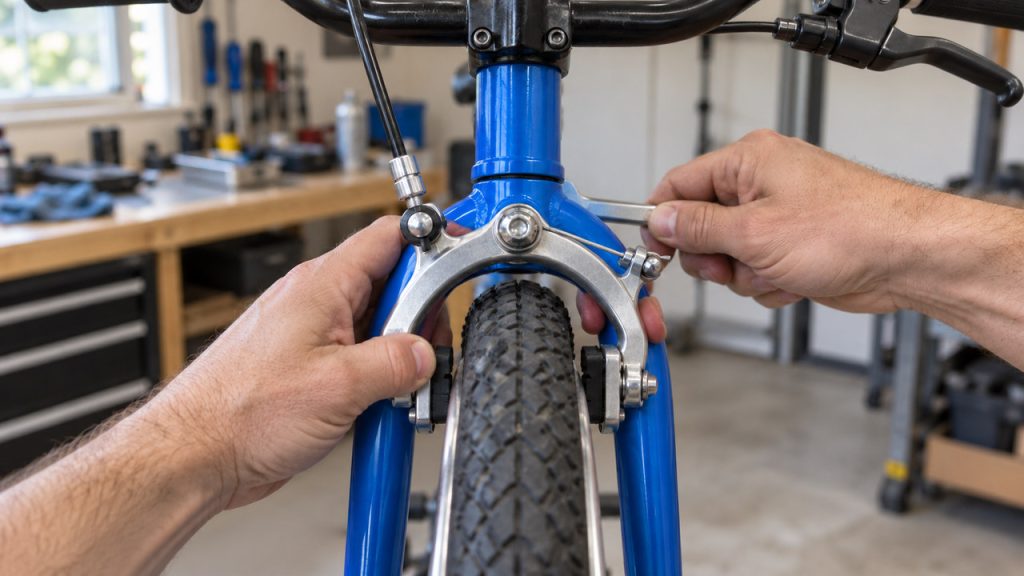
On many boxed bikes, the front brake already sits on the fork and only the cable needs connecting. On a V-brake, squeeze the two arms together and seat the curved metal “noodle” in its bracket. On a caliper brake that came in the parts bag, push its mounting bolt through the hole in the fork crown, tighten the nut behind it, then clamp the cable and set the pads. Before you ride, squeeze the lever hard: it should stop with more than an inch (25 mm) of space between lever and grip.
Identify your brake type below, then use its section, the torque table and the final safety check.
Which front brake do you have?
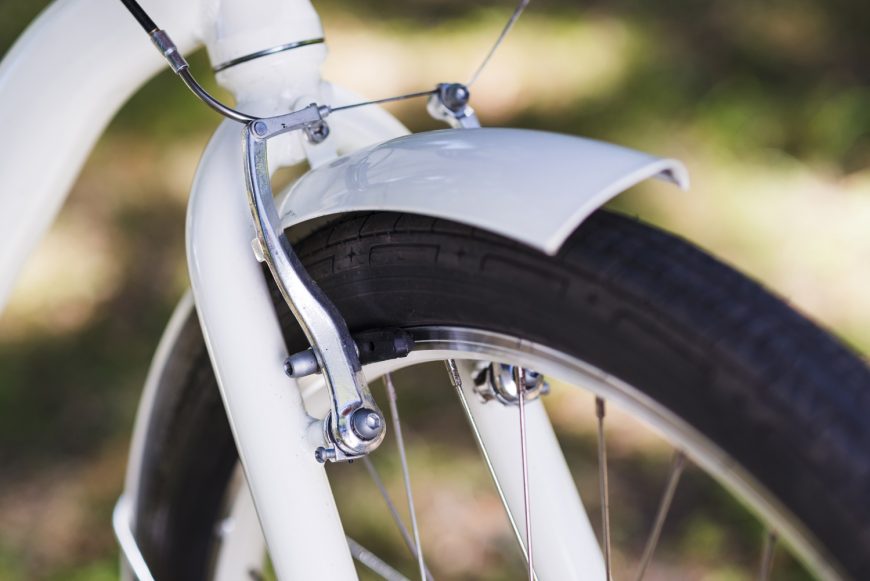
The brake type also decides which lever works with it. V-brakes need “long-pull” levers, and Park Tool notes that flat-bar mechanical discs such as Avid’s use the same levers. Sheldon Brown’s compatibility table pairs traditional cantilevers with standard short-pull levers, and caliper brakes use short-pull levers too. A mismatched lever feels mushy or bottoms out against the grip.
| Brake type | How to spot it | Common on | Lever | What changes when you install it |
|---|---|---|---|---|
| Caliper, nutted mount | One brake body above the tire on a bolt through the fork crown, with a hex nut (usually 10 mm) behind | Kids’ and box-store road or BMX bikes | Short pull | Bolt goes through the crown. Use the supplied washers and a locking nut. |
| Caliper, recessed mount | Same body; a round nut with a 5 mm hex socket goes in from the back | Newer rim-brake road bikes | Short pull | Needs a fork with a stepped hole. |
| V-brake (linear pull) | Two tall arms on posts on each fork leg; the cable enters through a curved metal tube (the noodle) | Box-store mountain, hybrid, cruiser and kids’ bikes | Long pull | Often shipped with the noodle unhooked. Reconnecting it is the whole job. |
| Cantilever | Two shorter arms on the same posts, joined by a straddle wire above the tire | Older mountain, touring and cyclocross bikes | Short pull | Needs a housing stop above the brake. |
| Mechanical disc | Rotor on the hub, caliper on the left fork leg, steel cable | Budget mountain, gravel and e-bikes | Long pull (flat bar) | Caliper bolts to fork tabs or an adapter; pad gaps set with knobs. |
| Hydraulic disc | Same, with a plastic hose instead of a cable | Mid-range and better bikes | Matching hydraulic lever | Sealed set. Never squeeze the lever with the wheel out. |
Before you start: which lever, which way the fork faces
Which hand works the front brake?
It depends on where the bike was sold. In the US, the Consumer Product Safety Commission’s bicycle rules (16 CFR 1512.5) put the front brake on the left lever, unless the buyer asks for it reversed. The UK’s Pedal Bicycles (Safety) Regulations 2010 put it on the right for bikes sold assembled. The rule excludes bikes supplied with unassembled parts, so a bike delivered in its box falls outside it. In Australia, the ACCC’s exposure draft Consumer Goods (Pedal Bicycles) Safety Standard 2026 (section 13) would require the right lever to work the front brake. It is a draft, open for comment from 12 October to 10 November 2026, not law yet.
The ISO and European bicycle standards leave lever location to local law, the ACCC notes. If you learned to ride with the levers the other way round, have a shop swap them. On cable brakes that means rerouting the cables, which may need new housing lengths. On hydraulic brakes it can mean hose changes and a bleed.
Check the fork isn’t backward
Some boxed bikes ship with the fork and handlebar turned around. Guardian Bikes lists fork rotation first when its customers can’t connect a front brake. Guardian’s SureStop bikes run both brakes from one lever, which US rules allow on either side, and the front brake won’t connect until the cable sits fully in the SureStop unit at the rear brake. Turn the bar so the fork legs curve forward and the cables hang straight in front of the head tube. A caliper brake mounts on the front face of the fork crown.
Tools
For a caliper or V-brake: 4 mm and 5 mm hex keys, a 10 mm wrench, and cable cutters if you need to trim the wire (side-cutting pliers fray it). Add a T25 Torx key for disc rotors. A torque wrench helps on carbon forks and disc calipers.
Box-store and kids’ bike caliper: step-by-step
This checklist follows Park Tool’s side-pull and dual-pivot service guides, with box-store details added.
- Identify the mount. If the brake bolt is long enough to pass through the crown and a hex nut came with it, you have a nutted mount. If the bolt is short and the parts bag has a round nut with a 5 mm hex socket, it’s a recessed mount. Sheldon Brown notes that recessed forks have a stepped hole, about 6 mm at the front and 8 mm at the back.
- Fit the brake. Push the bolt through the crown from the front, with the brake arms straddling the tire and the cable pinch bolt on top. Add any curved (radiused) washers so they match the curve of the crown, then thread the nut on from behind.
- Center it and tighten the mount. Hold the brake centered over the tire and tighten the nut. Park Tool’s torque chart lists 7.8-9.8 N·m for Shimano calipers and 8-10 N·m for Tektro. Box-store manuals such as Huffy’s say “securely” with no number. Use a nylon-insert locknut or a drop of blue threadlocker. Federal rules require a locking device on brake fasteners for new bikes, for a good reason: Sheldon Brown describes a loose front caliper rotating forward into the spokes and yanking the bar to one side.
- Run the cable. Seat the housing in the barrel adjuster on top of the brake, with the barrel turned out two or three turns from fully in. Pass the inner wire under the pinch bolt washer, in the groove meant for it.
- Close the brake’s release lever, then clamp. Many calipers have a small quick-release lever on the brake body that spreads the pads so a tire can pass. Close it before you clamp the cable, as Park Tool’s dual-pivot guide does. A release left open holds the pads away from the rim and leaves you with a weak brake. Then squeeze the arms until the pads touch the rim, pull the wire snug, and tighten the pinch bolt. Park Tool’s service guides give 4-5 N·m for side-pull pinch bolts and about 5 N·m for dual-pivots; its torque chart lists higher brand values (see the table below).
- Set pad height. On a single-pivot side-pull (common on kids’ bikes), the pads swing down as they close, so set them near the top of the rim’s braking surface without touching the tire. On a dual-pivot, Park sets the left pad high and the right pad low, seen from in front of the brake, because the two arms swing on different arcs. Keep each pad face flat against the rim.
- Center the pads. Turn the centering screw if the brake has one. If not, hold the brake body and the rear mounting nut and turn them together a few degrees.
- Set lever travel. Squeeze the lever hard several times to settle the housing and test the pinch bolt. Then set the barrel adjuster: turning it out (counterclockwise) pulls the pads closer to the rim, turning it in adds slack. Park Tool’s target is more than an inch between lever and grip when the pads touch the rim, with no pad rub; a hard squeeze should still stop well short of the grip. If the barrel runs out of thread, screw it back in, reclamp the wire a few millimeters tighter, and fine-tune again.
- Trim and cap. Cut the cable to leave 32-50 mm past the pinch bolt (Park Tool’s figure) and crimp on an end cap.
Kids’ bikes: what the front brake can and can’t be
US rules call a bike whose seat can’t go above 635 mm (25 in) a sidewalk bicycle, and a sidewalk bicycle can’t have hand brakes only. Many 12- and 16-inch bikes fall in that class, so one sold in the US with a front hand brake also has a coaster (back-pedal) brake. The rules also cap lever reach at 76 mm (3 in) on sidewalk bikes and 89 mm (3.5 in) on larger ones. If your child can’t reach the lever, adjust its reach screw or ask for a short-reach lever.
Check the spring too. On Bicycles Stack Exchange, a parent’s new Schwinn kids’ bike arrived with its caliper spring unhooked, and the top answer judged the spring bent. If the arms stay closed after you release the lever, replace the brake.
My kid’s bike has no front brake. Can I add one?
Only if the bike was built for one. Look for a hole through the fork crown (for a caliper), a pair of brake posts on the fork legs (for a V-brake) or disc tabs near the axle. If you find none, don’t drill the fork or clamp on an adapter. A forum answer on Bicycles Stack Exchange, the top reply to this question, warns that a frame and fork made without a front brake may not be built for its loads. Ask a shop whether a replacement fork with brake mounts fits.
V-brakes: reconnect the noodle, or fit from scratch
Huffy’s owner’s manual has you lift the noodle out of its bracket to fit the front fender, then hook it back in. To reconnect, squeeze the arms together, drop the noodle’s end into the slot in the bracket, and let go. Check that it’s fully seated, then run the safety check below.
To fit a new V-brake, follow Park Tool’s linear-pull steps:
- Grease the posts, add mild threadlocker to the threads, and seat both spring pins in the middle hole.
- Tighten the mounting bolts: Park Tool gives a typical 8 N·m (brand values in the torque table).
- Set pads near the top of the braking surface, never touching the tire, flat to the rim.
- Seat the housing in the noodle, draw the arms in, and clamp the wire under the pinch bolt on the other arm.
- Balance the pads with the spring screws on each arm. Turning one in pulls its pad away from the rim.
Skip a V-brake on a bike with drop-bar road levers: they pull too little cable, so the lever bottoms out. Our cantilever vs V-brake guide covers when each one fits.
Toe-in: only if it squeals
Toe-in angles the pad so its front edge touches the rim first. Park Tool says to ride first: no squeal, no toe needed. If it squeals, put a rubber band behind the trailing end of the pad, press the pad to the rim, tighten it and remove the band, leaving a slight gap at the back.
Cantilever brakes
Cantilevers bolt to the same fork posts as V-brakes but use short-pull levers and a straddle wire, and the front housing needs a stop above the brake on the stem or headset. Park Tool’s cantilever guide covers the setup: middle spring hole, 4-6 N·m on the arm bolts, and the arms close to parallel. On the front, add a fender or reflector bracket under the straddle wire. Sheldon Brown warns that if the main cable snaps, the straddle wire can drop onto a knobby tire and lock the wheel.
Mechanical disc brakes
The caliper bolts to the left fork leg, onto post-mount tabs or an adapter. The adapter sets the rotor size (140, 160, 180 or 203 mm are common), so match it to your rotor and your fork maker’s maximum. For Avid-style calipers, Park Tool’s method: loosen the caliper bolts, back both pad knobs out, turn the outer knob half a turn in and the inner knob in until it clamps the rotor, then tighten the bolts alternately. Attach the cable with the caliper arm fully open, then back the outer knob out a quarter turn and the inner half a turn. Unlike hydraulics, you can squeeze the lever with the wheel out, except on cable-actuated hydraulic calipers such as TRP’s.
Hydraulic disc brakes
A hydraulic brake comes as a sealed lever, hose and caliper set. SRAM’s manual sends you to its bleed manual if you shorten the hose, so leave the hose length alone unless you can bleed the system.
- Keep the pads apart. Squeezing the lever with the wheel out pushes the pistons out (Park Tool). Leave the pad spacer in until the wheel goes in; if the pads close, push them apart with a plastic tire lever.
- Post mount or IS? Post-mount calipers bolt into threaded fork tabs, in line with the rotor. IS (International Standard) tabs have holes parallel to the axle and need an adapter; SRAM’s mounting specifications list the right one.
- Center and torque. SRAM’s method: fit the caliper loosely, squeeze the lever three times and hold, snug the bolts, release and check the gaps. Then torque to your brand’s value in the table.
- Route and bed in. Run the hose through the fork’s guide with slack to turn the bar both ways. SRAM’s bed-in: about 20 firm stops to walking pace, then about 10 harder ones, seated, without locking the wheel.
Torque values for front brake parts
Maker values from Park Tool’s torque chart, plus SRAM’s current MTB brake manual where it differs. For rotor bolts on other brands, our bike torque spec finder has the common ranges.
| Part | Shimano | SRAM / Avid | Tektro | Source |
|---|---|---|---|---|
| Rim caliper to fork (side-pull, dual-pivot) | 7.8-9.8 N·m | n/a | 8-10 N·m | Park Tool chart |
| V-brake or cantilever arm to fork post | 8-10 N·m | SRAM 5-6.8 N·m; Avid 4.9-6.9 N·m | 6-8 N·m | Park Tool chart |
| Brake pad, threaded stud (common on V-brakes) | 5-7 N·m | SRAM 5.7-7.9 N·m; Avid 5.9-7.8 N·m | 5-7 N·m | Park Tool chart |
| Brake pad, smooth stud | 7.9-8.8 N·m | n/a | n/a | Park Tool chart |
| Brake pad bolt (side-pull, dual-pivot) | 6-8 N·m | n/a | 5-7 N·m | Park Tool chart |
| Cable pinch bolt, V-brake or cantilever | 6-7.8 N·m | SRAM 5.6-7.9 N·m | 6-8 N·m | Park Tool chart |
| Cable pinch bolt, caliper | 6-8 N·m | n/a | 6-8 N·m | Park Tool chart |
| Flat-bar brake lever clamp | 6-8 N·m | Avid 5-7 N·m | n/a | Park Tool chart |
| Disc caliper to fork or adapter | 6-8 N·m | SRAM 9.5 N·m; Avid 9-10.2 N·m | 6-8 N·m | Park Tool chart; SRAM user manual |
| Disc rotor, 6-bolt | 2-4 N·m | SRAM 6.2 N·m | n/a | Park Tool chart; SRAM user manual |
| Disc rotor, Center Lock lockring | 40 N·m | Avid 40 N·m | n/a | Park Tool chart |
| Front axle nuts (non-quick-release wheels) | 29.4-44 N·m, all brands | Park Tool chart | ||
“n/a” means the chart lists no value for that brand. Box-store front wheels often use axle nuts; Huffy’s manual requires serrated nuts and the wheel retainer tabs seated in the fork holes.
Final safety check before the first ride
- Lever travel. Squeeze hard. The lever should stop with more than an inch (25 mm) to spare.
- Light touch. A gentle squeeze should bring the pads on. US rules for new bikes require contact with under 44.5 N (10 lbf) at 25 mm from the lever tip.
- Brake release closed. On a caliper, check that the quick-release lever on the brake body is closed.
- Pads and tire. Spin the wheel. Rim pads should hit only the braking surface and release fully.
- Rock test. Hold the front brake and push the bike forward and back. Nothing at the brake should move. A clunk at the top of the fork means a loose headset.
- Bolt check. Recheck the mounting bolt or nut, the pinch bolt, and the wheel’s axle nuts or quick-release.
- Walking-pace stop. Ride at walking pace on flat, empty pavement and squeeze the front lever firmly. The bike should stop smoothly, without grabbing or shuddering. If it doesn’t, recheck pads and cable tension before riding faster.
Sheldon Brown notes that stopping on the rear brake alone takes about twice as long as on the front alone.
If a brake drags or won’t let go after this, see why bicycle brakes won’t release. For tuning brakes that already work, see our guide on how to adjust bike brakes. Then run the rest of the bike through our bike safety checklist.
Common questions
How do you reattach front brakes on a bike?
On a V-brake, squeeze the arms together and drop the noodle back into its bracket. On a caliper brake with a quick-release lever, close the small lever on the brake body. That lever opens the pads so a tire can pass. If neither applies, the cable has slipped from its pinch bolt and needs reclamping with the pads held against the rim.
Can I replace bike brakes myself?
Yes, with hex keys, a wrench and cable cutters, as long as the new brake matches your levers’ cable pull and your fork’s mounts. Reconnecting a shipped V-brake is one step; a full rim brake install takes longer because pad height, toe and cable tension each need setting. Take it to a shop if the fork has no mount for the brake you bought, if the lever bottoms out after adjustment, or if a hydraulic lever pulls too far. SRAM says excess lever throw can mean a bleed or new pads.
Sources
- US Code of Federal Regulations. 16 CFR 1512.5, Requirements for braking system (accessed October 14, 2026). Lever location, grip dimension, fastener locking, operating force, stopping distance, sidewalk bicycle rules.
- US Code of Federal Regulations. 16 CFR 1512.2, Definitions and 1512.18, Tests and test procedures. Sidewalk bicycle seat height and brake test speeds.
- UK legislation. The Pedal Bicycles (Safety) Regulations 2010, regulation 4. Right-hand lever must operate the front brake; regulation 4(2) excludes bicycles supplied with unassembled parts.
- Australian Competition and Consumer Commission. Exposure draft Consumer Goods (Pedal Bicycles) Safety Standard 2026 (consultation 12 October to 10 November 2026). Draft section 13: right handbrake lever operates the front brake.
- Australian Competition and Consumer Commission. Limited review of the pedal bicycles mandatory safety standard (October 2025). ISO and EN standards leave handbrake lever location to local law.
- Park Tool. Torque Specifications and Concepts (accessed October 14, 2026). Brand torque values for calipers, levers, pads, pinch bolts, rotors and axle nuts.
- Park Tool. Side Pull Brake Service and Dual Pivot Brake Service. Caliper mounting, pad height and toe, lever clearance, cable trim length.
- Park Tool. Linear Pull Brake Service and Cantilever Threaded Post Brake Service. Spring holes, mounting torque, pad and straddle setup.
- Park Tool. Avid Mechanical Disc Adjustment, Hydraulic Disc Brake Alignment, Disc Brake Rotor Removal and Installation and Disc Brake Pad Removal and Installation. Caliper alignment, rotor sizes, piston warning.
- SRAM. MTB Disc Brakes and Shifters User Manual, 95-5018-019-100 Rev M (2023). Post and IS mount torque, rotor bolt torque, caliper centering, bed-in procedure, hose shortening note.
- Sheldon Brown. Caliper Brakes. Nutted vs recessed mounting, loose front brake hazard.
- Sheldon Brown. Cantilever Geometry. Lever pull compatibility table, straddle cable catch.
- Sheldon Brown. Braking and Turning Your Bicycle. Front vs rear stopping distance.
- Huffy. Owner’s manual m0001 (2017). Front brake cable guide reconnection, front wheel axle nuts and retainers.
- Guardian Bikes. Connecting the front brake. Fork rotation on boxed bikes; SureStop cable seating.
- Guardian Bikes. 3 Reasons Your Kid Needs SureStop on Their Bike. SureStop’s single-lever system for both brakes.

Once you’ve taken a 5,000 to 10,000 km ride, you can already change brakes or brake pads if you want to. If the remaining brake pad materials are only 1.5mm or less, that’s also a good indicator that they’re due for changing.