
To remove light rust from a bike chain, wipe it with a dry rag and a brush, clean it with a mild bike cleaner or warm soapy water, let it dry, then lube it. If links stay stiff after lubing, the plates are pitted, or the chain has reached its wear limit, replace the chain. Keep vinegar, lemon juice, cola and rust remover off the chain: Shimano, SRAM and KMC all warn that acid or alkaline cleaners can make a chain break.
The rest of the bike needs different fixes. Rust on a steel frame comes off with an abrasive pad and gets covered with paint. Aluminum never turns orange; it grows a white powder instead. A rusty cable gets replaced, not cleaned. And nothing oily, including WD-40, goes near disc rotors or brake pads. Find your part in the table, then read its section below.
An earlier version of this page told readers to soak a chain in lemon juice and to use vinegar, cola, phosphoric acid and salt paste on bike parts. Chain makers warn against acid on a chain, and salt feeds rust, so we rewrote the page around the makers’ instructions.
Rust fix for each part of the bike
Start with the part that worries you. The last column is the point where cleaning stops paying off.
| Part | What you see | Do this | Replace it when |
|---|---|---|---|
| Chain, light rust | Orange film on the plates; every link still bends freely | Dry rag and brush, mild cleaner, dry, lube | It reaches its wear limit |
| Chain, heavy rust | Stiff links, pitted plates, rust bleeding from the rollers | Lube it once and flex each link as a test | Links stay stiff, plates are pitted, or wear reaches 0.5% (11-speed and up), 0.75% (10-speed or fewer) or 1.0% (single-speed) |
| Cassette, cogs, chainrings | Orange film on the teeth | Brush and rag, then ride with a freshly lubed chain | Teeth are pitted or hooked, or a new chain skips on them |
| Steel frame and fork, outside | Orange spots at paint chips, paint bubbling at the edges | Abrasive pad, then primer and touch-up paint, or a rust converter on the rusted spot only | Stop riding and get it inspected if rust has made a hole, or flakes at a weld, dropout or bottom bracket shell |
| Steel frame, inside | Orange water out of the seat tube or bottom bracket | Drain, dry, spray in a frame protectant | Stop riding and get it inspected if rust shows through from inside, as above |
| Aluminum frame and parts | White or grey chalky powder, often around bolts and clamps | Wash, rinse, dry, nylon scrub pad, wax | Corrosion has pitted the metal at a weld, clamp or bolt hole |
| Chrome-plated steel (old handlebars, rims, fenders) | Rust spots coming through the plating | Soft abrasive, then wax | The plating flakes and the steel under it is pitted on a handlebar |
| Bolts | Orange heads, bolts that won’t turn | Penetrating oil if stuck, then remove one at a time, clean the threads, refit with grease or anti-seize | Head rounded or threads pitted |
| Spokes (plated steel) | Rust spots, rust at the nipples | Fine abrasive pad, then wax | A nipple won’t turn, or a spoke breaks |
| Shift and brake cables | Rust on the inner wire; slow shifts or a brake that sticks | Nothing worth cleaning | Any rust on the inner cable |
| Disc rotors | Orange film after rain or storage | Clean rag and isopropyl alcohol | Deep pits, or at the maker’s minimum thickness (Shimano: 1.5 mm) |
| Disc brake pads | Oil, lube or rust spray got on them | Find where the oil came from | Contaminated with oil or grease, or worn to the maker’s minimum (Shimano: 0.5 mm) |
| Steel rims (rim brakes) | Rust on the braking track | Fine abrasive pad, then isopropyl alcohol | Pitted track that makes the brake grab or pulse |
How to remove rust from a bike chain
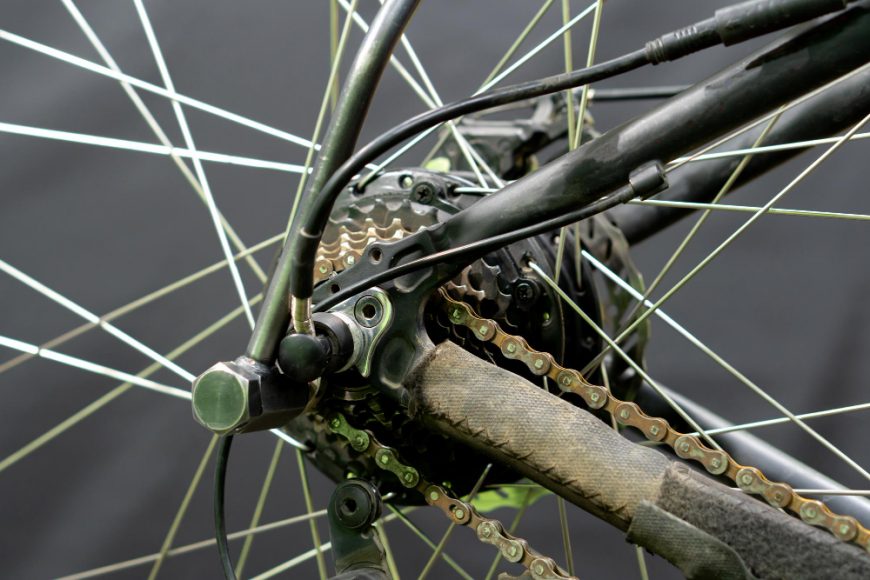
Orange on the outer plates is the part you can see. The rust that matters sits on the pins and inside the rollers, where no brush reaches. So judge a rusty chain by how it bends and how it measures, not by its color. That is Icebike’s rule.
- Check how it moves. Lift the rear wheel and turn the cranks backward. Watch the chain leave the lower derailleur pulley. A link that stays kinked is a stiff link.
- Clean it dry first. KMC’s care instructions start with a dry cloth on the chain, plus a brush for dirt and sand. Clean the cogs, chainrings and derailleur pulleys while you’re there.
- Clean it wet if it’s still dirty. KMC suggests lukewarm water with detergent, or a cloth soaked in thin oil. SRAM says to use biodegradable cleaners only. A stiff nylon brush lifts most of the orange film off the plates.
- Don’t soak it. SRAM says not to soak or store a chain or cassette in any cleaning product, because the chain can turn brittle and break under load. That rules out a bowl of anything, including the lemon juice bath this page once recommended.
- Dry it. Wipe it down, then let it air-dry. Park Tool says to lubricate the chain once it is dry.
- Lube it. One drop of chain lube on each roller while you backpedal, then wipe the outside plates. Park Tool calls household penetrating oil such as WD-40 “not an ideal chain lubricant” and says not to rely on it for routine chain lube.
- Flex and measure. Work any stiff link side to side, then check wear with a chain checker or a 12 in ruler. Park Tool’s limits are 0.5% for 11-speed and up, 0.75% for 10-speed or fewer, and 1.0% for single-speed. On a ruler, measure 24 links from a rivet at zero; the last rivet should sit on the 12 in mark. By our math, 1/16 in over is about 0.5%, 3/32 in about 0.75% and 1/8 in about 1.0%. Our chain wear and replacement estimator turns your measurement into a replace-or-ride answer.
Skip the cleaning if the chain has already reached its wear limit. Park Tool’s advice for a worn chain is to skip the hassle of cleaning it and replace it.
Why acid is off-limits on a chain
Three chain makers put it in writing:
- Shimano (chain user manual UM-0AH0A): “Never use alkali- or acid-based solvents such as rust cleaners. If those solvents are used the chain might break and cause serious injury.”
- SRAM (drivetrain cleaning support page): “Do not use alkaline or acidic solvents to clean the chain and cassette cogs.” It adds that soaking may cause the chain “to become brittle and break under load.”
- KMC (care of oiled chains): “Never use acidic or alkaline cleaners (rust remover). These will damage the chain and in extreme cases can lead to breakage.”
Vinegar, lemon and lime juice, cola and phosphoric acid are all acids. Commercial “rust removers” fall under KMC’s warning by name, and a soak in any of them breaks SRAM’s no-soaking rule.
No chain maker names the cause, but the likely one is hydrogen embrittlement. The UK Health and Safety Executive explains it for hardened lifting chain, whose makers do not recommend use where the chain is immersed in acid or strongly alkaline solutions: hydrogen generated at the surface of loaded high-strength steel can enter the metal and embrittle it, and acid pickling can trigger it. ASTM B849 lists cleaning procedures among the operations that can charge steel with hydrogen. Those sources cover lifting chain and plated parts, not bike chain, but the failure matches what the bike chain makers describe: steel that turns brittle and snaps under load.
When a rusty chain goes in the bin

Replace the chain if any of these is true after one clean and lube:
- Links stay stiff after you flex them, or spring back kinked.
- The plates or rollers are pitted, not just stained.
- It has reached Park Tool’s limit for your drivetrain.
- It snapped, or someone already joined it with a mismatched pin.
A rusty chain usually means rusty cogs too. If the new chain skips under load, the cassette or freewheel teeth are worn, and our guide to a bike chain slipping walks through that test. For sizing, joining and quick links, see how to fix a bike chain.
How to remove rust from a steel frame and fork
Surface rust on a steel frame stays cosmetic until it eats into the tube. Surly’s frame-care page says rust on the outside “never gets too far” because the surface gets a chance to dry. The inside of the tubes, which stays wet, is where Surly says rust starts. Treat both.
Outside: chips and scratches
- Wash the spot. Rust-Oleum’s surface prep for its rust products starts with removing dirt, grease, oil, salt and chemical contaminants.
- Take off the loose rust. Use a wire brush, an abrasive pad or fine sandpaper. Stop at the edge of the sound paint so you don’t widen the chip.
- Pick one finish. On bright, clean metal: primer, then touch-up paint in the frame’s color. On rust you can’t fully reach, such as a pitted spot under a cable guide: a rust converter.
- Follow the converter’s rules. Rust-Oleum’s Rust Reformer sheet says not to use it on non-rusted surfaces or galvanized steel. Apply it between 50 and 90°F (10 to 32°C) with humidity below 65%, and wait 24 hours before a topcoat. The sheet warns against use on surfaces hotter than 200°F. As Icebike’s own advice, keep it off aluminum and carbon, threads, bearing seats and brake mounts.
Skip this if the chip is small and you ride the bike often. Surly says scratches on a steel frame that gets ridden and dried rarely need touch-up. A dab of paint still keeps salt off bare metal through winter.
Inside: the rust you can’t see
Water runs down the seat tube and pools at the bottom bracket. Surly recommends coating the inside of the tubes with a sticky protectant: J.P. Weigle Frame Saver, motor fogging oil or boiled linseed oil. Seven Cycles recommends a rust inhibitor inside the frame at least once a season. After wet rides, Seven says to pull the seatpost and leave the bike upside down overnight so the water drains.
Seven’s limited frame warranty does not cover rust damage, so this maintenance is on you.
When frame rust is a safety problem
Icebike’s rule for steel: stop riding and have a frame builder or shop look at it if rust has made a hole, if paint bubbles along a weld or lug, or if metal flakes off at a dropout or the bottom bracket shell. Specialized’s owner’s manual sets a stricter line for its bikes: if you notice signs of corrosion or cracking on the frame or any component, the affected item must be replaced.
Aluminum doesn’t rust. It oxidizes.
Rust is iron oxide, so only iron and steel rust. Aluminum protects itself with a thin oxide film. European Aluminium’s materials guide says the film is stable from about pH 4.5 to 8.5, and that chloride, the active part of road salt, affects that stability. The same guide says that when strong acids or alkalis dissolve the film, the metal under it corrodes too, which is one more reason to keep those cleaners off aluminum parts. When salt gets under paint or into joints, you see white or grey powder, not orange rust.
- Clean it: warm soapy water, rinse, dry, then a nylon scrub pad on the white powder. Wax the bare spots. Skip steel wool: loose steel fibers left on the surface rust and stain it.
- Watch where aluminum meets steel. European Aluminium explains that in an aluminum and carbon steel couple, aluminum is the anode, the metal that corrodes. Park Tool says an aluminum post can bond inside a steel frame through an exchange of ions between the two metals. Its fix is a light coat of grease or anti-seize between the two, and pulling the post now and then to clean and regrease it.
- Stuck seatpost? This is the one job where Park Tool mentions a mild acid such as lemon juice or cola: to weaken the bond on a seized post. It is a last-resort removal trick, not a cleaning method.
Carbon frames don’t rust either, but their metal parts corrode: steel bolts rust, and aluminum hangers and bottom bracket cups grow white powder. Treat those like the bolts below.
Chrome, bolts, spokes and small steel parts
Chrome-plated steel on older bikes (handlebars, rims, fenders, seatposts) rusts through pinholes and chips in the plating. Use the softest thing that works: a common workshop trick is a scrunched ball of aluminum foil dipped in water, which is softer than the chrome. Then wax it. If a chrome handlebar has rust pitting under the stem clamp or the brake levers, Icebike’s advice is to replace the bar.
Bolts take the brunt of winter salt. Specialized’s manual warns that salty air, near the ocean or in winter, can cause galvanic corrosion of parts such as the crank spindle and bolts. If a bolt won’t turn, soak the threads with penetrating oil and give it a few minutes. WD-40’s own FAQ says its penetrant is for loosening seized, corroded and rusted nuts and bolts. Use a tool that fits the head fully so you don’t round it, and keep the spray off rotors and pads. A seized bolt in a carbon part, a crank or a stem is a shop job. Remove bolts one at a time, brush the threads clean and refit them with grease or anti-seize. Park Tool says anti-seize guards against moisture and corrosion better than grease. Tighten to the maker’s torque. Two exceptions: disc rotor bolts, which Park Tool says not to grease or oil (it uses a drop of threadlocker if the bolts have none), and bolts where the maker specifies a threadlocker. For bottle-cage, rack and fender bolts, stainless replacements of the same thread and length are a cheap upgrade. For stem, crank, seat clamp and brake bolts, use the maker’s part.
Spokes on cheaper wheels are plated steel and spot with rust. A fine abrasive pad and a coat of wax handle the spokes. Rust at the nipples is the bigger worry: a nipple that won’t turn means the wheel can’t be trued, so have a shop look at it.
Cables and housing: replace, don’t clean
Park Tool’s derailleur troubleshooting guide is blunt: “If there is rust, replace the cable.” It adds that dirt and grit work their way inside the housing, and its housing guide says a corroded cable or housing causes slow, inconsistent or hard shifting. A brake cable that sticks can keep a brake from releasing, so give brake cables the same rule. A scrubbed rusty cable still drags inside the housing.
Skip this if your bike has hydraulic brakes and electronic shifting. Then the only cable left to check is on a mechanical dropper post, if fitted.
Disc rotors, pads and rim braking surfaces

Steel rotors pick up a thin orange film after rain or a few weeks in a damp shed. Park Tool’s rotor guide says to wipe both sides of the rotor with a clean rag and isopropyl alcohol. Then make a few gentle stops at walking speed before you ride.
Keep everything else away from the brakes. Shimano’s disc brake dealer manual says: “Do not allow any oil or grease to get onto the disc brake rotor and brake pads.” It warns that oil or grease there may stop the brakes from working. WD-40’s own UK FAQ says its Multi-Use Product should not go on braking surfaces and to keep it off pads and discs. When you lube a chain on a disc-brake bike, drip it on; don’t spray it near the rear rotor.
- Pads with oil on them: Shimano’s manual says to replace brake pads that are contaminated with oil or grease. Park Tool adds that you should find the source of the contamination first, or the new pads will go the same way.
- Pitted or worn rotors: deep pits mean a new rotor. Shimano’s disc brake manual says not to use a rotor 1.5 mm thick or less, or one worn through to its aluminum core, and not to use pads 0.5 mm thick or less.
- Rim brakes: Park Tool says isopropyl alcohol is usually enough for rim braking surfaces, and that braking-surface cleaners must not leave an oily film. Steel rims on older bikes can take a fine abrasive pad first. Grey or black streaks on an aluminum rim are pad residue, not rust.
What not to put on a rusty bike
Top search results still recommend several of these.
- Vinegar, lemon or lime juice, cola or phosphoric acid on the chain. All acids, which Shimano, SRAM and KMC warn can break a chain.
- A salt and lemon paste on anything. Salt is what drives corrosion on bikes in the first place. Leaving salt in the gaps around a handlebar clamp invites more of it.
- Soaking the chain in any cleaner. SRAM’s rule covers every cleaning product, bike degreasers included.
- Aggressive degreasers on a chain. KMC says they strip the factory grease from the pins, which lets dirt in and shortens chain life.
- WD-40 as rust cure and lube in one. Park Tool rates penetrating oil a poor chain lube, and WD-40’s own FAQ keeps it off braking surfaces.
- Rust converter on clean or galvanized metal. Rust-Oleum’s data sheet rules out both.
- A pressure washer aimed at bearings. Specialized says no high-pressure spray on bearings; Park Tool says low pressure, wide spray.
How to keep a bike from rusting
Most bike rust comes from a wet bike put away wet, and road salt makes it worse. Use this checklist after any wet or salty ride:
- Rinse off mud and salt with a low-pressure hose or a bucket and sponge. Keep the water off the bearings.
- Wipe the chain dry with a cloth and re-lube it. KMC says the ideal is cleaning after every ride, and for bikes ridden in all weather, at least every 100 km (about 60 miles).
- On a steel frame, pull the seatpost and leave the bike upside down overnight to drain, as Seven Cycles suggests.
- Store it dry and indoors if you can. Surly points out that a bike left outside under a tarp rusts more than one that gets ridden.
- Once a season: spray protectant inside a steel frame, then pull, clean and regrease the seatpost.
- Before winter: refit exposed bolts with grease or anti-seize, and replace any cable that already shows rust.
Winter riders get the worst of it, because salt brine coats everything below the top tube. Our winter bike maintenance checklist covers cleaning and lubing through the salt season. For tires, clothing and riding technique, start at Icebike’s winter cycling guide. For routine chain care between rust scares, see how to clean a bike chain.
Rusty bike questions
Is my bike chain rusty or just dirty?
Wipe a few links with a dry rag. Grime comes off black or grey; rust stays orange on the plates and leaves an orange smear. Then flex the chain: rust inside the rollers shows up as stiff links.
Can a rusty bike chain be saved?
Yes, if the rust is a surface film and every link still bends freely after a clean and lube. If links stay stiff, the plates are pitted, or it has reached its wear limit, a new chain is the fix.
Will WD-40 remove rust from a bike chain?
It can loosen light surface rust and grime; WD-40’s FAQ says its Multi-Use Product works best with a brush or pad. It isn’t a chain lube, though. Park Tool calls penetrating oil a poor chain lubricant, so wipe it off, follow with real chain lube, and keep the spray away from the brakes.
Can I use vinegar or Coke to remove rust from a bike?
Not on the chain: Shimano, SRAM and KMC all warn that acid cleaners can make it break. On a frame, an abrasive pad plus paint or a rust converter does the job without acid sitting in joints and threads.
Is a rusty bike safe to ride?
Surface rust on a steel frame or chain is a maintenance job. Stiff chain links, rusty brake cables, oily pads, and rust that has holed a tube or flakes at a weld are safety problems: fix those before you ride.
Sources
- Shimano. Chain user manual UM-0AH0A-007 (accessed October 15, 2026). Never use alkali- or acid-based solvents such as rust cleaners; the chain might break.
- SRAM. Which cleaner can I use on my SRAM drivetrain? (accessed October 15, 2026). Biodegradable cleaners only; no alkaline or acidic solvents; no soaking; brittle chain can break under load.
- KMC. Care of Oiled Chains (accessed October 15, 2026). Dry cloth and brush, lukewarm water with detergent; never acidic or alkaline cleaners (rust remover); no aggressive degreasers; cleaning intervals.
- Park Tool. When to Replace a Worn Chain (accessed October 15, 2026). Wear limits of 0.5%, 0.75% and 1.0%.
- Park Tool. How to Clean and Lubricate a Chain (accessed October 15, 2026). Replace a worn chain instead of cleaning it; relubricate once dry.
- Park Tool. Guide to Bicycle Lubricants and Compounds (accessed October 15, 2026). WD-40 as a chain lubricant, isopropyl alcohol for rim braking surfaces, anti-seize against corrosion.
- Park Tool. Disc Brake Rotor Removal and Installation (accessed October 15, 2026). No grease or oil on rotor bolts; threadlocker if the bolts have none; clean rotors with isopropyl alcohol.
- Park Tool. Disc Brake Pad Removal and Installation (accessed October 15, 2026). Contaminated pads; find the source of contamination.
- Park Tool. Rear Derailleur Advanced Troubleshooting (accessed October 15, 2026). “If there is rust, replace the cable.”
- Park Tool. How to Size and Install Shift Cable Housing (accessed October 15, 2026). Corroded cable or housing and shifting faults.
- Park Tool. Seized Seatposts and Stems (accessed October 15, 2026). Aluminum post bonding in a steel frame through an exchange of ions; grease or anti-seize barrier; mild acid for a seized post.
- Park Tool. How to Wash a Bicycle (accessed October 15, 2026). Low-pressure hose with a wide spray.
- Shimano. Hydraulic disc brake dealer’s manual DM-RADBR10-07 (accessed October 15, 2026). No oil or grease on rotors and pads; replace contaminated pads; rotor minimum 1.5 mm, pad minimum 0.5 mm.
- WD-40 Company Ltd. FAQs (accessed October 15, 2026). Multi-Use Product should not be applied to braking surfaces; it can help loosen light surface rust; penetrant for seized, corroded and rusted nuts and bolts.
- Rust-Oleum. Stops Rust Rust Reformer technical data sheet SRT-14 (accessed October 15, 2026). Surface prep, not for non-rusted or galvanized surfaces, 50 to 90°F, humidity below 65%, 24 hours before topcoat.
- Surly Bikes. Care and Feeding of Your Steel Frame (accessed October 15, 2026). Outside versus inside rust, frame protectants.
- Seven Cycles. Steel Frame Care and Maintenance (accessed October 15, 2026). Rust inhibitor once a season, draining after wet rides, warranty exclusion for rust.
- Specialized. Diverge user manual (MY18) (accessed October 15, 2026). Salty air and galvanic corrosion of crank spindle and bolts; replace corroded parts; no high-pressure spray on bearings.
- European Aluminium. Aluminium Automotive Manual: Materials, Microstructure and Properties (accessed October 15, 2026). Protective oxide film, pH range, chloride, aluminum and steel galvanic couple.
- UK Health and Safety Executive. PM39: Hydrogen cracking of grade T and grade 8 chain and components (accessed October 15, 2026). Hydrogen embrittlement of high-strength steel chain; makers do not recommend immersion in acid or strongly alkaline solutions; acid pickling.
- ASTM International. ASTM B849, Pre-Treatments of Iron or Steel for Reducing Risk of Hydrogen Embrittlement (scope, accessed October 15, 2026). Cleaning procedures as operations capable of hydrogen charging.