

To fix a broken bike chain on a ride, push out the damaged link with a chain tool and rejoin the two ends with a quick link (master link) made for your chain’s speed count. On a Shimano chain built for pins, such as an 11-speed HG chain, a Shimano connecting pin does the same job. That repair gets you home, but Park Tool says any chain that has broken needs replacing once you’re back. For the replacement, size the new chain against the old one, or wrap it around the largest chainring and largest rear cog, bypassing the rear derailleur, and add two links (one inch). On a 1x bike with a 42-tooth or larger cog, Park adds four (two inches).
Two terms run through every step. A chain alternates narrow inner links and wide outer links, and Park Tool gives the spacing from one rivet to the next as half an inch. When Shimano says “add 2 links” or Park says “add two rivets”, both mean two of those half-inch steps: one inner and one outer, one inch in total. Take out an inner and an outer together and the chain gets one inch shorter.
Which fix do you need?
Find what happened to your chain, then jump to the fix.
| What happened | Fix | Go to |
|---|---|---|
| Chain snapped, a plate cracked or a rivet pulled out | Remove the damaged links and rejoin with a quick link or connecting pin | Roadside fix |
| One link twisted after a jam or a crash | Remove that link with its neighbor and rejoin | Roadside fix |
| Chain broke and wrapped around the rear derailleur | Shorten the chain into a single speed to ride home | Single-speed bailout |
| Chain jumps at a steady rhythm and one link won’t bend | Flex the stiff link | Stiff link |
| Chain is worn past its limit, or it broke on your last ride | Fit a new chain | Replace the chain |
| Chain came off but is in one piece | Put it back on, no tools needed | Put a chain back on |
What to carry for a chain repair
Park Tool’s on-the-ride kit is a chain tool (or a multi-tool with one) and a spare connector. Without the tool you can’t push out a damaged rivet.
- Chain tool, or a multi-tool chain breaker.
- A new quick link for your exact speed count, or a connecting pin if your chain uses pins. Park says to check with the component maker that the connector fits.
- Master link pliers at home, to open a link. Shimano says its 12-speed QUICK-LINK needs a Shimano tool to remove, and SRAM says its Eagle PowerLock comes off only with chain link pliers. Closing a link takes no pliers.
- Pliers to snap the guide off a connecting pin, and a rag.
Which connector fits your chain
Count the cogs on your rear wheel. Chains get narrower as the cog count goes up, so a connector for one speed count won’t fit another. Park Tool’s nominal widths, measured across the rivet:
| Rear cogs | Chain width across the rivet | Join it with |
|---|---|---|
| 1 (single speed, BMX, hub gears) | About 9 mm (1/8 in roller chain) | Single-speed master link with a spring clip, or a connecting pin |
| 6, 7 or 8 | 7 mm | 6-8 speed quick link, or the chain maker’s connecting pin |
| 9 | 6.5 to 7 mm | 9-speed quick link or connecting pin |
| 10 | 6 mm | 10-speed quick link or connecting pin |
| 11 | 5.5 mm | 11-speed quick link, or a Shimano 11-speed reinforced connecting pin on a Shimano chain |
| 12 | 5.3 mm | 12-speed quick link. Shimano’s 12-speed manual says to use a QUICK-LINK in place of a pin. SRAM Flattop road chains need SRAM’s Flattop 12-speed PowerLock |
Park Tool calls SRAM’s 12-speed Flattop chains proprietary: they don’t cross over to other 12-speed parts. KMC sells MissingLinks for 6 to 12-speed chains and says to pick the one that matches the chain.
Can you reuse a quick link?
It depends on the maker and the model:
- Shimano 12-speed (SM-CN910-12 on CN-M9100, M8100, M7100 and M6100 chains): no. Shimano’s manual says a reused QUICK-LINK can loosen and come apart, and to fit a new link with every new chain.
- SRAM Eagle and Flattop 12-speed PowerLocks: no. SRAM calls the Eagle PowerLock single use and says to fit a new one each time you install a chain, and says Flattop PowerLocks are not reusable either.
- KMC MissingLink: links with a latch are single use. Reusable MissingLinks have no latch. KMC’s global site rates them for 3 to 5 uses; its European site says you can open and close one as many times as you want but must discard it when the chain is worn. Either way, replace it with the chain. KMC fits non-reusable links to all its e-bike chains.
Carry a new link, not one you’ve taken off a chain.
How to fix a broken bike chain on the road
Each pair of links you remove takes one inch out of the chain, so remove as little as you can. A quick link that replaces one damaged outer link keeps the chain the same length.
- Get the bike out of traffic and lay it on its left side, or hang it from a fence by the saddle, so the drive side faces up.
- Find all the damage. Look for cracked or bent plates, a twisted link and a rivet that has pulled partway out. Check the links on both sides of the break too.
- Plan the ends. A quick link joins two inner (narrow) ends. A connecting pin or a reused rivet joins an inner end to an outer (wide) end. Work out which links have to go so the ends match your connector.
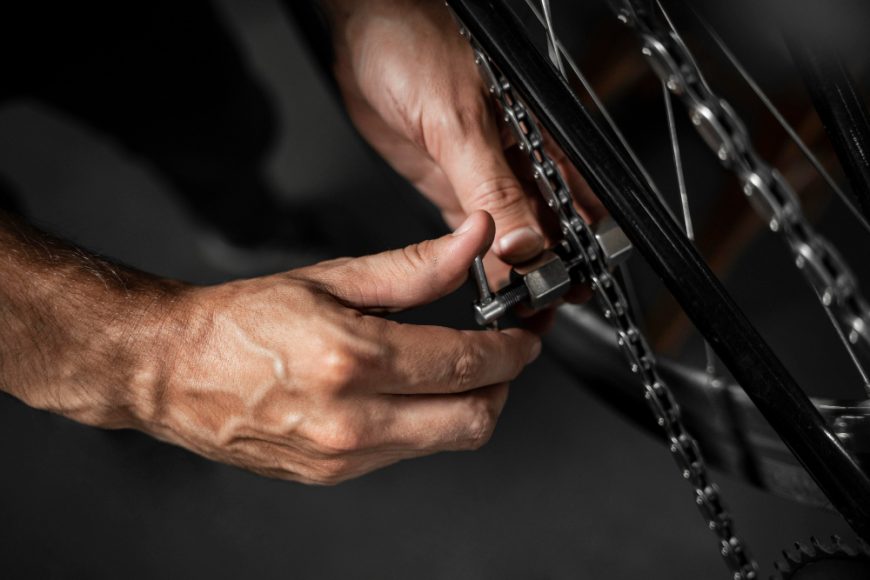
- Push out the damaged links. Seat a rivet in the chain tool’s cradle, line up the tool’s driving pin with the rivet, and turn the handle until the rivet comes out. Park’s method:
- Quick link: press out both rivets of the damaged outer plates so both ends finish on inner links.
- Connecting pin: remove the damaged link along with the next set of inner plates, driving the rivet all the way out.
- No spare connector: push the rivet out only far enough to free the damaged section, leaving it stuck in the outer plate.
- Route the chain back through the front derailleur cage, around the chainring, over the cog and through both rear derailleur pulleys. Keep it on the correct side of any tab on the derailleur cage.
- Join it.
- Quick link: fit both halves with any arrows pointing the way the chain travels. Shimano says the arrow should point in the crank’s rotation direction, viewed from the outside of the bike. Move the link to the upper run of chain, hold the rear brake and push down on a pedal. Park says this seats the link. Check both pins sit fully home in their slots.
- Connecting pin: drive it in until it matches the depth of the rivets next to it, then snap off the pilot tip with pliers. The next section covers Shimano’s rules.
- Reused rivet: push the same rivet back in until it matches its neighbors. Park calls this a last resort and says the rivet’s strength has been significantly compromised. Ride home gently and don’t stand on the pedals.
- Backpedal and watch the joint go through the derailleur. If it kinks, flex it as described under stiff links.
- Stay off the big gears if you removed links. Park notes that a master link fix that only swaps the damaged plates keeps the chain’s length, so you keep every gear. A chain you’ve shortened shouldn’t go into the largest cogs and chainrings. By our math, a chain sized with Park’s method below is one inch longer than the tightest wrap in that gear, so removing one pair of links uses up the margin.
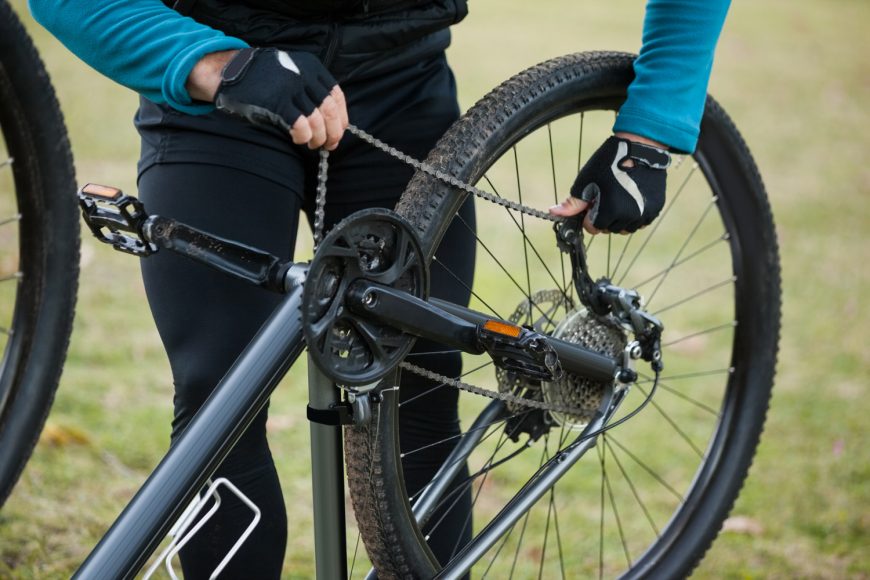
A twisted chain gets the same treatment. Park’s rule: if the twist is in one link, remove it with a set of side plates and rejoin. If several links are twisted, remove more chain, and you may have to turn the bike into a single speed.
Single-speed bailout when the derailleur is wrecked
A chain that breaks can wrap around the rear derailleur and bend it. Park Tool’s get-home fix bypasses the derailleur. Free the chain from the derailleur, wrap it around the middle chainring and a middle rear cog with a straight chainline, and find the shortest length where an inner end meets an outer end. If the chain is still slack there, try the next cog and check again. Join it, don’t touch the shifters, and repair the drivetrain at home.
Joining a Shimano chain with a connecting pin
Shimano chains that don’t use a QUICK-LINK join with a reinforced connecting pin: a longer rivet with a guide on one end that you snap off after fitting. Shimano’s chain manual, which lists a pin for each of its 11-speed chains, sets these rules:
- Use only the connecting pin model listed for your chain. Park adds that each connecting rivet is specific to the make and model of chain.
- Never break the chain at a rivet that is already a connecting pin. Shimano says doing so damages the chain. Park says to break the chain several rivets away from any connecting rivet.
- Insert the new pin from the same side the chain cutter went in when you broke the chain. If you pushed the old rivet out from the inside of the bike, this matches Park’s method below.
- Put the connecting pin in the leading hole of the outer link, in the direction the chain moves. Shimano says this joint is stronger than one made the other way.
- After you snap off the guide, the pin sits slightly proud of the plate. That’s normal.
Park Tool lubes the pin and drives it from the inside of the bike out toward you, so the burr left by the snapped pilot faces away from the cogs. Expect resistance at each outer plate, and stop when the pin matches its neighbors. Campagnolo 11, 12 and 13-speed pins need one more step: Park peens the pin with an extra quarter turn of the tool on a peening anvil.
Skip this section if your chain has a quick link. Shimano’s 12-speed chains use a QUICK-LINK, not a pin.
How to fix a stiff link
A stiff (tight) link won’t bend around the cogs and derailleur pulleys, so the chain jumps each time it comes round. To tell a stiff link from wear or indexing trouble, use the symptom table in bike chain slipping. Park Tool lists three causes: no lube, corrosion, and a poorly installed chain.
- Backpedal slowly and watch the chain run over the cog. The tight link stays straight where the others hinge.
- Grip the chain with both hands, one on each side of the tight link.
- Flex the chain side to side (Park says “laterally”) until the link bends freely.
If the stiff link is one you just joined, compare its rivet depth with the neighbors. For rust, bad joins and other causes, see why bicycle chains break.
How to replace a bike chain
Replace the chain after any break and whenever it reaches its wear limit. Park Tool’s limits, measured with a chain checker: 0.5% for 11-speed and up, 0.75% for 10-speed and fewer, 1.0% for single speed. With a ruler, line up a rivet with the zero mark and count 24 more rivets. If that rivet sits more than 1/16 in past the 12 in mark, Park says the chain is due. Our chain wear replacement estimator helps you plan the next check.
Step 1: Check the old chain’s length
If the old chain was the right length, it’s your template. Park’s test:
- Shift to the largest chainring and the largest rear cog. The chain should make it with two slight bends at the derailleur pulleys.
- Shift to the smallest chainring and smallest cog. The chain should have no slack, and the derailleur shouldn’t pull so far back that the chain touches itself.
Pass both? Size the new chain to the old one. Fail either, or changed the cassette or crankset? Measure from scratch (step 3).
Step 2: Take the old chain off
Taking the rear wheel out first slackens the chain. If there’s a quick link, move it to the lower run and open it with master link pliers. If not, or if the chain is worn out anyway, break it with the chain tool at any rivet several links away from a connecting pin.
Step 3: Size the new chain
New chains come long. If the old chain passed the length test, lay the two side by side, inner plates to inner plates, and match them rivet by rivet. Count rivets instead of lining up the far ends, because the old chain has lengthened with wear.
Otherwise, on a derailleur bike whose largest cog has 36 teeth or fewer, wrap the new chain around the largest chainring and the largest cog without threading it through the rear derailleur. Pull it snug, find the nearest rivet where an inner end meets an outer end, add two rivets (one inch) and cut there. Fit one half of the quick link before you measure, because it adds half an inch.
1x drivetrains with a 42-tooth or bigger cog, Shimano and SRAM groups with their own rules, and full-suspension bikes size differently. Our chain length rules by drivetrain table lists each maker’s rule, and the chain length calculator runs Park Tool’s equation for you.
Step 4: Route and join it
- Check the side plates. Park says logos and printing face out on directional chains, and Shimano marks the outer face of its chains.
- Thread the chain through the rear derailleur on the correct side of the cage tabs, inside the frame, and through the front derailleur cage. On a connecting-pin chain, lead with the outer plates.
- Join it with a new quick link or a new connecting pin, as in the roadside steps. Shimano says to fit a new QUICK-LINK whenever you fit a new chain.
- Refit the wheel, backpedal and check for tight links at the joint.
- Shift through every gear in a stand or on a quiet road.
If the new chain skips under load, Park points to worn cassette or freewheel cogs, which may need replacing after a chain has run too long past its limit.
Chain speed compatibility
Buy a chain made for the number of cogs on your rear wheel. Park Tool flags two traps: a narrow 10 or 11-speed chain on chainrings spaced for 8 or 9 speeds can drop between the rings during a front shift, and SRAM’s 12-speed Flattop chain works only with the SRAM parts it was designed for. On a bike that mixes brands, Park’s advice is to stick with the drivetrain maker’s chain or ask a mechanic.
Skip this if you’re buying the same chain model the bike came with.
Single-speed, BMX and hub-gear bikes
These bikes run a wider 1/8 in chain, joined with a master link held by a spring clip (Park removes the clip with needle-nose pliers) or with a connecting pin. To size a new chain from scratch, Park pushes the wheel all the way forward in the dropouts, wraps the chain around both sprockets, finds the reference rivet and adds two rivets (one inch) for wheel removal and tire clearance. Our single-speed chain length calculator estimates the length from your chainstay and tooth counts. Then set tension to about 1/2 in of up-and-down movement halfway between the sprockets; how to tighten a bike chain shows how to move the wheel.
Checklist before you ride on a repaired chain
- The connector matches your speed count and its arrows point the way the chain travels.
- Both quick link pins sit fully in their slots, or the connecting pin matches its neighbors with the guide snapped off.
- No link kinks as you backpedal through the derailleur.
- A shortened chain stays out of the largest cogs and chainring.
- After a quick link or connecting pin repair, stand and push hard in a middle gear on a quiet road before you ride in traffic. After a reused rivet, stay seated and ride home gently.
Questions riders ask
Can you fix a broken bike chain without a chain tool?
Not well. You need a chain tool to push out the damaged rivet, and a quick link alone can’t remove it. If the break left two clean inner ends, a quick link will join them by hand. Otherwise, call a ride or walk to a shop.
Should I replace my chain after it breaks?
Yes. Park Tool says to fit a new chain after any break, since the roadside fix only gets you home. Check the cassette at the same time if the old chain was worn.
Can I put a quick link on a Shimano chain?
Yes. Shimano’s 12-speed chains join with its own SM-CN910-12 QUICK-LINK, and Shimano’s manual says to use only the link it lists for the chain. Other brands sell links for Shimano chains, but Shimano doesn’t list them. On 11-speed and older Shimano chains, Shimano’s 2019 chain manual lists a reinforced connecting pin; check your chain’s current manual before relying on a quick link. Whatever you fit, match the speed count exactly.
Sources
- Park Tool. On-the-Ride Chain Repair (read October 15, 2026 from the Internet Archive copy of September 30, 2025). Tight links, master link and connecting rivet repairs, reused rivet as a last resort, twisted chains, single-speed conversion, replace the chain after a break.
- Park Tool. Chain Replacement: Derailleur Bikes (read October 15, 2026 from the archived copy of April 29, 2026). Length check, removal, sizing to the old chain, routing, master link seating, connecting rivet installation, skipping after a new chain.
- Park Tool. Chain Length Sizing (read October 15, 2026 from the archived copy of September 18, 2026). Largest-to-largest method plus two rivets, plus four rivets for 42-tooth and larger cogs, half a master link, rear suspension.
- Park Tool. Chain Compatibility (read October 15, 2026 from the archived copy of April 20, 2026). Half-inch pitch, chain widths by speed, SRAM Flattop, narrow chains on wide chainrings.
- Park Tool. When to Replace a Worn Chain (archived copy of October 14, 2026). 0.5%, 0.75% and 1.0% limits and the 12 in ruler test.
- Park Tool. Chain Replacement: Single Speed Bikes (archived copy of February 16, 2026). Spring-clip master links, sizing plus one inch, 1/2 in tension.
- Shimano. Dealer’s Manual, 12-speed chain (DM-MACN001-08) (read October 15, 2026 from the archived copy of April 29, 2026). QUICK-LINK in place of a pin, no reuse, new link with each chain, arrow direction, front side of the chain.
- Shimano. Dealer’s Manual, chain (DM-CN0001-07) (December 2019; read October 15, 2026 from the archived copy). Reinforced connecting pin rules, chain length for SHADOW road and MTB/trekking derailleurs, and sizing at the greatest suspension extension.
- SRAM. Can I use the SRAM Eagle PowerLock multiple times? (accessed October 15, 2026). Single use, removal with chain link pliers.
- SRAM. How do I size a chain for a SRAM Eagle AXS drivetrain? (accessed October 15, 2026). Hardtail plus two inches; full suspension plus one inch at the axle-farthest point.
- SRAM. What PowerLock do I use for my Flattop 12-speed chain? and Can I reuse the Flattop PowerLock after I have removed it? (accessed October 15, 2026). Flattop PowerLock only; not reusable.
- KMC. Multi-speed connector and Chain connectors (accessed October 15, 2026). Latch links single use, reusable links 3 to 5 times (KMC’s European site: reuse until the chain is worn, then discard), e-bike chains use non-reusable links.

My chain slips on my bike more frequently. some tips in this guide helped me to fix it. Thanks a lot.