
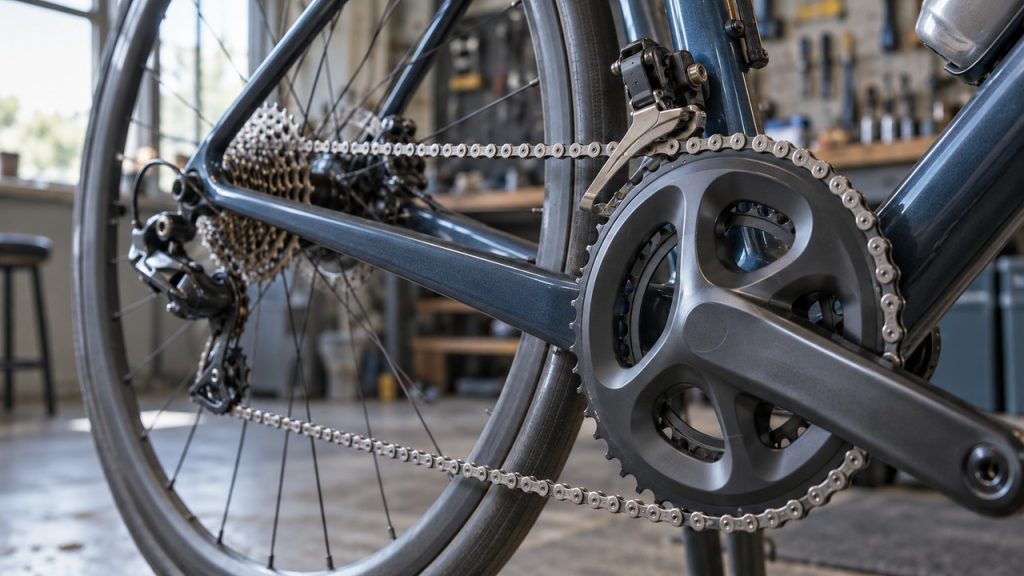
Bike Gear Ratio and Speed Calculator
Compare gear ratio, gear inches, development, and speed at different cadences.
Bike speed = cadence × (chainring teeth ÷ cog teeth) × wheel circumference. At 90 rpm, a 50-tooth chainring driving a 17-tooth cog on a 700×28 road wheel (2.13 m around) moves the bike 6.26 m per pedal turn, which works out to 33.8 km/h (21.0 mph). Speed rises in step with cadence: the same gear gives 30.1 km/h (18.7 mph) at 80 rpm and 37.6 km/h (23.4 mph) at 100 rpm.
To use the calculator above, enter your chainring and cog teeth, pick your wheel and tire from the menu (700×28 is the default) and set your cadence and speed units. You get the gear ratio, gear inches, development (meters per pedal turn) and your speed in mph or km/h, plus a table of speeds from 60 to 110 rpm in both units. The calculator works out wheel diameter as the rim’s ISO bead seat plus twice the tire width, so a 700×28 wheel measures 678 mm. For a tire the menu does not list, choose Custom and type the outside diameter in millimeters; the wheel circumference table below gives the figure for common sizes.
Speed chart for your whole drivetrain
The second calculator shows every gear at once, at one cadence. It opens on a 700c wheel (622 mm rim) with 28 mm tires, chainrings from 34 to 50, cogs from 11 to 32 and 90 rpm, which fits a compact road crank. Change the rim and tire width to match your bike, set the smallest and largest chainring and cog, enter a cadence, choose mph or kph and press Calculate. Each cell shows the speed for that ring and cog. Cell shading separates slow (under 10 mph), middle and fast (20 mph and up) gears, and a gear keeps the same colour in mph or kph. The grid lists every cog in the range, so ignore rows for cogs your cassette doesn’t have.
The grid lists every tooth count from the smallest to the largest chainring, so on a compact crank read the 34 and 50 columns and ignore the ones in between. On a phone, swipe the grid sideways. For a 27.5-inch mountain bike pick 650b/27.5 (584 mm); 29ers and gravel bikes stay on 622 mm.
Field Value post_title Bicycle Gear Speed Calculator post_status publish post_type shortcoderHow to calculate gear speed by hand
You need four numbers, and the bike carries all of them:
- Chainring teeth: stamped on the ring, often next to the crank arm (for example “50T” or “50-34”).
- Cog teeth: stamped on the face of each cassette cog. Count the teeth if the stamp has worn off.
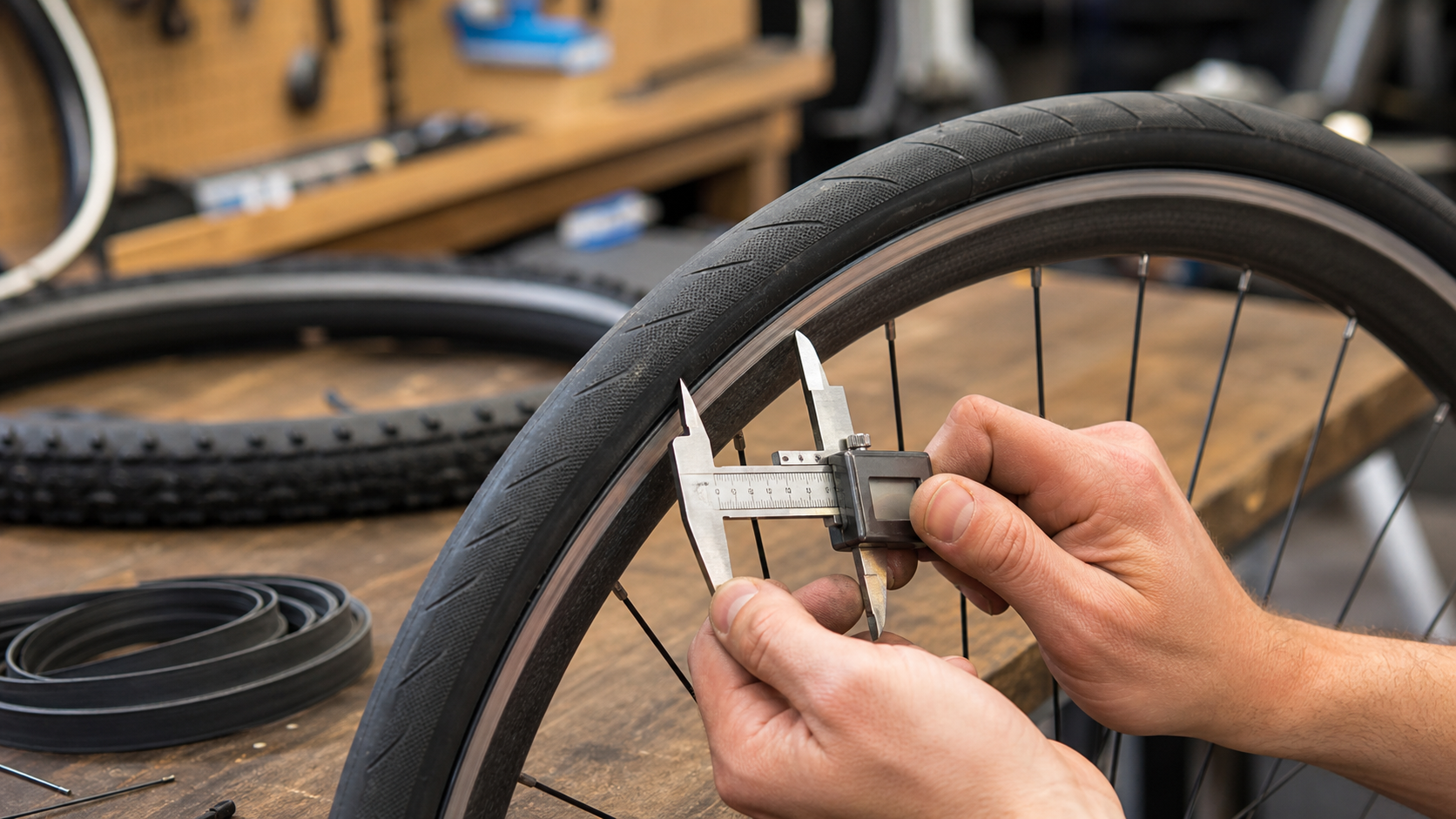
- Tire size: the ISO pair on the sidewall, such as 28-622 (28 mm wide on a 622 mm bead seat). Outside diameter = bead seat + 2 × width.
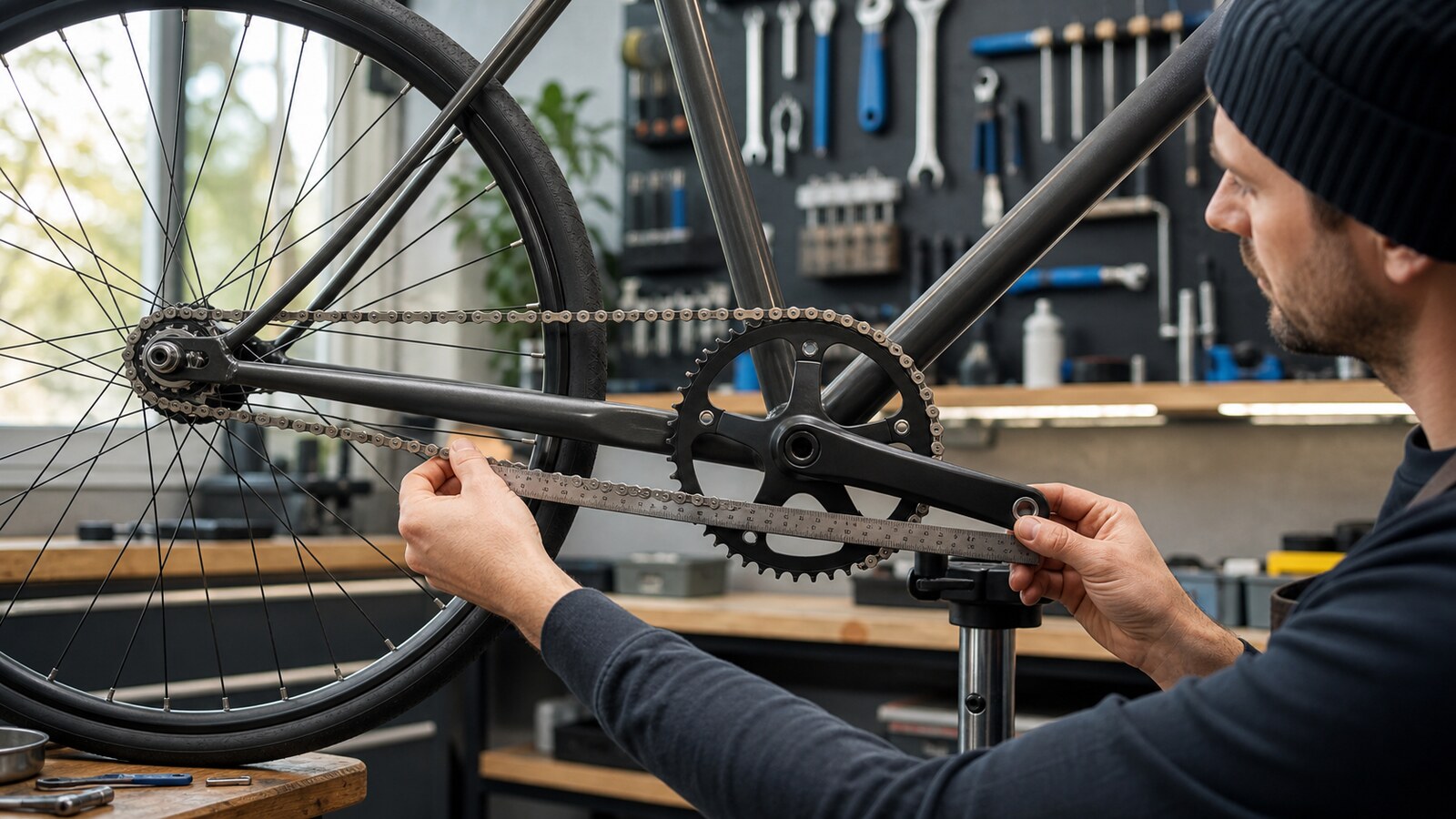
- Cadence: crank turns per minute from a cadence sensor, or count right-foot downstrokes for 15 seconds and multiply by 4.
Worked example for 50×17 at 90 rpm on 28-622 tires:
- Gear ratio: 50 ÷ 17 = 2.94. The rear wheel turns 2.94 times per crank turn.
- Wheel circumference: (622 + 2 × 28) = 678 mm diameter, × π = 2,130 mm, or 2.13 m.
- Development: 2.94 × 2.13 m = 6.26 m per crank turn.
- Speed: 6.26 m × 90 rpm × 60 minutes = 33,800 m per hour, or 33.8 km/h. Divide by 1.609 for 21.0 mph.
Two shortcuts give the same answer. In km/h, multiply development in meters by cadence and by 0.06. In mph, multiply gear inches by cadence and divide by 336: 78.5 × 90 ÷ 336 = 21.0 mph. The gear inches calculator gives gear inches and development for every gear on your bike.
Gear speed charts for four common setups
These charts use the same formula as both calculators on this page: circumference = π × (bead seat diameter + 2 × tire width). Each cell shows km/h, with mph in brackets. Tooth counts come from the Shimano and SRAM spec pages listed under Sources.
Road 2x: 50/34 chainrings, 11-32 cassette, 700×28 tires
Shimano 105 FC-R7000 crankset (50-34T) with the CS-R7000 11-speed 11-32T cassette. Wheel: 28-622, 678 mm (26.7 in).
| Cog | 50T at 70 rpm | 50T at 90 rpm | 50T at 110 rpm | 34T at 70 rpm | 34T at 90 rpm | 34T at 110 rpm |
|---|---|---|---|---|---|---|
| 11 | 40.7 (25.3) | 52.3 (32.5) | 63.9 (39.7) | 27.7 (17.2) | 35.6 (22.1) | 43.5 (27.0) |
| 12 | 37.3 (23.2) | 47.9 (29.8) | 58.6 (36.4) | 25.3 (15.7) | 32.6 (20.2) | 39.8 (24.7) |
| 13 | 34.4 (21.4) | 44.2 (27.5) | 54.1 (33.6) | 23.4 (14.5) | 30.1 (18.7) | 36.8 (22.8) |
| 14 | 31.9 (19.9) | 41.1 (25.5) | 50.2 (31.2) | 21.7 (13.5) | 27.9 (17.4) | 34.1 (21.2) |
| 16 | 28.0 (17.4) | 35.9 (22.3) | 43.9 (27.3) | 19.0 (11.8) | 24.4 (15.2) | 29.9 (18.6) |
| 18 | 24.8 (15.4) | 31.9 (19.9) | 39.0 (24.3) | 16.9 (10.5) | 21.7 (13.5) | 26.6 (16.5) |
| 20 | 22.4 (13.9) | 28.8 (17.9) | 35.1 (21.8) | 15.2 (9.4) | 19.6 (12.1) | 23.9 (14.8) |
| 22 | 20.3 (12.6) | 26.1 (16.2) | 31.9 (19.9) | 13.8 (8.6) | 17.8 (11.0) | 21.7 (13.5) |
| 25 | 17.9 (11.1) | 23.0 (14.3) | 28.1 (17.5) | 12.2 (7.6) | 15.6 (9.7) | 19.1 (11.9) |
| 28 | 16.0 (9.9) | 20.5 (12.8) | 25.1 (15.6) | 10.9 (6.7) | 14.0 (8.7) | 17.1 (10.6) |
| 32 | 14.0 (8.7) | 18.0 (11.2) | 22.0 (13.6) | 9.5 (5.9) | 12.2 (7.6) | 14.9 (9.3) |
The 50×11 top gear reaches 52.3 km/h (32.5 mph) at 90 rpm. If your top speed on the flat sits under 45 km/h, you reach it in the 50×13 or 50×14 at 90-110 rpm, and the 11 and 12 serve on descents. Around 30-35 km/h, the 16, 18 and 20 cogs do the work, and each shift changes your speed by 3-4 km/h at 90 rpm. The 34×32 bottom gear holds 9.5 km/h (5.9 mph) at 70 rpm.
Gravel 2x: 46/33 chainrings, 10-36 cassette, 700×40 tires
SRAM Rival crankset (46/33T) with the Rival XG-1250 12-speed 10-36 cassette. Wheel: 40-622, 702 mm (27.6 in).
| Cog | 46T at 70 rpm | 46T at 90 rpm | 46T at 110 rpm | 33T at 70 rpm | 33T at 90 rpm | 33T at 110 rpm |
|---|---|---|---|---|---|---|
| 10 | 42.6 (26.5) | 54.8 (34.0) | 67.0 (41.6) | 30.6 (19.0) | 39.3 (24.4) | 48.0 (29.8) |
| 11 | 38.7 (24.1) | 49.8 (30.9) | 60.9 (37.8) | 27.8 (17.3) | 35.7 (22.2) | 43.7 (27.1) |
| 12 | 35.5 (22.1) | 45.7 (28.4) | 55.8 (34.7) | 25.5 (15.8) | 32.8 (20.4) | 40.0 (24.9) |
| 13 | 32.8 (20.4) | 42.1 (26.2) | 51.5 (32.0) | 23.5 (14.6) | 30.2 (18.8) | 36.9 (23.0) |
| 15 | 28.4 (17.7) | 36.5 (22.7) | 44.6 (27.7) | 20.4 (12.7) | 26.2 (16.3) | 32.0 (19.9) |
| 17 | 25.1 (15.6) | 32.2 (20.0) | 39.4 (24.5) | 18.0 (11.2) | 23.1 (14.4) | 28.3 (17.6) |
| 19 | 22.4 (13.9) | 28.8 (17.9) | 35.2 (21.9) | 16.1 (10.0) | 20.7 (12.9) | 25.3 (15.7) |
| 21 | 20.3 (12.6) | 26.1 (16.2) | 31.9 (19.8) | 14.6 (9.0) | 18.7 (11.6) | 22.9 (14.2) |
| 24 | 17.8 (11.0) | 22.8 (14.2) | 27.9 (17.3) | 12.7 (7.9) | 16.4 (10.2) | 20.0 (12.4) |
| 28 | 15.2 (9.5) | 19.6 (12.2) | 23.9 (14.9) | 10.9 (6.8) | 14.0 (8.7) | 17.2 (10.7) |
| 32 | 13.3 (8.3) | 17.1 (10.6) | 20.9 (13.0) | 9.6 (5.9) | 12.3 (7.6) | 15.0 (9.3) |
| 36 | 11.8 (7.4) | 15.2 (9.5) | 18.6 (11.6) | 8.5 (5.3) | 10.9 (6.8) | 13.3 (8.3) |
The 40 mm tires add speed on their own. On the same 622 rims, a 40 mm tire stands 30 mm taller than a 25 mm road tire (702 vs 672 mm), so every gear runs 4.5% faster at the same cadence. The 33×36 low gear gives 8.5 km/h (5.3 mph) at 70 rpm.
Mountain bike 1x: 32T chainring, 10-52 cassette, 29 x 2.4 tires
SRAM XS-1275 Eagle Transmission cassette (10, 12, 14, 16, 18, 21, 24, 28, 32, 38, 44, 52) with a 32T chainring. Wheel: 61-622, 744 mm (29.3 in). The columns drop to 60-100 rpm because mountain bike climbs run at lower cadence.
| Cog | 32T at 60 rpm | 32T at 80 rpm | 32T at 100 rpm |
|---|---|---|---|
| 10 | 26.9 (16.7) | 35.9 (22.3) | 44.9 (27.9) |
| 12 | 22.4 (13.9) | 29.9 (18.6) | 37.4 (23.2) |
| 14 | 19.2 (12.0) | 25.6 (15.9) | 32.1 (19.9) |
| 16 | 16.8 (10.5) | 22.4 (13.9) | 28.0 (17.4) |
| 18 | 15.0 (9.3) | 19.9 (12.4) | 24.9 (15.5) |
| 21 | 12.8 (8.0) | 17.1 (10.6) | 21.4 (13.3) |
| 24 | 11.2 (7.0) | 15.0 (9.3) | 18.7 (11.6) |
| 28 | 9.6 (6.0) | 12.8 (8.0) | 16.0 (10.0) |
| 32 | 8.4 (5.2) | 11.2 (7.0) | 14.0 (8.7) |
| 38 | 7.1 (4.4) | 9.4 (5.9) | 11.8 (7.3) |
| 44 | 6.1 (3.8) | 8.2 (5.1) | 10.2 (6.3) |
| 52 | 5.2 (3.2) | 6.9 (4.3) | 8.6 (5.4) |
In the 32×52 bottom gear you can climb at 5.2 km/h (3.2 mph) and still turn 60 rpm, about walking pace. The jump from the 44 to the 52 cuts speed by 15%, so a rider who drops into the 52 on a climb feels a big change.
Single speed and fixed gear
With one gear, cadence is your only way to change speed, so the useful question is how fast each ratio goes at low and high cadence. Gear inches are listed for comparison with fixed gear charts.
| Gear | Tire | Gear inches | 60 rpm | 80 rpm | 100 rpm | 120 rpm |
|---|---|---|---|---|---|---|
| 42×16 | 700×32 (686 mm) | 70.9 | 20.4 (12.7) | 27.2 (16.9) | 33.9 (21.1) | 40.7 (25.3) |
| 44×16 | 700×28 (678 mm) | 73.4 | 21.1 (13.1) | 28.1 (17.5) | 35.1 (21.8) | 42.2 (26.2) |
| 46×17 | 700×25 (672 mm) | 71.6 | 20.6 (12.8) | 27.4 (17.0) | 34.3 (21.3) | 41.1 (25.6) |
| 48×17 | 700×25 (672 mm) | 74.7 | 21.5 (13.3) | 28.6 (17.8) | 35.8 (22.2) | 42.9 (26.7) |
| 32×18 | 29 x 2.2 (734 mm) | 51.4 | 14.8 (9.2) | 19.7 (12.2) | 24.6 (15.3) | 29.5 (18.3) |
| 36×18 | 26 x 2.1 (666 mm) | 52.4 | 15.1 (9.4) | 20.1 (12.5) | 25.1 (15.6) | 30.1 (18.7) |
A 70-75 inch city gear tops out near 41-43 km/h (25-27 mph) at 120 rpm. On a fixed gear you cannot coast, so that cadence sets your safe descending speed. The fixed gear calculator adds skid patches to the same numbers.
Wheel circumference by tire size
Your tire sets the distance per wheel turn, so a wrong tire size skews every speed by the same percentage. The ISO (ETRTO) size on the sidewall gives width first and bead seat diameter second: 28-622 is a 28 mm tire on a 622 mm rim, sold as 700x28C. Both calculators add twice the width to the bead seat to get the outside diameter. The table compares that formula with the calibration figures Garmin and Sheldon Brown publish for setting a bike computer.
| Tire | ISO size | Outside diameter (calculator menu) | Formula circumference (mm) | Garmin (mm) | Sheldon Brown (mm) | Formula vs published |
|---|---|---|---|---|---|---|
| 700×23 | 23-622 | 668 mm | 2099 | 2096 | 2097 | +0.1% |
| 700×25 | 25-622 | 672 mm | 2111 | 2105 | 2105 | +0.3% |
| 700×28 | 28-622 | 678 mm | 2130 | 2136 | 2136 | -0.3% |
| 700×32 | 32-622 | 686 mm | 2155 | 2155 | 2155 | 0.0% |
| 700×35 | 35-622 | 692 mm | 2174 | 2168 | 2168 | +0.3% |
| 700×40 | 40-622 | 702 mm | 2205 | 2200 | not listed | +0.2% |
| 700×45 / 29 x 1.75 | 45-622 | 712 mm | 2237 | 2242 | not listed | -0.2% |
| 29 x 2.2 | 56-622 | 734 mm | 2306 | 2298 | 2325 | +0.3% |
| 29 x 2.4 | 61-622 | 744 mm | 2337 | not listed | not listed | no published figure |
| 27 x 1-1/4 | 32-630 | 694 mm | 2180 | 2161 | 2161 | +0.9% |
| 650c x 23 | 23-571 | 617 mm | 1938 | 1944 | not listed | -0.3% |
| 650b x 47 | 47-584 | 678 mm | 2130 | not listed | not listed | no published figure |
| 27.5 x 2.4 | 61-584 | 706 mm | 2218 | not listed | not listed | no published figure |
| 26 x 2.1 | 54-559 | 666 mm | 2091 | 2068 | 2070 (listed as 26 x 2.125) | +1.1% |
| 24 x 1.75 | 44-507 | 596 mm | 1872 | 1890 | not listed | -1.0% |
| 20 x 1.75 (BMX) | 44-406 | 495 mm | 1555 | 1515 | 1491 | +2.6% |
| 16 x 1-3/8 (Brompton) | 35-349 | 419 mm | 1316 | not listed | 1282 | +2.7% |
The last column compares the formula with Garmin’s figure, or with Sheldon Brown’s where Garmin lists none. The two published sources do not always agree: for 29 x 2.2, Garmin lists 2,298 mm and Sheldon Brown 2,325 mm, which puts the formula 0.3% above one and 0.8% below the other. Tires sold in inch widths use the calculator’s exact conversion, so 2.1 in counts as 53.3 mm and 1.75 in as 44.5 mm; that is why the 26 x 2.1 row shows 666 mm, not the 667 mm you get from the rounded ISO width of 54. On 700c road and gravel tires the formula lands within 0.3% of the published numbers, so the speed charts above hold to within about 0.1 km/h at 30 km/h. On 26-inch, 24-inch and smaller wheels it drifts 1-3% either way, and the small wheels read long. One cause, per Sheldon Brown: a loaded tire rolls about 1% smaller than its nominal diameter on a road bike, and smaller still at low pressure. The calculator prints the same 1-2% caveat under every result. On a 20 x 1.75 BMX or kids’ wheel, the calculator’s 22.0 km/h for 42×16 at 90 rpm works out to 21.5 km/h with Garmin’s circumference.
The same page puts chart and ISO-based figures within one or two percent of the real value. Skip the rollout test on 700c road and gravel tires, where the formula sits within 0.3% of the published figures. For an exact figure on other wheels, do a rollout test: mark the front tire and the floor, sit on the bike, roll forward one full wheel turn and measure the distance. Divide by π for the outside diameter in millimeters and enter it under Custom in the calculator above, or enter the circumference in the wheel circumference calculator. The bike tire size chart decodes older inch and French labels.
What cadence to use in the calculator
Use the cadence you can hold for the ride, not your best sprint. Studies of trained riders put that at 80-100 rpm on flat roads and in the lab, and about 70 rpm on long climbs, and less-trained riders choose lower numbers as the effort rises.
| Riders and setting | Cadence measured | Study |
|---|---|---|
| 7 professionals, flat Grand Tour stages | 89.3 rpm average | Lucía et al. 2001 |
| Same riders, time trials of about 50 km | 92.4 rpm average | Lucía et al. 2001 |
| Same riders, mountain passes of about 15 km | 71.0 rpm average | Lucía et al. 2001 |
| 12 trained cyclists and 10 trained runners, lab, 75-250 W | Chose 90-100 rpm at every power output | Marsh and Martin 1997 |
| 10 less-trained men, lab, 75-175 W | Chose about 80 rpm at 75 W, falling to 65 rpm at 175 W | Marsh and Martin 1997 |
| All three groups, lowest oxygen cost | 53-60 rpm | Marsh and Martin 1997 |
| 14 elite cyclists, lab ergometer time trials of about 30 minutes | Fastest at 80 rpm; freely chosen average 90 rpm | Foss and Hallén 2005 |
The studies point in different directions on what is “best”. Marsh and Martin found every group pedaled faster than its most economical cadence, and speculated that less-trained riders chose lower cadences to cut their oxygen demand. In Foss and Hallén’s time trials, riders forced to 60, 100 and 120 rpm finished 3.5%, 1.7% and 10.2% slower than at 80 rpm, while their freely chosen cadence (90 rpm on average) gave finishing times statistically indistinguishable from 80 and 100 rpm. Lucía’s team suggested the professionals dropped to about 70 rpm on climbs, possibly because of the demands of that phase of racing.
For planning, Icebike’s rule of thumb is to read your cruising speed at 85-90 rpm, check your climbing gear at 60-70 rpm, and check your top gear at 100-110 rpm. If you ride without a cadence sensor, count your pedal strokes on a steady stretch before you trust any of these columns.
Why your real speed differs from the calculator
The calculator tells you how fast a gear moves the bike at a given cadence. It cannot tell you whether your legs can turn that gear at that cadence into a headwind or up a 6% grade. Power, wind, grade, tire pressure and the weight on the bike decide that. Three checks explain most mismatches:
- Wrong wheel setting. A bike computer set to Garmin’s 700×23 figure (2,096 mm) under-reads by 3.3% on 700×35 tires (2,168 mm).
- Coasting and soft pedaling. Average speed includes coasting, so it rarely matches the gear-and-cadence figure for any single moment.
- Snow and soft surfaces. Tires sink and slip on loose snow, so the bike covers less ground per turn than the table says. Expect your true speed to fall below the chart in winter.
To see what speed riders hold over a whole ride, read our guide to average bike speed. To turn a speed into ride time or distance, use the speed, distance and time calculator.
FAQ
How fast is 90 rpm on a bike?
It depends on the gear and tire. At 90 rpm, a 50×17 road gear on 700×28 tires gives 33.8 km/h (21.0 mph). A 34×34 climbing gear on a 29 x 2.4 mountain bike gives 12.6 km/h (7.8 mph). The road 50×11 top gear gives 52.3 km/h (32.5 mph). Enter your own gear in the calculator above.
How do I convert gear and cadence to mph?
Multiply gear inches by cadence and divide by 336. For 50×17 on 700×28 (78.5 gear inches) at 90 rpm: 78.5 × 90 ÷ 336 = 21.0 mph. For km/h, multiply development in meters by cadence and by 0.06: 6.26 × 90 × 0.06 = 33.8 km/h. One mph equals 1.609 km/h.
What cadence do I need for 20 mph?
Cadence = speed in km/h ÷ (development in meters × 0.06). In mph, convert first (1 mph = 1.609 km/h). On a 50×17 gear with 700×28 tires (6.26 m development), 20 mph (32.2 km/h) needs 85.6 rpm and 25 mph (40.2 km/h) needs 107 rpm. Icebike’s rule of thumb: if the answer comes out above about 100 rpm, shift to a smaller cog; if it falls below about 70 rpm on the flat, shift to a bigger one. Read development for your gear from the calculator at the top of the page.
Does a bigger chainring make you faster?
Not by itself. At the same cadence, moving from a 46T to a 50T ring raises speed by 8.7%, but on flat ground you need far more than 8.7% more pedal force to hold that speed, because air drag grows faster than speed does. If you ride at the same speed instead, the bigger ring drops your cadence by 8.7% and raises the force on each pedal stroke by 8.7%. Fit a bigger ring when you spin out on descents or in fast group rides, where you already make the power and only run short of gear.
Do wider tires change my speed in the same gear?
Yes, a little. A taller tire covers more ground per wheel turn. On 622 mm rims, going from 25 mm to 40 mm tires raises the outside diameter from 672 to 702 mm, so the same gear and cadence give 4.5% more speed. Whether you hold that speed depends on rolling resistance and your power.
Why does the calculator differ from my bike computer?
Check the wheel circumference set in the computer first. Compare it with the table above, or measure it with a rollout test. If the circumference matches and the numbers still differ, check that you entered the cog you were riding in: one cog off on a road cassette shifts speed by 7-14%.
What cadence should a beginner use?
Start with a cadence you can hold. In the Marsh and Martin study, less-trained riders chose about 80 rpm at light effort and 65 rpm at harder effort, while trained riders stayed at 90-100 rpm. Icebike’s rule of thumb: shift to an easier gear when your cadence falls below about 60 rpm on a climb.
Sources
- Lucía A, Hoyos J, Chicharro JL. Preferred pedalling cadence in professional cycling. Medicine and Science in Sports and Exercise 2001;33(8):1361-1366. https://pubmed.ncbi.nlm.nih.gov/11474339/ (flat stages 89.3 rpm, time trials 92.4 rpm, mountain passes 71.0 rpm)
- Marsh AP, Martin PE. Effect of cycling experience, aerobic power, and power output on preferred and most economical cycling cadences. Medicine and Science in Sports and Exercise 1997;29(9):1225-1232. https://pubmed.ncbi.nlm.nih.gov/9309635/ (trained riders 90-100 rpm; less-trained 80 to 65 rpm; most economical 53.3-59.9 rpm)
- Foss Ø, Hallén J. Cadence and performance in elite cyclists. European Journal of Applied Physiology 2005;93(4):453-462. https://pubmed.ncbi.nlm.nih.gov/15503124/ (80 rpm fastest; 60, 100 and 120 rpm 3.5, 1.7 and 10.2% slower; freely chosen mean 90 rpm)
- Garmin, Edge 830 Owner’s Manual, Wheel Size and Circumference, https://www8.garmin.com/manuals/webhelp/edge830/EN-US/GUID-DB0BC20A-DADF-41EB-A61C-14BEC158B43C.html (circumference by tire size, including 700x40C 2200, 700x44C 2235 and 29 x 2.1 2288 mm)
- Sheldon Brown, Cyclecomputer Calibration, https://www.sheldonbrown.com/cyclecomputer-calibration.html (circumference by ISO size; rollout test method; charts differ from a given bike by one or two percent)
- Sheldon Brown, Tire Sizing Systems, https://www.sheldonbrown.com/tire-sizing.html (ISO/ETRTO width and bead seat diameter: 622, 584, 559, 630, 406, 349 mm)
- Shimano, 105 crankset FC-R7000 (50-34T) and 105 cassette CS-R7000 (11-32T: 11-12-13-14-16-18-20-22-25-28-32), https://bike.shimano.com/products/components/pdp.P-FC-R7000.html, https://bike.shimano.com/products/components/pdp.P-CS-R7000.html and Shimano dealer’s manual DM-RACS001, https://si.shimano.com/en/pdfs/dm/RACS001/DM-RACS001-03-ENG.pdf
- SRAM, Rival crankset FC-RIV-D1 (46/33T), https://www.sram.com/en/sram/models/fc-riv-d1
- SRAM, Rival XG-1250 cassette (10-36t: 10, 11, 12, 13, 15, 17, 19, 21, 24, 28, 32, 36), https://www.sram.com/en/sram/models/cs-xg-1250-d1
- SRAM, XS-1275 Eagle Transmission cassette (10-52t: 10, 12, 14, 16, 18, 21, 24, 28, 32, 38, 44, 52), https://www.sram.com/en/sram/models/cs-xs-1275-a1

There are two valuation tools to determine the worth of your bike: Bike Faff and OBV. They can find out the price of most bikes, even if it’s a road bike, MTB, or even an e-bike.