How big is a bike box?
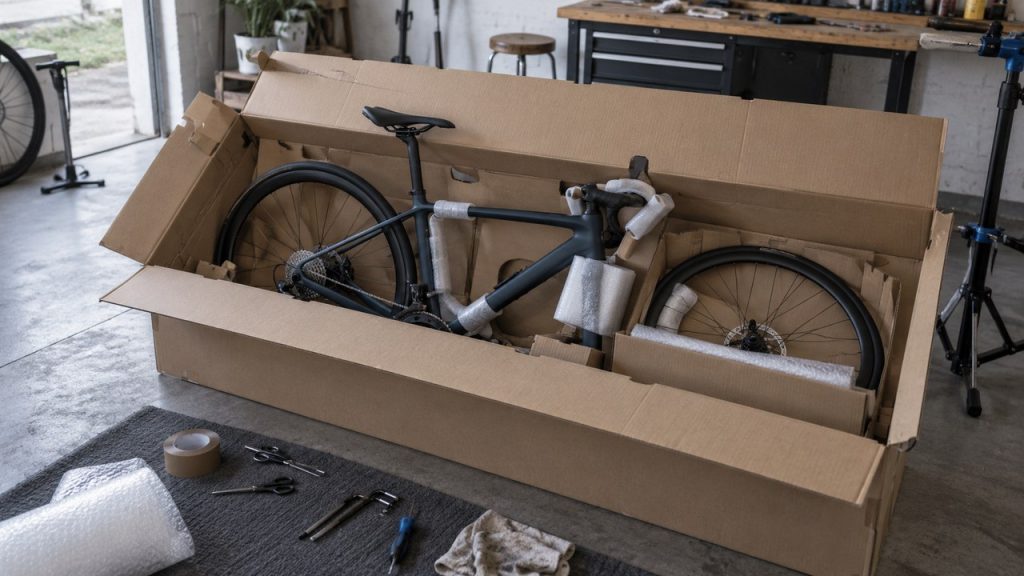
A cardboard box from a bike shop measures about 54-63 in long, 8-10 in wide and 27-32 in tall (137-159 x 20-25 x 69-81 cm). FedEx Office sells a 54 x 8 x 28 in bike box, and Canyon ships road bikes in a 150 x 23.5 x 81 cm box. Padded bags and hard cases run 45-58 in long. Before you book, measure your packed box two ways: length + width + height for airlines, and length plus girth for UPS, FedEx and USPS.
Most websites quote 43 x 11 x 32 in (110 x 28 x 82 cm) as the “standard” bike box. None of the bike makers or carriers listed in our sources publishes that size. It sits between BikeFlights’ Small (43 x 10 x 24 in) and Medium (45 x 12 x 30 in) boxes, and BikeFlights says riders most often pack its Medium with both wheels off.
Bike box and travel case sizes compared
Each size below comes from the maker’s published spec. The last two columns are our math: L + W + H is what airlines measure, and length + 2 x width + 2 x height (“length plus girth”) is what parcel carriers measure.
| Box or case | Size, in (cm) | Empty weight | L + W + H (airlines) | Length + girth (couriers) |
|---|---|---|---|---|
| FedEx Office bike box | 54 x 8 x 28 (137 x 20 x 71) | Not listed (95 lb packed max) | 90 in (229 cm) | 126 in |
| Guardian adult 27.5 in bike, factory box | 54 x 10 x 27 (137 x 25 x 69) | 41 lb with the bike inside | 91 in (231 cm) | 128 in |
| Canyon road bike box | 59.1 x 9.3 x 31.9 (150 x 23.5 x 81) | About 6 kg (13 lb) | 100 in (254 cm) | 141 in |
| Canyon mountain bike box | 62.6 x 9.4 x 29.9 (159 x 24 x 76) | About 6 kg (13 lb) | 102 in (259 cm) | 141 in |
| Canyon fat bike box | 59 x 16.3 x 31.4 (150 x 41 x 80) | About 12 kg (26 lb) | 107 in (271 cm) | 154 in |
| BikeFlights Small | 43 x 10 x 24 (109 x 25 x 61) | 17 lb (8 kg) | 77 in (196 cm) | 111 in |
| BikeFlights Medium | 45 x 12 x 30 (114 x 31 x 76) | Not listed | 87 in (221 cm) | 129 in |
| BikeFlights Large | 64 x 14 x 32 (163 x 36 x 82) | 22 lb (10 kg) | 110 in (279 cm) | 156 in |
| BikeFlights Extra Large | 56 x 21 x 32 (142 x 53 x 81) | 23 lb (10.4 kg) | 109 in (277 cm) | 162 in |
| Scicon AeroComfort 3.0 Road (padded bag) | 45.3 x 11 x 37.4 (115 x 28 x 95) | 9.5 kg (21 lb) | 94 in (238 cm) | 142 in |
| EVOC Bike Bag Pro (padded bag) | 57.9 x 14.2 x 33.5 (147 x 36 x 85) | 9.6 kg (21 lb) | 106 in (268 cm) | 153 in |
| Thule RoundTrip Road (hard-sided case) | 48.8 x 13 x 33.5 (124 x 33 x 85) | 27.6 lb (12.5 kg) | 95 in (242 cm) | 142 in |
| Thule RoundTrip MTB (hard-sided case) | 56.7 x 15 x 35 (144 x 38 x 89) | 31.8 lb (14.4 kg) | 107 in (271 cm) | 157 in |
| The quoted “standard” box | 43 x 11 x 32 (109 x 28 x 81) | No maker source | 86 in (218 cm) | 129 in |
Every box, bag and case in the table fits inside the 115 in (292 cm) bike limit at American and Delta. Only the cardboard boxes 54 in long or shorter stay at or under 130 in length plus girth, the line where UPS starts billing a Large Package Surcharge and FedEx an Oversize Charge. Every padded bag and hard case goes over it.
How much does a bike box weigh?
Canyon lists its cardboard road and mountain bike boxes at about 6 kg (13 lb) empty. BikeFlights’ reinforced boxes weigh 17-23 lb (8-10.4 kg), padded bags 9.5-9.6 kg (21 lb), and Thule’s hard-sided cases 27.6-31.8 lb (12.5-14.4 kg). Put a 25 lb (11 kg) bike in the Thule MTB case and you reach about 57 lb (26 kg), past the 50 lb (23 kg) line where American and Delta start charging overweight fees.

UPS, FedEx and USPS size limits for a bike box
Parcel carriers measure length plus girth: the longest side, plus twice the width, plus twice the height. For UPS, a packed bike box at or under 130 in, 17,280 cubic inches and 50 lb avoids the Large Package surcharge and the weight trigger for Additional Handling. A 54 x 8 x 28 in box comes to 126 in. Size alone still triggers Additional Handling on most bike boxes.
| Carrier | Hard limits | Where surcharges start | What it means for a bike box |
|---|---|---|---|
| UPS | 150 lb, 108 in long, 165 in length + girth | Additional Handling: over 50 lb, over 105 in length + girth, longest side over 48 in, second side over 30 in, over 10,368 cubic inches, or any container that isn’t corrugated cardboard; size triggers bill at a 40 lb minimum. Large Package: over 130 in length + girth, 96 in long, 17,280 cubic inches or 110 lb, billed at a 90 lb minimum. UPS bills one or the other, not both. | Most cardboard bike boxes hit Additional Handling on size alone. Every padded bag and hard case in the size table is over 130 in, so UPS bills it as a Large Package instead. |
| FedEx | Freight above 150 lb or 165 in length + girth. The FedEx bike box holds 95 lb. | Additional Handling over 48 in on the longest side, 30 in on the second side or 105 in length + girth. Oversize charge over 96 in long or 130 in length + girth, with a 90 lb minimum billable weight. | The FedEx box (126 in) stays under the oversize line, but at 54 in long it still pays Additional Handling. Canyon’s factory boxes (141 in) and every case in the table go over it. |
| USPS | 70 lb. 130 in length + girth for Ground Advantage, 108 in for other services. | Ground Advantage charges its oversized price from 108 to 130 in. | Boxes from 111 to 129 in ship Ground Advantage at the oversized price. Anything over 130 in can’t be mailed. |
Size also sets the weight you pay for. UPS multiplies length x width x height in inches, divides by 139 at daily rates or 166 at retail rates, and bills the larger of that dimensional weight and the scale weight. Take the 54 x 8 x 28 in box to a UPS counter and it bills as 73 lb even if the bike and box weigh 40 lb.
Skip the carrier math if you book through a bike shipping service; it sizes the box for you. You still need the packed size and weight to compare quotes. Our guide on how to ship a bike covers the shipping options and the damage-prevention steps.
Airline bike box limits and fees
Airlines add length + width + height. American and Delta take a bike up to 115 in (292 cm), United waives its oversize fee on a packed bike, British Airways takes a box up to 190 x 95 x 65 cm, and KLM prices each bike by route. We checked all five airline pages on October 14, 2026.
| Airline | Size limit | Weight | Fee | Packing rules |
|---|---|---|---|---|
| United | None listed for bikes | Not listed for bikes; only the oversize fee is waived | Counts as a checked bag; oversize fee waived on a properly packed bike | Bars sideways, pedals off, front wheel off if the bars won’t clear. Bike case, or a hard-sided or durable cardboard box with foam inside. No battery-powered bikes (small shifting batteries allowed). |
| American | 115 in / 292 cm | 70 lb / 32 kg max | Standard checked-bag fee up to 50 lb, overweight fee from 51 to 70 lb, no oversize fee | Hard case, bike bag or bike box; bars fixed sideways and pedals off, or both wrapped in foam. Outside a hard case, the bike travels as a fragile item. |
| Delta | 115 in / 292 cm | Excess weight fee over 50 lb; refused at 100 lb | Standard checked-bag fee | Durable container built for bikes. A soft bag or anything other than a hard-shell case needs a signed limited-release form. |
| British Airways | 190 x 95 x 65 cm (75 x 37.5 x 25.5 in) | No separate bike limit listed | One item of your checked allowance; Economy Basic fares pay for an extra bag | Tell BA at least 72 hours before you fly. Drop the bike at the out-of-gauge desk no later than 3 hours before long-haul or 2 hours before short-haul flights. No clothes or personal items in the bike box. |
| KLM | None listed | None listed | Set by route; the price shows in My Trip | Reserve at least 48 hours ahead. Bars turned lengthways, pedals off; KLM recommends deflating the tires. E-bikes only with the battery removed, and KLM won’t carry the battery. |
Two American Airlines rules catch bike travelers out. From Madrid, no side of a checked sports item can exceed 43 in (110 cm), so only the 43 in boxes in the size table qualify. American’s special-items page also caps boxes on flights to or from Mexico at 80 in (203 cm) in total, which only BikeFlights’ Small meets; confirm with American that the cap applies to your bike box before you fly that route.
Flying another airline? Open its sports equipment page before you buy the ticket. On a codeshare, read the bike page of the airline that operates the flight as well. The archive section below shows what happens when the two airlines disagree.
How to get a free bike box from a bike shop
New bikes reach shops in boxes, and shops break the empties down for recycling. Riders have asked for them for decades. “I find in North America any local bike store will give me a box,” a rider wrote on our KLM archive page in 2002.
- Call a shop that sells new bikes and ask when its next delivery comes in. Ask them to hold one box for you.
- Ask for a box from a bike of the same type and size as yours, or bigger. Canyon’s mountain bike box is 3.5 in longer than its road box. A kids’ bike box won’t do: Guardian’s run 35-53 in long and only 7-8 in wide for 12-20 in wheels.
- Ask for the packing kit too: the plastic fork spacer, the rear axle spacer, foam tubes and any cardboard wheel separators.
- For a fat bike or a bike with racks and fenders, ask for an e-bike box. Canyon’s e-road box measures 159 x 40 x 89 cm and weighs about 12 kg empty: 16 cm wider and 8 cm taller than its road box. At 164 in length plus girth, it ships as a Large Package.
- No shop box? FedEx Office sells its 54 x 8 x 28 in box, and FedEx says a bike box costs $15-$40 or more depending on where you buy it. BikeFlights sells reinforced boxes from $79.95 (Small) to $109.95 (Extra Large), October 2026 prices.
Bike box packing checklist

Measure the bike the way you will pack it, with the front wheel off, the bars turned or removed and the seatpost dropped. BikeFlights tells riders to measure “as you will pack it.” Then run the list below before you tape the box shut.
- Pedals off. United, American and KLM ask for it.
- Bars turned parallel to the frame, or removed. Mountain bike bars come off in almost every box, per BikeFlights.
- Fork spacer in the dropouts, and a cardboard divider between the frame and the wheel (FedEx’s packing guide shows the divider).
- Foam or pipe insulation on the top tube, down tube, fork and stays.
- Tires deflated, as KLM recommends.
- Pedals, thru-axles and bolts bagged and zip-tied to the frame.
- Shake the closed box. If something rattles, pad it or tie it down (FedEx).
- Tape the center seam and every edge.
- Name, phone number and destination address on the outside and inside of the box (British Airways asks for both).
- Weigh it: stand on a scale holding the box, then subtract your own weight. Aim for 50 lb (23 kg) or less.
- Do the math: L + W + H at or under 115 in (292 cm) for American and Delta, and length + girth at or under 130 in for couriers.
- Photograph the bike before you close the box, for any damage claim.
Our guide to flying with a bike walks through the teardown and compares a cardboard box with a clear plastic bike bag.
Can you fly with an e-bike or a fat bike?
None of the five airlines above lists a complete e-bike as an accepted bike. United won’t check battery-powered bikes, British Airways takes only non-electric bikes, the American and Delta bike rules cover only non-motorized bikes, and KLM carries an e-bike only with the battery removed and won’t carry the battery. Ship it instead. Canyon’s e-city box measures 177 x 57 x 104 cm, which comes to 197 in length plus girth. That’s over the 165 in UPS and FedEx package limit, so it goes as freight.
A fat bike flies, but watch the weight. Canyon’s fat bike box measures 150 x 41 x 80 cm, 271 cm (107 in) in total, inside the 115 in cap at American and Delta. The box alone weighs about 12 kg (26 lb), so with a fat bike inside you will likely pass 50 lb (23 kg). Riders heading to a winter trip can move studded tires, pedals and tools into a second checked bag. Two bags under 50 lb can cost less than one overweight bag. A 2007 report in our archive below found the same.
What riders reported: the Icebike airline archive
Since the 1990s, Icebike readers have sent in reports of flying with their bikes, sorted by airline and country on our Bike Access page. The fees in them date from 1997 to 2014 and tell you nothing about today’s prices. The problems they describe match the rules in the airline table above.
- Airline boxes were bigger than suitcases (Qantas, 2005). Anna Rossander reported that Qantas supplied cardboard bike boxes measuring 140 x 30 x 80 cm. That’s 250 cm (98 in) in total, inside today’s 292 cm cap at American and Delta. She packed her own bike in a free bike shop box and padded it with the clothes she was bringing; British Airways now bans clothes and personal items in a bike box. More reports are on the Qantas bike experiences page.
- The box was too small (Qantas, 2003). Brian Woodward found the Qantas boxes too short for two touring bikes, even with the bars and pedals off. Baggage handlers let the bikes fly unboxed after he signed a waiver. Delta still asks for a release form for any bike outside a hard-shell case.
- The label cost more than the box (KLM, 2007). Check-in staff were ready to charge Mary Arneson 50 euros for the size and weight of her boxed bike, then charged 150 euros once they spotted the bike labels. Split into two boxes inside the size and weight limits, with nothing on them saying “bike”, it would have cost nothing, she wrote.
- The operating airline set the price (KLM and Delta, 2011). Janet Miller booked KLM because it counted sports equipment up to 23 kg as a standard bag, and KLM quoted her 55 euros on the phone. At Heathrow the flight was Delta-operated, and Delta charged her 176 pounds ($281). The KLM bike experiences page holds 12 reports from 2000 to 2012.
- Same airline, different answer (Turkish Airlines, 2002 and 2014). James Spears flew Vancouver to Istanbul in 2002 and paid nothing for his bike. In 2014 a rider posting as emmeemme paid 80 euros per bike from Italy to Nepal, with bags inside the 20 kg and 193 cm limits. Both reports sit on the Turkish Airlines bike experiences page.
Three habits would have saved most of these riders money or stress: measure and weigh the box at home, get the bike fee in writing from the airline that operates each flight, and label the box inside and out.
Sources
- UPS. U.S. Daily Rates and Service Guide (updated September 2026). Maximum size and weight, Additional Handling and Large Package definitions.
- UPS. Shipping Dimensions and Weight (accessed October 14, 2026). Girth formula and dimensional weight divisors.
- FedEx. What is an Oversize Charge? and How to ship large items (accessed October 14, 2026).
- FedEx. FedEx Express and FedEx Ground fee and surcharge changes (2021). Additional Handling dimension thresholds: 48 in longest side, 30 in second side, 105 in length + girth.
- FedEx. How to ship a bike (accessed October 14, 2026). FedEx bike box size, 95 lb limit and packing steps.
- USPS. Parcel Size, Weight and Fee Standards (accessed October 14, 2026).
- United Airlines. Traveling with sports equipment (accessed October 14, 2026).
- American Airlines. Special items and sports equipment (accessed October 14, 2026).
- Delta Air Lines. Flying with sports equipment (accessed October 14, 2026).
- British Airways. Flying with sports equipment (accessed October 14, 2026).
- KLM. Special baggage (accessed October 14, 2026).
- Canyon. Bike Guard dimensions. Box sizes and weights by bike type.
- Guardian Bikes. How big is the bike box? Box sizes by wheel size.
- BikeFlights. What size Bikeflights Bike Box do I need? (modified February 26, 2025) and spec pages for the Small, Large and Extra Large boxes.
- Thule. Spec pages for the RoundTrip road and RoundTrip MTB cases.
- EVOC. Does my bike fit into the Bike Bag Pro? and the Bike Bag Pro spec page.
- Scicon. AeroComfort 3.0 Road spec page.
- Icebike reader archive: Qantas, KLM and Turkish Airlines bike experiences, 1997-2014.