
History of ice biking update: This page was refreshed on May 23, 2026 with a faster decision section, clearer rider checks, and stronger internal links for the next step.
Ice Biking History: Practical Transport Became a Riding Culture
The history of ice biking is not just about riders proving they can handle cold weather. Winter cycling grew from practical transport, commuting, experimentation, tire choices, local climate, and riders sharing what worked when roads and paths turned cold, snowy, or icy.
| Era or theme | What changed | Why it matters |
|---|---|---|
| Practical winter transport | Riders adapted normal bikes to cold roads | Winter cycling started from necessity as much as sport. |
| Equipment experiments | Tires, clothing, lights, and fenders improved | Better gear made cold rides less punishing. |
| Online rider archives | Stories and advice became easier to share | Winter cyclists could learn from other climates. |
| Modern winter riding | Commuting, fitness, and adventure overlap | The best advice still depends on local conditions. |
Why does Icebike history matter today?
Icebike history matters because the old lessons are still useful: traction, warmth, visibility, maintenance, and patience decide whether winter cycling is enjoyable. New gear helps, but the core judgment has not changed.
Continue with the winter cycling in ice and snow guide and Pam Blalock winter cycling tips.
Icebikers sometimes think themselves unique or inventive, and almost always believe themselves to be resourceful. These beliefs are all true of course, and athletic, competitive, self-reliant and macho suggest themselves frequently as well.
Icebikers sometimes think that winter cycling is relatively new, an invention of the last 10 years or so, made possible by modern fabrics and commercial studded tires.
However, if the truth is known, icebiking has been around for a long time. That term, of course, was coined by Joe Clark, the originator of the Icebike mailing list. But the concept predates all of the current winter cyclists and all of our modern gear. It dates virtually from the invention of the bicycle.
Winter cycling was hot (figuratively and literally) and heavy (probably much heavier) in the early days of bicycles, before the popularization of the automobile. There were few alternatives for personal transportation other than horses, which were expensive to feed and house.
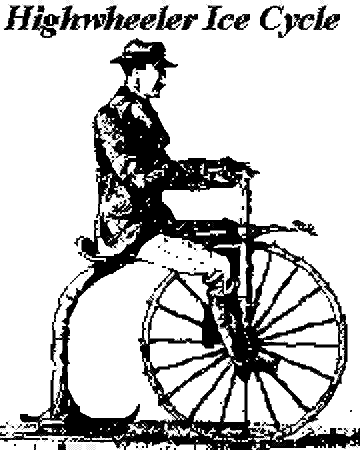 The bicycle found its way into every corner of “modern” life and was ridden in all corners of the world. Hardy cyclists drove bicycles into wilderness areas where roads were nonexistent. The arrival of bicycles lead to the demand for roads, and today’s modern road system is the result of the demands of “wheelmen”. All this happened before the automobile was available to any but the rich.
It was a natural progression to winter cycling. The freedom of movement afforded by the bicycle would not easily be surrendered to autumn breezes or winter chills. Getting off the bicycle meant walking in many cases.
In this section of Icebike.org, we will gather articles on winter cycling in the early days. As usual, we solicit your input. If you have old photos or written histories we would be glad to give them a permanent home here on Icebike.org (just email us if you have something).
Max Hirschberg’s 1900 Bicycle Ride to Nome
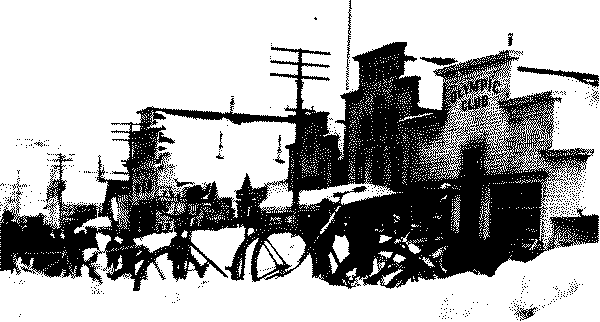
Unlike others, Max Hirschberg knew how to operate a bicycle before he rode his “wheel” from Dawson to Nome in 1900. Hirschberg was born in Ohio in about 1880, and went north at the time of the Klondike gold rush “to see what he could do.” He ran a roadhouse in the Dawson district but sold out in 1900 to join the stampede to Nome.
Hirschberg followed a “two-inch trail” with his bicycle much of the way to Nome. It was a rough trip. The journey took him about two-and-a-half months, during which time he suffered from snowblindness, exhaustion, and exposure.
Crossing the Shaktoolik River he nearly drowned. He was in the water for almost two hours, and during that time he lost his watch and his poke with $1,500 in gold dust. He saved his bicycle, however. Just east of Nome on the ice of Norton Sound his bicycle chain broke. A strong wind was blowing and he made a sail with his coat that he rigged on the bike. Hirschberg then sailed across the ice the rest of the way into Nome.
At the request of his wife, Max wrote the story of his bicycle ride to Nome in the 1950s, so that his children and grandchildren would know the true story. He died in 1964. Hirschberg’s granddaughter, Penni Busse, submitted his account of the ride to Nome to ALASKA magazine, which published the story in February 1978.
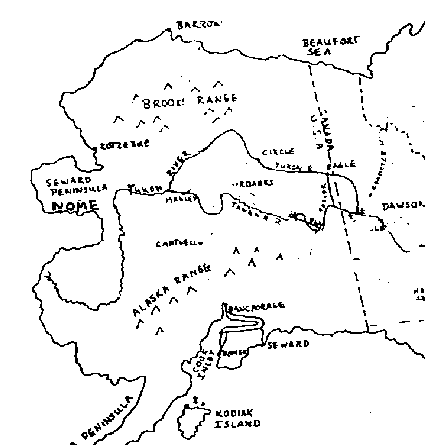
In January 1900, I secured a dog team and an outfit to go over the ice, down the Yukon from Dawson to Nome. I sold my share in a roadhouse and my mining claims in Dawson. My partner, Hank West, however, did not believe the reports about the gold strike in Nome were authentic. I did, so we parted.
In Dawson, I got my outfit and dog team, and I stayed at the Green Tree Hotel. At about midnight, I was awakened by the smell of smoke — the hotel was on fire. I jumped into my clothes and rushed outside. Hundreds of people had formed a bucket line from the Yukon River to the hotel. I joined the line, and we passed buckets of water to quench the fire and to wet blankets on adjoining buildings. The fire department was helpless because the fire hose froze in the extreme cold. Every available man joined the bucket line, but the building burned to the ground.
Broken boards were scattered over the snow. It was pitch dark and I stumbled on a board that contained a rusty nail. I went to the hospital with blood poisoning. It was March before I was up and around again, too late to get to Nome by dog team. With the spring thaw underway, the Yukon would be unfit for travel on the ice. I knew the news of the gold strike at Nome would bring thousands of people from the States to Nome by boat, so I had to get there quickly. I decided to travel by bicycle. I had been an expert bicycle rider for years, and I figured I could reach Nome before the Yukon became unfit for travel.
Many dog teams, driven in single file, had preceded me down the river and had made a hard trail about 2 inches wide where the sled runners cut deep troughs in the snow. I rode this narrow road, stopping at Indian villages or roadhouses.
The day I left Dawson, March 2, 1900, was clear and crisp, 30° below zero. I was dressed in a flannel shirt, heavy fleece-lined overalls, a heavy mackinaw coat, a drill parka, two pairs of heavy woolen socks and felt high-top shoes, a fur cap that I pulled down over my ears, a fur nosepiece, plus fur gauntlet gloves.
On the handlebars of the bicycle, I strapped a large fur robe. Fastened to the springs, back of the seat, was a canvas sack containing a heavy shirt, socks, underwear, a diary in waterproof covering, pencils, and several blocks of sulfur matches. In my pockets, I carried a penknife and a watch. My poke held gold dust worth $1,500 and my purse contained silver and gold coins. Next to my skin around my waist, I carried a belt with $20 gold pieces that had been stitched into it by my aunt in Youngstown, Ohio, before I had left to go to the Klondike.
A number of friends, including my old partner, Hank West, waved goodbye.
The road out of Dawson was broad and well packed, the was cold and exhilarating, and the Sky was clear and calm. There were numerous dog teams headed for Forty Mile, Circle City and points farther down the Yukon. Whenever I approached a dog team, the driver would accommodatingly pull off the trail and restrain his howling, snapping dogs from nipping me. I passed many dog teams before reaching Forty Mile. At the combination bar, gambling room, and roadhouse, I thawed out before a roaring wood fire in an oil-tank stove. Eight or ten whiskered men were sitting and smoking, talking about the rumor of a nearby gold strike
The Yukon River at Dawson was about 1,500 feet wide. When the river froze, huge cakes of ice, some standing on edge, others slanting, formed a barrier to the opposite shore. As the final freeze occurred, cakes of ice from the lowered river caused the trail to resemble a sidehill slope. There were overflows covering the ice in places, some frozen over with newly formed ice, which broke when stepped on, leaving a few inches of water over the solid ice beneath.
The trail led along this slanting ice, then along the bank of the river, across frozen cracks winding in and out from the tundra, and back to the sloping ice along the riverbank. Creek overflows were numerous, and by the time I reached Forty Mile, my socks were wet and ice covered my felt shoes. It took me quite a while to orient myself to my 2-inch trail and I had many spills on this early part of my journey.
A few miles below Forty Mile I crossed the boundary line · between Canada and the United States. A thrill shot through me as I caught sight of Old Glory waving on U.S. soil.
Eagle City was my next stop, about 100 miles from Dawson. Calico Bluff was about 10 miles farther and at the mouth of Seventymile River was the mushroom town of Star City. Bold, rugged mountains, conspicuous by their height, were visible for a considerable distance. About 180 miles from Eagle City is Circle City. There were many log cabins, saloons, a hospital and an Episcopal church. Adjoining Circle City was an Indian village.
Here the river widened into the Yukon Flats for about 250 miles down the river. Not even a hill was in sight, just scrubby, stunted spruce along the shore.
Twenty miles· or so below Circle City was Charley Creek, where I came to a Native village, and a little farther on was a roadhouse. Some 10 miles farther was Charley River, where I saw hundreds of caribou.
The most dangerous and difficult parts of the flats were between Circle City and Fort Yukon. Save for a portage land trail of 18 or 20 miles out of Circle City, the trail was on the river, which split into many channels without landmarks. The current was so swift that I encountered stretches of open water and blow holes. Snow storms completely obliterated the trail.
At last I made Fort Yukon, the most northerly point reached by the Yukon River, and about a mile north of the Arctic Circle. There were several saloons, Native cabins, a church, and stores displaying marten, fox, wolf and bear skins. It is a site of the oldest English-speaking settlement on the Yukon River. The oldest white man’s graves in Alaska, with the exception of Nulato, are those in the little
Hudson’s Bay cemetery near Fort Yukon; the headboards were dated 1850 and 1860. In 1862, the Church of England had a clergyman here, Mr. McDonald, who married a Native girl and translated the Bible and prayer book into the Native tongue.
Next, I reached Birch Creek and the end of all mountains for the first time. Down the Yukon some 75 miles, I came to the upper Ramparts, where there was a trading post. Then I came to Rampart City and another Native village. Rampart City consisted of stores, log cabins, and saloons. It furnished supplies for the placer gold mines on adjacent creeks. About 40 miles farther I came to the rapids, where the ice was free of snow, and for 20 miles my bicycle skidded on the slippery ice, causing me numerous falls.
I arrived at the mouth of the Tanana River, where there was a trading post. I saw Mount McKinley far to the south, as the day was clear.
About five miles out of Tanana I skidded on the glare ice. When I picked myself up, I found I had broken a pedal. I returned to Tanana, and, with the help of the storekeeper, cut out wooden pedals and drilled a hole through the center of each. I also bought bolts, nuts, and washers. The pedals wore out about every 75 miles.
Two hundred and fifty miles farther on, I came to the Koyukuk River, and 20 miles beyond that I arrived at Nulato, where a Russian trading post had been established in 1822.
As I wheeled into Nulato, a Jesuit priest met me outside of his home and invited me to stay with him overnight. The next day he took me to his workshop and fashioned a new pedal for my bicycle out of galvanized sheet metal and riveted it together with copper rivets. Luckily, I had the extra bolts I had bought at Tanana, for he had none. This pedal lasted until I reached Nome.
About fifty miles out of Nulato, I reached the Kaltag cutoff and headed overland to the Bering Sea, away from the Yukon, which wound its course to St. Michael. The days were warmer and the trail had begun to thaw and at times became indistinct. Water was flowing in the creeks and rivers. As I crossed the Shaktoolik River, I broke through the ice. Water was running under the surface ice, although there was still ice on the bottom of the river. I succeeded in breaking the surface ice and, hanging on to my bicycle, reached the opposite shore.
As I neared the Bering Sea, I saw what appeared to be glare ice off the shore. I headed for this and before I could stop, I found I was in calm, open water. I succeeded in wading back to shore and, although wet, continued on toward Nome.
Near Norton Bay was a roadhouse, where I dried off and had lunch before continuing. The boys at the roadhouse warned me that the ice would shift in Norton Sound but I started across it anyway. Just as I was nearing the opposite shore, the ice shifted, leaving about 8 to 10 feet of open water between the ice and the shore. I took a chance and leaped to the shore, where I picked up a piece of driftwood, jumped back on the ice floe and poled myself and my bicycle back to the shore, and went on my way. Just east of Nome, I skidded on glare ice. When I picked up my bicycle, I discovered the chain had snapped and broken
There was a fair wind blowing toward Nome, so I picked up a stick, put it on my back inside my mackinaw coat, and began sailing for Nome. At times the wind was so strong that was forced to drive into some soft snow to stop my wild flight. Without my chain, I could not control the speed of my bicycle. However, I finally arrived at Nome, on May 19, 1900, without further incident. I had had my 20th birthday on the trip.
by Max Hirschberg
Fun with the ice bike
There’s no need to put your bike away when the snow starts flying and ice freezes over your favorite fishing pond. Instead, you can head for the pond with your bike and make the skaters look like they are moving in slow motion.
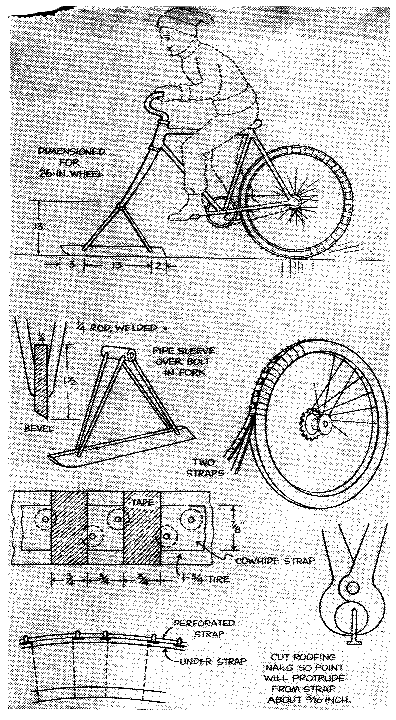
There is only one simple alteration to your bicycle required to assemble this speedy sporster. Simply remove the front wheel and substitute a steel runner with welded legs (your dad’s garage mechanic will probably weld the front runner for you). For the rear tire, obtain two cowhide straps cut to proper lengths and taper the ends for lap joints. Cement the joint after you install the studs in the outer strap.
Studs are galvanized roofing nails cut so that the points protrude from the outer strap about 3/16″ as illustrated. The inner strap protects your tire. Bind into position by taping each pair of slightly staggered points.
Make the front runner from a piece of hardwood such as oak. If you can find a piece of angle iron to fasten to the bottom of the runner, the life of your runner can be extended considerably, and you can enjoy many hours on the ice.
by Hi Sibley
Swedish Iscykel
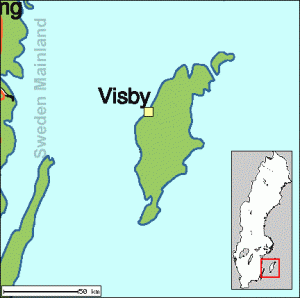 Bjorn B. Setterberg posted to the icebike list that he had seen a “Real” icebike at a Farmers Museum” in the town of Havdhem on the Island of Gotland just west of the Swedish coast in the Baltic.
Gotland is a popular cycling destination, being mostly flat and rich with history. The largest city is Visby on the eastern edge of the island. Frequent ferry service to the Swedish mainland is provided.
As Bjorn described the icebike: “Instead of wheels it had a front skate that you could steer with ordinary steering handles, and at the rear it had also a skate, inside which there was a moving skate that went forwards and backwards as you pedaled it via a chain.
It was used for transportation on frozen lakes.”
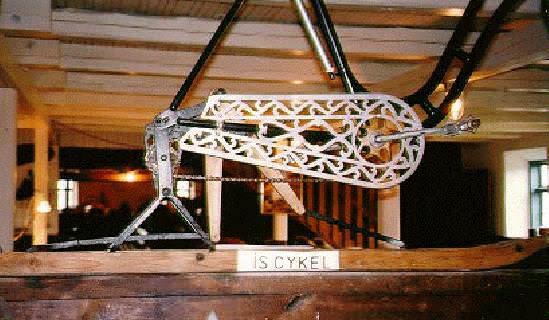 Bjorn was kind enough to take photos of the bike and scan them for the Icebike site.
The first photo shows the Iscykel from the front, showing the front skate, or runner, which appears to be made of iron clad wood. This appears to be loosely coupled to the back runner (detail largely lost in the photo at right), in such a way as to allow the front skate to turn, and at the same time to force the rear skate to follow without inducing stress in the frame.
The front suspension consists of a light wooden “Crutch” like structure which bolts into the existing front fork.
This required fabricating only one part to attach to the front runner. The existing handlebars and steering mechanism remain in place.
Even more interesting than the front structure is the drive mechanism. The rear runner has slot in the center running longitudinally. In this slot there appear to be two independent drive skates or claws that slide fore and aft. These are driven by a linkage system not dissimilar to that found on old railroad steam engines.
The difference is that these linkages are designed to operate at a mechanical disadvantage with regard to power so that they have a Long and Fast “stride”.
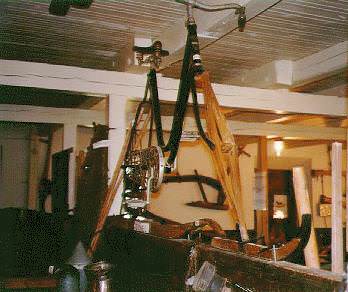
Careful study of the linkage reveals that the builder replicated the structure of a human speed skater. You can see the mechanical equivalent of the thighs and lower leg, the knees, the hips, etc.
The most noticeable difference being that one knee appears to bend backward so that the one of the skates may be placed ahead of the other rather than having them run beside each other. The power strokes are opposed so that there is always one skate in the power stroke (moving rearward) while the other is in recovery (moving forward). This, I speculate, provides easier mounting and less friction.
Compare the above photo to the one below. Note the different position of the “legs”, the leg that is stretched forward in the top photo is as fully to the rear in the second image, on what appears to be 1/8 turn of the crank.
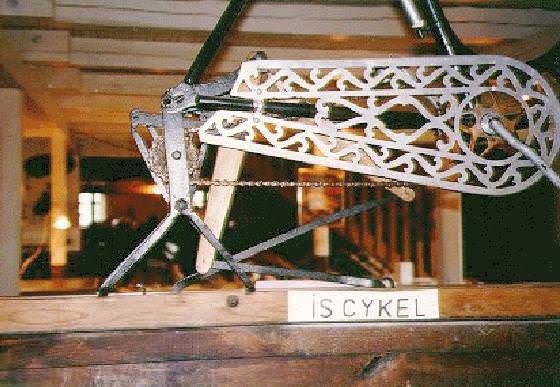
Bjorn was not able to provide shots of the other side of the gear train, so one can only speculate that the “thighs” are driven by a linkage (visible in the photo above just to the rear of the cog set) which in turn are driven (I’m speculating here) by a cam arrangement just inboard of the cog-set on axle.
Although there appear to be multiple cogs on the rear cluster, there is no derailleur, so without dismounting and adjusting the chain, it would appear to be a fixed gear arrangement. One wonders what purpose the frame pump would serve on this device. One wonders about the practicality of the design in general, after all, Bjorn only saw ONE.
Also Read:
- 15 Best Bikes For Heavy Riders
- How To Do Winter Cycling In Ice And Snow- Icebike Tips
- Winter Cycling Techniques For Any Kind Of Snow And Ice
- Real Winter Biking – This Is How You Cycle In Really Cold Weather