
To learn more about ice biking, check out this page. You might also want to check out our guide to winter cycling clothes and winter cycling gear.
There are more than a few products that you may or may not think would work in icebiking applications. Some that do and perhaps some that don’t appear here as various folks on the Icebike list have the time to review items in the winter environment.
Clearly we can’t cover every saddle that works or every summer bike short that does not work in winter. We can offer selective reviews of products that either pass the freeze test (when you might not think them suitable) or fail (when they were marketed for winter cycling), or are new or different or grab our attention.
If it doesn’t fit elsewhere on our site, it might just show up here. It will probably show up here first.
Yukon HL Headlamp
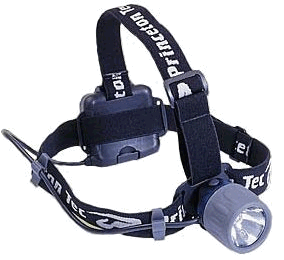 In Oct. I saw an ad for a new Princeton Tec headlamp that had wide dispersion LED’s and a focused beam LED (Yukon HL) which sounded like what I’ve been looking for.
It uses 3 AA’s and has the same strap set up as the Princeton Tec Moonlight LED headlamp. While the battery pack is quite a bit bigger than the Moonlight’s 3 AAA battery pack it will still fit under headgear and stay warm. I’m a little nervous about the latch for the battery pack, it’s stiff and we’ll see how it works at -30F. There is a lifetime warranty and Princeton Tec has already replaced another light I had, no questions.
Mounted on a hinged plate for up and down quick adjustment there is a rubber button on top to activate. One click turns on the 3 high output 5 millimeter LED’s which blow away the 4 LED Moonlight, much brighter and to my eye. Another click turns it off and the next click turns on the 1 watt focused beam LED, another click to turn it off and restart the cycle.
The 1 watt side emitting LED is very bright and unlike another focused LED light I have is white and has a large perimeter of light around the focused spot which is nice. The focused beam is adjustable to a very wide and still surprisingly bright beam.
The 3 LED setting is so bright it will probably be all I need for snow-covered trails and of course will be a good camping-reading-chores all around light. Burn time, 25 – 120 hours, I’m assuming the 25 hours is using the 1 watt. Weight 8 oz. with batteries, it will be a little less with ni-cads instead of alkaline.
Just got in from a 2.5 hour pre dawn ride testing the Yukon HL. It was -20F and the light worked perfectly. The small (3/8 inch) diameter on-off button was just a little stiff but easily operated mitt-gloves. I Still want to see how the switch works at -30F and colder, but working that well at -20F is a good sign.
The 3 high output LED’s are slightly blue, but not as blue as the Black Diamond Moonlight. The 1 watt is very white. I realized right away that the 1 watt focused beam is preferable to three LED setting for biking.
The focused beam threw out a nice spot and at the speeds I ride I usually had it pointed 20-30 feet in front. At that distance the diffused light around the spot just reached the front tire and did a nice job of lighting the surroundings.
There is a little less evenness of light in both settings compared to the Moonlight and a Princeton Tech “Impact” focused beam LED flashlight but not much and still a vast improvement over any incandescent I’ve used.
At the end of the ride I opened the battery case to test the catch which hadn’t inspired confidence when testing the night before. It worked fine.
Again this works for me on highly reflective winter trails and slower speeds than most icebikers probably ride.
by Tony Torti
AirFree Tires
I purchased the AirFree Daytona High Performance because I liked the idea of a flat proof tire that would be durable – something similar to a car tire.
The tires installed great and I took them out for a ride. Although these tires appeared durable and solid, they handled poorly on wet, cold or snowy pavement. They tend to loose their grip and quickly dump the rider! These tires were especially dangerous on ascents and corners.
After numerous spills in the same test run, I sent the tires back to the folks at AirFree. They provided great service and sent an upgraded tire with better traction. The upgrade Daytona HPs were a slight improvement but had similar results. In short, these are fair weather tires and are downright dangerous on anything other than dry pavement.
To the Editor: I would strongly caution against the use of these tires on snow or ice because even after the first fall, and cycling with caution, these tires loose traction so fast you fall hard. On ice, snow, or even rainy conditions a serious accident could result. I found similar results with the GreenTyre brand and sent those tires back also.
by Virginia Kelley
Magura Hydraulic Brakes
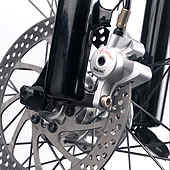 More than a few icebikers have found that Hydraulic brakes solve many of the braking problems so common in winter cycling. Frozen brake cables are common where rain is followed by a sudden cold snap. Hydraulics eliminate this by eliminating the cable and replacing it with a light oil in a tube to actuate the brake pads with hydraulic pressure.
Sounds messy, heavy, and finicky? Guess again! Available as rim-brakes or disk brakes (shown at left) the weight of these units has been minimized, and the reliability is amazing. They have been available for many years and the design is fairly well optimized. Most user report fewer problems that regular brakes.
While more expensive than regular brakes, these systems provide stopping power that is simply unavailable with cables and guides.
While my riding buds were coping with frozen V-brake cables and jammed pivots, my Maguras provided unbeatable winter riding braking. I would highly recommend Maguras for 4 season riding.”
Tektro’s Quartz Series Upgrade Kit
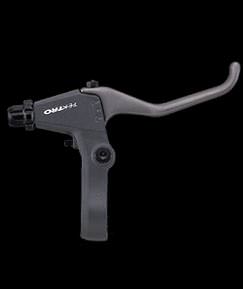 Aside from what “KB” says V-type brakes stop very well and are easy to set up. The problem with upgrading to a V-type brake system is the cost, since new brake levers are required.
Tektro Technology Corporation has come out with an economical solution to this upgrade problem. This solution is called the “Quartz Series Upgrade Kit”.
The kit consists of two 342A V-type levers, front/rear 820AG V-type brakes with Koolstop multi-condition Thinline brake pads and cables. The kit comes packed in a cool looking box and is very complete. Different size brake stud bolts are included, which should handle any variation in mounting studs and or brake bridges.
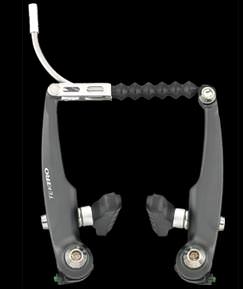 The brakes/levers/cables mounted well and were a breeze to set up. Clearance between the tires (2.1’s front and back) was great and I don’t foresee any clearance problems with suspension forks brake bridges.
I have also tried these brakes with a set of SnowCat rims with great results. All that was needed to do was to remove the brake pad spacers and lengthen the cables (it worked great!).
The brake levers have plenty of room for three fingers or two lobster gloved icebiker fingers. The weight of the system is on par to any other V-type brakes out there and will not be a factor if you switched from cantilevers ;^)
Performance of the Quartz Series kit is great, good modulation, one finger lock ups, and no squealing (I’m in heaven). The only problem is that I wore through the brake pads in a couple of weeks. By chance I had a set Koolstop road pads which I mounted onto the brakes. Low-and-behold, brake performance is on par to the Thinlines and the road pads last longer.
After several months of hard riding, Tektro’s Quartz Series Brakes have held up very well and I would definitely recommend the to the budget rider. The price of the Quartz Series Upgrade kit retails around a wallet friendly $70
by Chris Svirklys
Shimano DX PD-M636 BMX/Downhill/Dual-Slalom Pedals
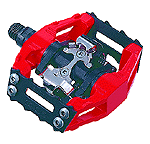 All I can think about when I saw these red SPD pedals was “They must weigh a ton!”
Well, not quite a ton. The M636’s weigh in at around 680 grams a pair. Definitely not for the cross-country set. I used these pedals on my rigid city beater and found them a joy to pedal around town on. Entry was a breeze due to the spring-loaded SPD body. This spring holds the SPD on an angle in relation to the pedal, easing entry.
Release was another issue. I found that if you used an aggressive soled mtb-racing shoe, the shoe threads would inhibit the release action. These pedals work best with a BMX style shoes. Once I got the shoes straighten out I had positive releases.
Mud clearance is very good on these pedals and the large pedal body provides ample traction when you can’t click in. This feature makes these pedals ideal for icebiking, BMXing, etc. The pedal bearings did seem a little tighter then what they should be. It is difficult to say if this will be an issue in the life of the pedal. Of course I will know more about this when it’s time for a pedal rebuild.
Yes, the M636’s are rebuildable (yeah!). The M636’s cost around $70 and you definitely get what you pay for by weight. I would have to give M636’s a rating of “3 pedals” because of this weight. Don’t buy these pedals if you plan to pedal up hills. I am sure with a little creative redesigning the weight of these pedals can be brought down 400 gram mark.
by Chris Svirklys
Parson’s Ammonia
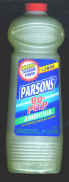 This is a product for iced up brake pads. (Not to mention rear clusters). Winter bicyclists know what it is like to hit the brakes only to find that ice has built up on the pads. Skreeeee! As if you don’t have any brakes at all, you fly right into danger.
Fill a water bottle with Parson’s Bo Peep Ammonia (I like lemon scent. Mmmm!). If your brake pads or other parts, get iced up, squirt the ammonia on them to dissolve the ice. Ammonia has a lower freeze point than water, so it stays liquid even in temperatures below 32 F (0 C). Unlike alcohol, ammonia won’t swell rubber parts like your brake pads and tires, so it is relatively easy on bike parts.
Ammonia will remove most wax finishes, so if you have to use it frequently, be sure to treat your bike to regular coats of wax polish. Don’t mistake it for your normal water bottle when thirsty.
I have experimented since and it works. Household ammonia is mostly water anyway and it will eventually freeze. At around 10 F (-12 C) the household ammonia turns to slush.
But the icing-up problem seems to happen at warmer temperatures (between say 20 F to 32 F) when water and ice get flung up onto the rims, brakes, and chain. I never experience brake freezing at temperatures in teens or lower. Thus, the ammonia rinse works in conditions when it is most often needed.”