
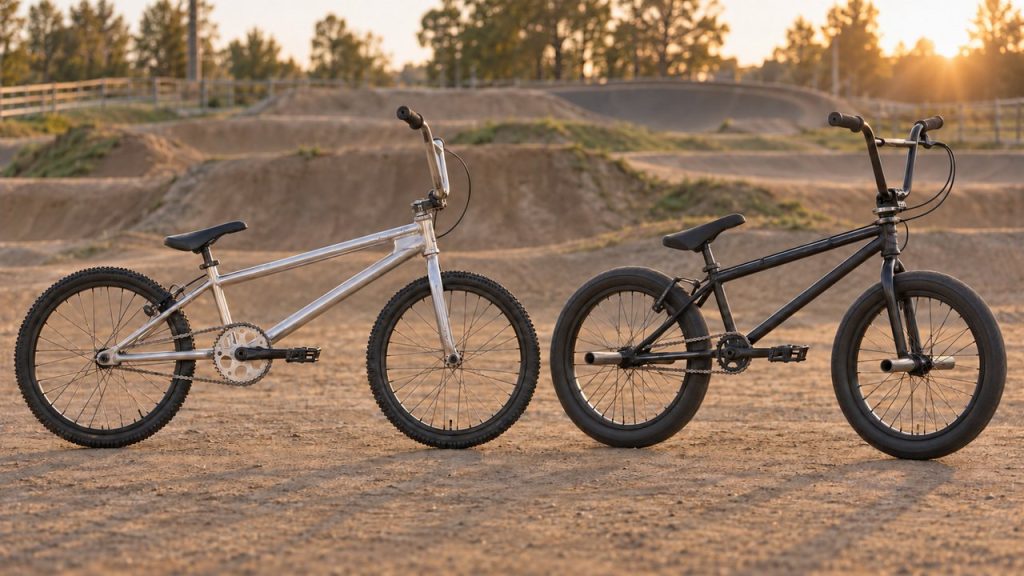
A BMX race bike is a light aluminum sprinter: a long top tube, 1-1/8 to 1.75 in tires, a 36 to 44 tooth chainring and a hand-operated rear brake. Chase’s full-size Edge Pro weighs 20.6 lb without pedals. A trick (freestyle) BMX is a steel bike of 25 to 28 lb complete with 2.3 to 2.5 in tires, a 25T sprocket on a 9T driver, short chainstays and room for pegs and a U-brake. Buy the race bike if you plan to race on a BMX track. Buy the freestyle bike for skateparks, street spots and learning tricks.
If you are unsure, start on a freestyle bike. The USA BMX rulebook lets a Novice race any 20 in or cruiser bike with flat pedals, as long as it has a working brake and the pegs come off.
Race vs freestyle vs dirt jump BMX: spec table
Every figure below comes from the maker’s own spec or geometry page, checked on October 15, 2026. Prices are each maker’s US list price. Weights follow each maker’s own basis: Chase weighs its bikes without pedals, Kink, Cult and Wethepeople list complete bikes, and GT and Haro publish no weights.
| Spec | Race BMX | Freestyle BMX (street and park) | Dirt jump |
|---|---|---|---|
| Built for | Sprinting from the start gate to the finish on a dirt or paved track, in heats of up to eight riders (UCI 6.1.021) | Skateparks, ledges, rails, stairs, flatland | Dirt jump lines, pump tracks, bike parks |
| Example bikes and list price | GT Mach One Pro $360; Haro Race Lite Expert $599.99; GT Speed Series Pro $900; Chase Edge in 9 sizes | Kink Curb $399.99; Sunday Blueprint $459.99; Cult Gateway $469.99; Kink Williams $999.99 | 20 in: Wethepeople Swamp Master (full suspension). 24 and 26 in: GT LaBomba 24 $450, GT LaBomba $475 |
| Frame material | 6061 aluminum on every race complete checked (GT, Chase, Haro). Carbon at the top: the Supercross Vision F1x frame alone lists from $2,399.95 | Hi-ten steel on entry bikes (Kink Curb and Launch, Haro Downtown, Wethepeople Nova). Chromoly front triangle on the Cult Gateway ($469.99); full 4130 chromoly on the Kink Whip ($549.99) and GT Team bikes | 4130 chromoly (Swamp Master); 6061 aluminum (LaBomba) |
| Top tube, full-size 20 in | 20.5 to 22 in (Chase Edge Pro 20.5 in to GT Speed Series Pro XXL 22 in) | 20 to 21.25 in (Kink Curb 20 in to GT Team Conway 21.25 in) | 21.5 in (Swamp Master); 22.2 or 23.2 in on the 26 in LaBomba |
| Chainstay | 13.2 to 15.9 in (GT Speed Series Mini 13.19 in, Pro XXL 15.87 in) | 12.4 to 13.5 in (GT Team Kachinsky 12.44 in, Sunday Blueprint 13.2 to 13.5 in) | 14.1 to 14.8 in (Swamp Master); 14.9 in (LaBomba) |
| Head angle | 73 to 74° | 74.5 to 75.5° | 71° (Swamp Master); 68.5° (LaBomba) |
| Wheels | 20 in; 24 in for the cruiser class. Mini to Expert sizes use narrow 451 mm rims, and the Chase Edge Micro uses 18 in wheels | 20 in (406 mm rims). Kids’ sizes from 12 in; 24, 26 and 29 in “big wheel” versions exist | 20 in (Swamp Master); 24 or 26 in (LaBomba) |
| Spokes | 36 on Pro sizes; 24 or 28 on Mini to Expert sizes | 36 where listed (GT, Sunday, Wethepeople) | 36 (Swamp Master); 32 (LaBomba) |
| Tires | 20 x 1-1/8 to 1.75 in race tread (Kenda Kompact, Vee Rubber Speedster); 24 x 1.75 in on cruisers | 20 x 2.3 to 2.5 in (GT Pool 2.3 in; Kink Sever 2.4 in on the Launch and Whip; Cinema Williams 2.5 in on the Kink Williams) | Maxxis Minion 20 x 2.4 in front, 2.3 in rear (Swamp Master); Kenda 2.10 to 2.25 in (LaBomba) |
| Maximum tire pressure (sidewall rating) | Maxxis Torch race tire: 110 psi at 20 x 1.75 in, 65 psi at 24 x 1.75 in | Cult Dehart and Vans x Cult Wafflecup 2.40 in: 110 psi. Eclat Decoder 2.40 in: 80 psi | Maxxis Minion DHF 20 x 2.4 in: 65 psi |
| Brakes | Rear brake, hand-operated. V-brake on GT Mach One and GT Speed Series Mini to Expert XL. Haro’s Race Lite Expert page lists a Promax V-brake in its specs but calls the bike disc-equipped in its description. Rear disc on GT Speed Series Pro (hydraulic, 140 mm), every Chase Edge (mechanical on Micro and Mini, Shimano hydraulic from Junior up) and Haro Race Lite Expert XL (mechanical, 160 mm) | Rear U-brake on every 20 in complete that names its brake type (Cult 990, Sunday Odyssey Springfield, GT NBS, Wethepeople Eclat Talon and Salt Geo XL); Kink fits its Mission Cease V2. Removable mounts on the models that state them (Kink Downside, Switch and Williams; Cult Control and Devotion; Wethepeople Battleship; GT Team; Haro Dana) | Front and rear disc: 160 mm hydraulic (Swamp Master and LaBomba 24), 160 mm mechanical (LaBomba 26) |
| Gearing | 36/16 (Chase Edge Mini) to 44/16 (GT Speed Series Pro). Cruisers: 39/18 or 41/18 | 25/9 on every 20 in complete that lists both parts | 28/9 (Swamp Master); 28/13 (LaBomba) |
| Gear inches (Icebike estimate) | 53.6 at 44/16 on 20 x 1.75 in | 57.7 at 25/9 on 20 x 2.4 in (54.1 on 20 x 1.75 in) | 64.7 at 28/9 on 20 x 2.4 in; 57.1 at 28/13 on 26 x 2.25 in |
| Crank length | 130 to 180 mm by size (Chase Edge Micro 130 mm, GT Speed Series Pro XL 180 mm) | 160 to 175 mm (Wethepeople Battleship 160 mm, most at 170 mm, Cult Devotion 175 mm) | 175 mm (Swamp Master); 170 mm (LaBomba) |
| Pegs | None. USA BMX bars freestyle pegs from the track | Optional. Kink Downside and Williams ship with 4; Cult Devotion, Haro Dana and Wethepeople Battleship with 2; Kink Curb, Launch and Whip with none | None on the bikes checked |
| Gyro (brake detangler) | No | Sunday Primer Park ships with an Odyssey Gyro G3. Wethepeople CRS and Nova frames have holes for gyro tabs | No |
| Rear hub | 16T cog, on a cassette hub on most bikes (GT Mach One uses a freewheel); 18T on 24 in cruisers | 9T cassette driver, 14 mm axle. Freecoaster on Kink Downside, Kink Williams and Wethepeople Battleship | 9T cassette (Swamp Master); 13T cog (LaBomba) |
| Handlebar | 7.5 in rise x 27 in wide (Chase Edge Pro) to 8.375 x 29 in (GT Speed Series Pro) | 8.5 in rise (GT Slammer) to 9.9 x 30 in (GT Team Conway) | 8 in rise (Swamp Master); 780 mm wide alloy riser (LaBomba) |
| Published weight | Chase Edge Pro 20.6 lb and Chase Edge Pro Cruiser 22 lb, both without pedals | Cult Gateway 25 lb; Kink Launch 26 lb 6 oz; Wethepeople CRS 27.09 lb; Kink Whip 27 lb 13 oz; Wethepeople Battleship 27.94 lb | Wethepeople Swamp Master 30.64 lb |
Gear inches are Icebike’s estimate: gear ratio times the wheel’s outside diameter, using rim size plus twice the tire width from each tire’s ETRTO size.
Brakes: race bikes must have one, freestyle riders choose
UCI article 6.1.077 requires an effective rear brake operated by hand, with the cable secured to the frame. A front brake is allowed but not required. The USA BMX rulebook is looser: it asks for an operating braking system, hand and/or coaster (foot) brake, so a kid’s coaster-brake bike can race at a local track.
Race makers now split by price. GT fits V-brakes to its Mach One and to the Speed Series Mini to Expert XL. Haro’s Race Lite Expert page lists a V-brake in the spec table but describes the bike as having a rear disc, so check the bike in the shop. GT’s Speed Series Pro, Haro’s Race Lite Expert XL and all nine Chase Edge sizes use a rear disc, mechanical on the Chase Micro and Mini and Shimano hydraulic from Junior up.
Every 20 in freestyle complete checked ships with a rear brake, a U-brake on every one that names the type. It mounts under the seat stays, where it stays clear of your feet and the pegs. Some frames state removable brake mounts, including the Kink Downside, Switch and Williams, the Cult Control and Devotion and the Wethepeople Battleship, so on those bikes brakeless is a choice you make after purchase. Keep the brake if you ride on streets with traffic or you are still learning to stop with your foot on the tire.
Gearing: same ratio, different parts
A race bike is not geared much taller than a freestyle bike. GT’s Speed Series Pro runs 44/16, a 2.75 ratio. Every 20 in freestyle complete that lists both parts runs 25/9, a 2.78 ratio. On the same 20 x 1.75 in tire, that works out to about 53.6 and 54.1 gear inches. On the freestyle bike’s fatter 2.4 in tire, the 25/9 bike is the taller of the two at about 57.7 gear inches. Check any combination with the single-speed gear calculator, which has a 20 x 1.75 BMX wheel option.
The race bike gets its speed from about 4 to 7 lb less weight (Chase weighs its race bikes without pedals), narrow tires and a longer wheelbase. Freestyle bikes use a 25T sprocket and 9T driver because the small parts sit higher off the ground, which keeps them off ledges and coping. Race brands also step the chainring with bike size: Chase goes from 36T on the Edge Mini to 43T on the Pro XL, and GT from 38T on the Speed Series Mini to 44T on the Pro.
Frame, weight and geometry
Every race complete in the table uses 6061 aluminum. The Chase Edge Pro weighs 20.6 lb without pedals. Freestyle completes run 25 to 28 lb, with steel frames, 2.3 to 2.5 in tires and 36-spoke wheels.
On freestyle bikes, chromoly buys strength and adds no weight savings at this price. Kink’s hi-ten Curb weighs 27 lb 2 oz at $399.99, and the chromoly Whip weighs 27 lb 13 oz at $549.99. 4130 chromoly is a stronger steel than hi-ten, so frame makers can use thinner tubes for the same job. Skip the upgrade if you ride curbs and small ramps. Pay for it before you start dropping stairs or riding a bowl.
Geometry splits the two as much as material does. GT’s Speed Series Pro has 15.35 in chainstays and a 7.5 in standover. GT’s Team Kachinsky freestyle bike has 12.44 in chainstays and a 9.06 in standover. Long stays keep a race bike stable when you sprint and pump through rollers. Short stays make it easier to lift the front wheel for manuals and spin the bike in the air.
Wheels and tires: two 20 in rim sizes and a 24 in cruiser class
“20 inch” covers two rim standards on race bikes. Chase builds the Edge Mini, Junior and Expert on 451 mm rims with 20 x 1-1/8 or 1-3/8 in tires, and the Expert XL and Pro sizes on 406 mm rims with 1.4 to 1.75 in tires. The two do not swap. A 451 tire will not fit a 406 rim, so check the rim before you buy spare tires for a junior race bike. Freestyle bikes use 406 mm rims.
The cruiser class runs 24 in wheels. UCI article 6.1.074 sets the 20 in class at 57 cm (22.5 in) maximum wheel diameter with the tire inflated, and the cruiser class at 57 to 66.05 cm. USA BMX holds the same 22.5 in line and runs cruiser classes for every age group, from 7 & Under to 66 & Over.
Treat the sidewall number as a ceiling. Maxxis rates its Torch race tire at 110 psi in 20 x 1.75 in, and Cult rates its 2.40 in Dehart tire at 110 psi. Run less than the maximum on loose dirt for grip, and run closer to it if you pinch-flat on hard landings.
Pegs, gyros and freecoasters
Pegs bolt onto the axles for grinds and stalls. Kink’s Curb, Launch and Whip ship without them, and you can add pegs later. A gyro (brake detangler) lets the bars spin 360° without twisting the rear brake cable. Of the completes checked, Sunday’s Primer Park is the one that lists a gyro. A freecoaster hub lets you roll backward without the cranks turning, for fakie tricks on flat ground and ramps. Kink fits one to its $799.99 Downside and $999.99 Williams, and Wethepeople fits one to the Battleship. None of these parts belong on a race bike: USA BMX bars freestyle pegs from the track at any time.
For the full list of trick-bike features, see 8 things that make BMX bikes the perfect trick bikes.
Race rules that shape a race BMX
Two rulebooks apply. USA BMX covers local, state and national racing in the US and Canada. UCI Part 6 covers UCI events, including the World Championships, World Cups and the Olympics, where BMX racing has run since Beijing 2008.
| Rule | USA BMX 2026 rulebook | UCI Part 6, version 01.01.2026 |
|---|---|---|
| Brakes | Operating braking system, hand and/or coaster (foot) brake | Effective rear brake operated by hand; cable secured to the frame; front brake optional (6.1.077) |
| Pegs and accessories | Freestyle pegs not allowed on the track at any time. Kickstands, chain guards and reflector brackets must be removed | No chain guards, side stands, mudguards, frame-mounted reflectors or sharp protruding objects (6.1.073) |
| Axle ends | No more than 1/4 in past the axle nut | No more than 5 mm past the hub nuts (6.1.074) |
| Wheel size | Intermediate, Expert, Girls Expert and Pro: 22.5 in (57 cm) total diameter or less. Cruiser: more than 22.5 in | 20 in class: 57 cm or less. Cruiser 24 in class: 57 to 66.05 cm (6.1.074) |
| Gears | Multi-speed MTB-style bikes allowed, classed by wheel diameter | Multiple-speed gear systems not permitted (6.1.079) |
| Handlebars | 30 in wide maximum; grips must cover the bar ends | 73.7 cm (29 in) wide and 30.5 cm (12 in) rise maximum; grips mandatory (6.1.075) |
| Pedals | Flat pedals only for riders 12 and under and for Novices of any age | Flat pedals only for riders 12 and under; toe clips and straps banned (6.1.079) |
| Number plate | On the front of the handlebars, numbers at least 3 in high | On the front of the handlebars, plastic or similar flexible material (6.1.091) |
| Rider gear | Helmet with a permanent strap; full-face or ear-covering helmet highly recommended; long pants and long sleeves recommended | Full-face helmet with a visor at least 10 cm long (6.1.081); long-sleeved jersey (6.1.082) |
The 2026 UCI Part 6 text has no minimum-weight article for BMX bikes. One example of the gap between the two books: GT’s Team Conway freestyle bike comes with a 30 in wide bar, which passes USA BMX tech but is 1 in over the UCI limit.
Can you race a freestyle BMX?
Yes, at USA BMX tracks. The rulebook lets Novice riders race a 20 in (“class”) or cruiser bike with flat pedals. Before you roll up to the gate, take off the pegs, any kickstand, chain guard and reflector brackets, make sure the brake works, and cut any axle end that sticks out more than 1/4 in past the nut. Add a number plate on the bars.
A freestyle bike gives away about 4 to 7 lb (Chase’s race weights exclude pedals) and rolls on 2.4 in street tires, so expect to lose ground on the first straight to riders on race bikes. Icebike’s advice: if racing sticks, a race bike sized by top tube is your next purchase. For UCI events, the bike also needs a hand-operated rear brake and a bar no wider than 29 in.
Can you do tricks on a race BMX?
You can jump, manual and bunny hop a race bike; the track asks for all three. Pegs, grinds, stair drops and flatland are a different matter. Race makers spec no pegs, build frames from butted aluminum tubes and fit rear hubs with 3/8 in axle bolts (GT, Chase), where freestyle completes use a 14 mm rear axle. Icebike’s view: if tricks are the goal, a $400 to $500 freestyle bike is the better tool than a $690 to $900 GT Speed Series race bike.
Where dirt jump bikes fit
Dirt jumping sits between the two. You can build a 20 in BMX for dirt with a longer top tube of 21 in or more, a rear brake, treaded 2.2 to 2.4 in tires and no pegs. Wethepeople’s Swamp Master takes the idea further with a Manitou Machete J-Unit Comp fork (100 mm travel), a Manitou Mara rear shock, 21.5 in top tube and Maxxis Minion tires, and Wethepeople describes it as built for terrain from bike parks to dirt jumps. It weighs 30.64 lb.
If you are over about 5’10” or come from mountain bikes, Icebike suggests a 24 or 26 in dirt jumper instead. GT’s LaBomba ($475, 26 in) and LaBomba 24 ($450) use aluminum frames, disc brakes and 28/13 gearing. The 26 in bike has a 100 mm RST Dirt-T fork; the 24 uses a Manitou Machete J-Unit. A 20 in dirt bike can race a 20 in class once it meets the brake and peg rules. The 26 in LaBomba fits the USA BMX cruiser rule, which sets no upper wheel limit, but its 26 x 2.25 in tires put it over UCI’s 66.05 cm cruiser cap (Icebike estimate: about 67 cm).
BMX sizing by top tube
BMX brands size bikes by top tube length. Chase says its height charts overlap because arm and leg length change the fit, so two riders of the same height can need different sizes. Use the height ranges below to narrow to two sizes, then pick by top tube.
Race BMX sizes (makers’ own charts, checked October 15, 2026):
| Size | Chase Edge top tube | Chase rider height | GT Speed Series top tube | GT rider height |
|---|---|---|---|---|
| Micro | 16.25 in (18 in wheels) | 3’3″-3’9″ (1.00-1.15 m) | Not sold | 2’0″-4’0″ |
| Mini | 17.25 in | 3’7″-4’1″ (1.10-1.25 m) | 17.5 in | 4’0″-4’4″ |
| Junior | 18.75 in | 4’0″-4’5″ (1.22-1.35 m) | 18.5 in | 4’3″-4’7″ |
| Expert | 19.75 in | 4’4″-4’10” (1.32-1.46 m) | 19.5 in | 4’6″-5’5″ |
| Expert XL | 20 in | 4’9″-5’1″ (1.44-1.55 m) | 20 in | 5’2″-5’6″ |
| Pro | 20.5 in | 5’0″-5’5″ (1.52-1.66 m) | 20.75 in | 5’4″-5’8″ |
| Pro XL | 21 in | 5’5″-5’10” (1.64-1.78 m) | 21.25 in | 5’7″-6’0″ |
| Pro XXL | 21.5 in | 5’9″-6’2″ (1.75-1.87 m) | 22 in | 6’0″-6’5″ |
| Pro cruiser (24 in) | 21.5 in | 5’6″-6’1″ (1.68-1.85 m) | 21.75 in (Pro XL 24) | 5’6″-6’5″ |
Chase heights are rounded to the nearest inch from Chase’s published figures. GT’s heights come from its fit guide. GT’s own product pages give different ranges at most sizes: Mini 4’6″ and under, Junior 4’4″-4’10”, Expert 4’8″-5’4″, Expert XL 5’2″-5’8″ and Pro 5’6″-5’10”.
The two brands disagree by up to 7 in at the same size name: Chase’s Expert tops out at 4’10” and GT’s fit-guide Expert at 5’5″. GT’s Pro top tube is also 0.25 in longer than Chase’s. When you compare brands, compare top tubes and ignore the size names.
Freestyle sizing. Fit Bike Co’s chart puts riders from 4’0″ to 5’4″ on 18 to 20.5 in top tubes, 5’0″ to 5’8″ on 20 to 23 in, 5’6″ to 6’0″ on 20.25 to 23 in and 6’0″ and up on 21 to 23 in. Riders from 5’0″ up can also look at 22 and 26 in wheels on Fit’s chart. Full-size 20 in completes run 20 to 21.25 in. Icebike’s rule of thumb for a 20 in freestyle bike: under 5’4″, 20 to 20.25 in; 5’4″ to 5’10”, 20.5 to 20.75 in; over 5’10”, 21 in or longer. Riders who spin and ride street often go a quarter inch shorter, and dirt riders go longer.
Fit’s chart puts kids from 3’6″ to 4’6″ on 18 in wheels, 3’0″ to 3’8″ on 14 or 16 in, 2’8″ to 3’4″ on 12 or 14 in and 2’0″ to 3’0″ on 12 in. Kink and Cult both sell freestyle bikes from 12 in wheels up, and race brands start at the Micro. Use the kids bike size chart to match height to wheel size, then see the best BMX bikes for kids for current models.
Which BMX should you buy? Decision checklist
- You want to race at your local track: buy a race bike sized by top tube from the table above. Budget pick: GT Mach One Pro, $360, V-brake, 20.75 in top tube.
- You want to try racing before you spend: race your current bike in Novice with the pegs off and a working brake.
- Your child, 3’3″ to 4’7″, wants to race: look at Micro, Mini or Junior race sizes. Check whether the bike uses 18 in, 451 mm or 406 mm wheels before you buy spare tires.
- You are an adult over 5’10” who wants to race: pick a Pro XL or Pro XXL (21 to 22 in top tube), or race the 24 in cruiser class, which USA BMX runs for every age group up to 66 & Over.
- You ride skateparks, ramps and bowls: buy a chromoly freestyle bike with a gyro or room for one. Sunday’s Primer Park ships with a gyro.
- You ride street, ledges and rails: buy a chromoly freestyle bike with pegs or add them; consider a freecoaster if you ride backward.
- You jump dirt most of the time: choose a freestyle frame with a 21 in or longer top tube, keep the rear brake, fit 2.2 to 2.4 in treaded tires and leave the pegs off. If you are tall or ride mountain bikes, look at a 24 or 26 in dirt jumper.
- You want one BMX for everything and have $400 to $500: buy a freestyle complete with a brake. It handles the skatepark and the street, and it can race Novice.
- You ride around town: a freestyle bike’s 2.3 to 2.4 in tires ride smoother on pavement than race tires. Taller riders can look at 26 in cruisers such as the Cult Devotion 26 (V-brakes, 25/10 gearing).
Comparing brands? See the best BMX brands. On a tight budget, start with the best inexpensive BMX bikes.
Sources
- UCI. UCI Cycling Regulations, Part 6: BMX Racing, version on 01.01.2026, articles 6.1.003, 6.1.021, 6.1.073 to 6.1.082 and 6.1.091 (accessed October 15, 2026).
- USA BMX / BMX Canada. 2026 Official Rulebook, revised December 2025: Rider Identification and Apparel and Equipment (Bicycle) sections, cruiser age groups (accessed October 15, 2026).
- UCI. BMX: one sport, two amazing worlds (accessed October 15, 2026).
- GT Bicycles. Speed Series Pro, Mini, Junior, Expert, Expert XL, Pro XL 24, Mach One Pro, Team Kachinsky, Team Conway, Slammer, LaBomba and LaBomba 24: specifications, geometry and fit guide (accessed October 15, 2026).
- Chase Bicycles. Chase Edge Micro to Pro XXL and Pro Cruiser specifications, and sizing guide (accessed October 15, 2026).
- Haro Bikes. Race Lite Expert, Race Lite Expert XL, Downtown 20 and Dana (accessed October 15, 2026).
- Kink BMX. Curb, Launch, Whip, Downside and Williams 2027 specifications and geometry (accessed October 15, 2026).
- Cult. Gateway, Devotion, Devotion 26 cruiser and Dehart tire and Vans x Cult Wafflecup tire (accessed October 15, 2026).
- Sunday Bikes. Blueprint and Primer Park (accessed October 15, 2026).
- Wethepeople. Swamp Master, Battleship, CRS and Nova (accessed October 15, 2026).
- Supercross BMX. Vision F1x carbon race frame (accessed October 15, 2026).
- Fit Bike Co. Bike sizing chart (accessed October 15, 2026).
- Maxxis. Torch and Minion DHF tire specifications (accessed October 15, 2026).
I love freestyle a lot myself – This inspires me to choose the BMX freestyle bike for stunts. I used to freestyle in my college days and it was great fun with my friends and community. I also made road shows on several occasions.
Nice game
Very good article: (1) sound advice; (2) logical; (3) informative; (3) fair; (4) great examples…
All I did was ride my hybrid box on the burms along the railroad tracks in Vallejo Ca. My parents nor I had the cash on hand for that Redline for $300and now that my wife and I have kids, all I want for them is to swim well and ride a decent bmx.
Errata: box –> bmx
Thank you for that article Euan.
Those are crazy BMX Bikes Jumps!
I do accept as true with all the concepts you’ve presented in your post.
They’re very convincing and can certainly work.
Nonetheless, the posts are too brief for
beginners. May just you please lengthen them a little from
next time? Thank you for the post.
The Rampar R10 that was mine and is now shared by my two sons agrees (pretty closely) with your Best BMX of all time. My boys have shown the Rampar more air than I ever did!
Now they’re both looking for more park/stunt-oriented bikes…but it’s hard to figure out the right price vs. quality vs. weight ratio. Any suggestions?
Hi there,I check your blogs named “BMX Racing Bikes vs. BMX Trick Bikes – What Is The Best Choice?” daily.Your writing style is witty, keep up the good work! And you can look our website about powerful love spells.
Hey – that’s my bike! The Raleigh Burner.
Granted it was a good 30 years ago, but it was the best bike on the street 😉
Gary
I just got here to see if i can use a trick bike on a race track and we’ll after reading this article I must say that I am well informed about what to use and where to use it , I know what i want so I’m in the last category.
Thanks for the information , I died laughing at this part in the article ” “Yo, dude, that’s like totally heinous, there’s like so much more to it than that. What about…” ” , there is so many people like that in the world that they forget why they are riding, to just RIDE! AND HAVE FUN !
Again , thanks so much for this article had a few chuckles and have been properly informed for a person who had a basic question!
Keep up the good work!