
What size bike does my child need?
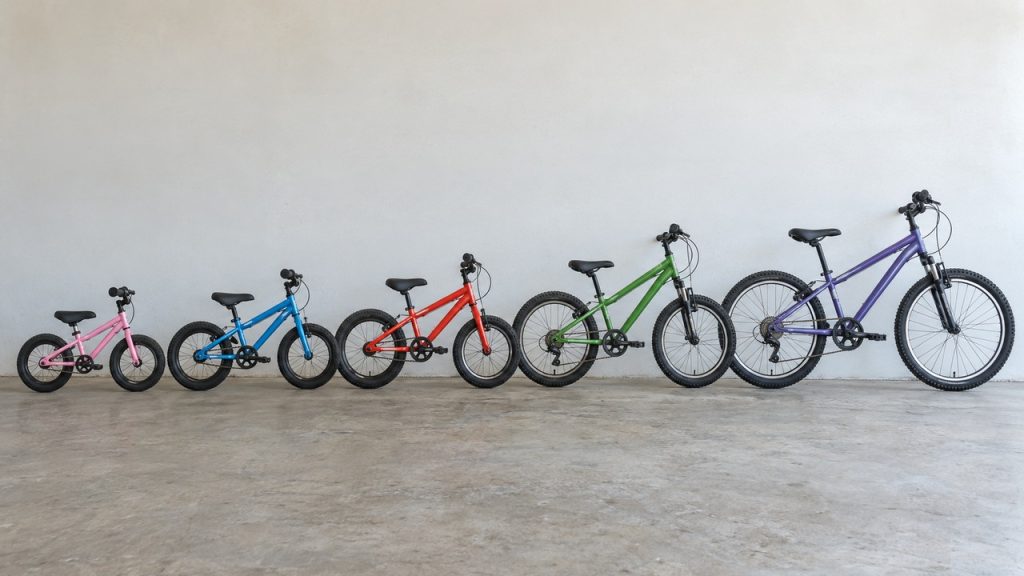
Most children ride a 12 or 14 in wheel at ages 3-4, a 16 in wheel at 4-6, a 20 in wheel at 6-8, a 24 in wheel at 8-11 and a 26 in wheel from about 10. Use height to pick the wheel size and inseam to pick the bike. Trek, woom and Guardian, the makers that publish heights as numbers, disagree by about 2 in of rider height for the same wheel, and Guardian says the lowest seat on two same-size bikes can differ by up to 5 in.
Start with your child’s height in the first chart, then measure the inseam and compare it with the lowest saddle height of the bike you want. A child on a first pedal bike should sit with both feet flat on the ground. A rider who already pedals without help can sit with heels 2-3 in up, per Guardian’s sizing guide. Still on a balance bike? Use our balance bike size chart, which sets the seat 0.5-1 in below the inseam.
Kids bike size chart by wheel size
Each row combines the published charts of Trek, Specialized, woom, Guardian, Prevelo and Cleary, checked October 15, 2026. “Height range (all makers)” shows the full spread from the lowest maker minimum to the highest maximum. “All makers agree” is the height band that every chart with that wheel size includes.
| Wheel size | Height range (all makers) | All makers agree | Inseam range (all makers) | Ages listed |
|---|---|---|---|---|
| 12 in | 33-40 in (84-102 cm) | 34-36 in (86-91 cm) | 15-18 in (38-46 cm), Cleary only | 3-5 |
| 14 in | 37-43 in (94-109 cm) | 37-43 in (94-109 cm) | 14-19 in (36-49 cm) | 3-5 |
| 16 in | 36-47 in (91-119 cm) | 41-46 in (104-117 cm), excluding Specialized | 15.5-25 in (39-64 cm) | 4-6 |
| 20 in | 41-53 in (104-135 cm) | 45-51 in (114-130 cm), excluding Specialized | 18-28 in (46-71 cm) | 5-9 |
| 24 in | 46-59 in (117-150 cm) | 51-55 in (130-140 cm) | 22-32 in (56-82 cm) | 7-12 |
| 26 in | 54-65 in (137-165 cm) | 55-64 in (140-163 cm) | 24.5-37 in (62-95 cm) | 9-14 |
Specialized publishes its heights as a bar chart, so its ranges here are approximate. That chart starts each Riprock size 2-5 in shorter than the other makers do, so it sits outside the agreement band at 16 and 20 in. Some charts list 18 in wheels too. None of the six makers here sells one, so this chart skips that size.
Rider height by wheel size, maker by maker
Trek, woom and Guardian publish height ranges as numbers. Specialized publishes a bar chart, so its ranges are read from the graphic and are approximate to about 1 in. Prevelo and Cleary don’t publish height ranges as numbers, so they appear in the inseam table only.
| Wheel | Trek Precaliber | Specialized (chart, approx.) | woom | Guardian |
|---|---|---|---|---|
| 12 in | 86-102 cm (33.9-40.2 in), ages 3-4 | Riprock 12 Coaster (chart only): about 33-36 in, ages 3-5 | No 12 in pedal bike | No 12 in pedal bike |
| 14 in | No 14 in model | No 14 in model | GO 2: 37-43 in, ages 3-4.5 | 14 in: 37-43 in, ages 3-5 |
| 16 in | 99-117 cm (39.0-46.1 in), ages 4-6 | Riprock 16 Coaster: 36-41 in, ages 5-6 | GO 3: 41-47 in, ages 4-6 | 16 in: 40-46 in, ages 4-6 |
| 20 in | 114-132 cm (44.9-52.0 in), ages 6-8 | Riprock 20: 41-46 in, ages 6-9 (the chart’s Riprock 20 Coaster, same band, is chart only) | GO 4: 45-51 in, ages 6-8 | 20 in Small: 43-51 in, ages 5-8. 20 in Large: 45-53 in, ages 6-9 |
| 24 in | 130-150 cm (51.2-59.1 in), ages 8-12 | Riprock 24: 46-55 in, ages 9-12 | EXPLORE 5: 49-57 in, ages 7-11 | 24 in: 49-57 in, ages 7-11 |
| 26 in | No 26 in model | No 26 in model | EXPLORE 6: 55-65 in, ages 10-14 | 26 in: 54-64 in, ages 10-14 |
Specialized’s chart also shows Jett models: Jett 16 at about 37-48 in, Jett 20 at about 39-55 in and Jett 24 at about 45-62 in. On October 15, 2026, Specialized’s US shop page listed the Hotwalk balance bike, Riprock Coaster 16, Riprock 20, Riprock 24 and Riprock Comp 24. Models marked “chart only” appear on Specialized’s sizing chart but not in that shop listing.
Inseam by wheel size, maker by maker
woom and Prevelo publish inseam ranges. Guardian lists a minimum leg length per bike. Cleary closed its business; the last archived copy of its chart (January 2025) still helps if you buy a used Cleary.
| Wheel | woom | Guardian (minimum) | Prevelo Alpha | Prevelo Zulu | Cleary (archived) |
|---|---|---|---|---|---|
| 12 in | None | None | Alpha Zero is a balance bike | None | Gecko: 15-18 in |
| 14 in | GO 2: 16.0-19.1 in | 15 in | Alpha One: 14-17.5 in | Zulu One: 14-17 in | None |
| 16 in | GO 3: 19.1-25.2 in | 16.25 in | Alpha Two: 15.5-22 in | Zulu Two: 16-22 in | Hedgehog: 17-21 in |
| 20 in | GO 4: 22.1-27.9 in | 18.3 in (Small), 19.5 in (Large) | Alpha Three: 19-23 in | Zulu Three: 20-26 in | Owl: 19-23 in |
| 24 in | EXPLORE 5: 26.4-32.3 in | 22 in | Alpha Four: 23-28 in | Zulu Four: 23-29 in | Meerkat 24: 22-26 in |
| 26 in | EXPLORE 6: 29.5-37.4 in | 24.5 in | Alpha Five: 25-30 in | Zulu Five: 26.5-31 in | Meerkat 26: 25-29 in |
Why the charts disagree
Wheel size names the tire, not the frame. Guardian’s sizing guide says the minimum seat height of two brands’ bikes with the same wheel size “can vary up to 5 inches,” and Guardian itself sells two different 20 in frames. Three patterns show up in the tables above:
- woom’s inseam numbers run high. Its 16 in GO 3 starts at a 19.1 in inseam, while Prevelo’s 16 in Alpha Two starts at 15.5 in and Cleary’s Hedgehog at 17 in.
- Specialized sizes small riders onto bigger wheels. Its chart puts a 42 in child on the Riprock 20. Trek doesn’t list its 20 in bike below 44.9 in.
- Chart minimums sit below the saddle. Every Prevelo pedal bike lists a minimum inseam 0.75 to 3.1 in shorter than its lowest saddle height: the Alpha Two fits from a 15.5 in inseam, but its saddle only drops to 16.9 in. Guardian does the same: its 16 in bike lists a 16.25 in minimum leg length and an 18.5 in lowest seat. A child at the bottom of either range rides on tiptoes. Cleary went the other way and sized its chart so children sit with both feet on the ground.
Use the charts to shortlist two or three bikes, then make the final call with the seat-height check below.
What size bike for a 3- to 12-year-old?
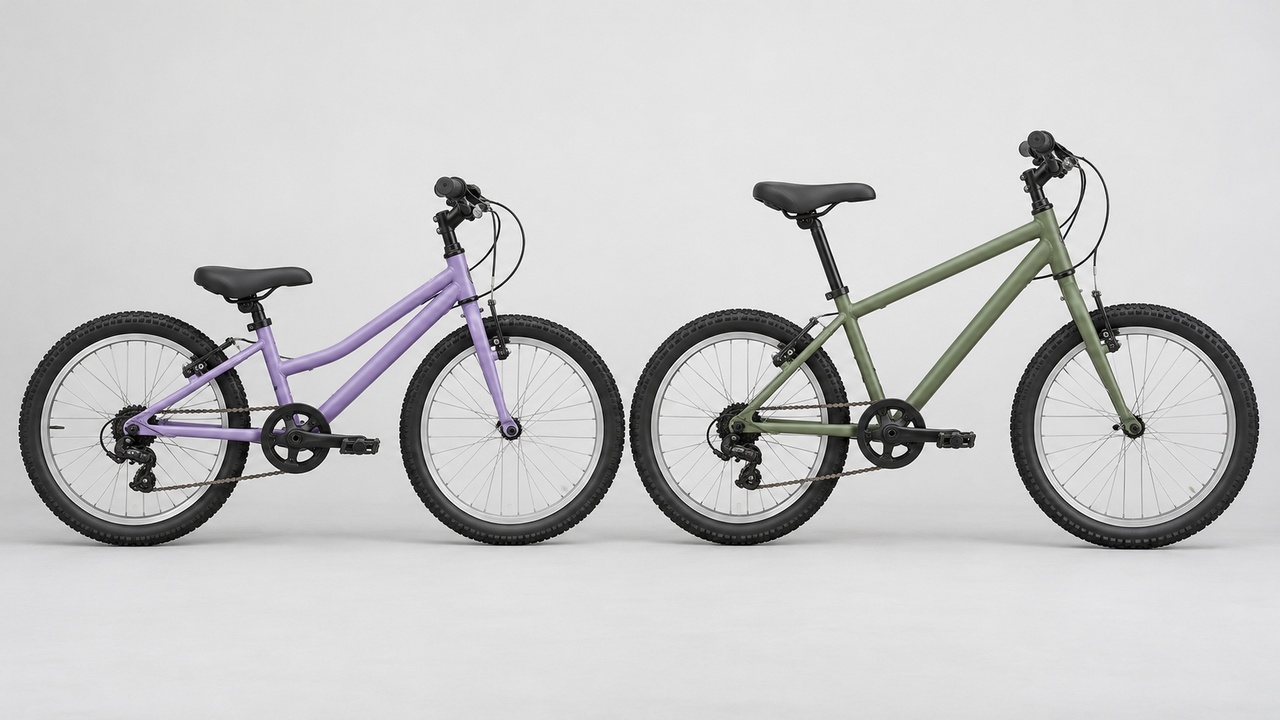
The table lays the CDC’s height range for each age (10th to 90th percentile, at each birthday plus half a month) against each maker’s chart. The wheel sizes are the ones each maker lists for a child of median height. The “Typical pick” column is Icebike’s reading of where the makers converge, not a maker recommendation. Heights come from the CDC 2000 growth charts’ stature-for-age table (statage): 10th, 50th and 90th percentiles at each birthday plus half a month, boys and girls averaged.
| Age | Height, 10th-90th percentile (median) | Trek | Specialized | woom | Guardian | Typical pick |
|---|---|---|---|---|---|---|
| 3 | 35-39 in (37 in) | 12 in | 16 in Coaster (12 in Coaster chart only) | 14 in | 14 in | Balance bike, or 12-14 in |
| 4 | 38-42 in (40 in) | 12 or 16 in | 16 in | 14 in | 14 or 16 in | 14 in |
| 5 | 40-45 in (43 in) | 16 in | 20 in | 14 or 16 in | 14 or 16 in | 16 in |
| 6 | 43-48 in (45 in) | 16 or 20 in | 20 in | 16 or 20 in | 16 or 20 in | 16 in (new rider), 20 in (experienced) |
| 7 | 45-51 in (48 in) | 20 in | 24 in | 20 in | 20 in | 20 in |
| 8 | 48-53 in (50 in) | 20 in | 24 in | 20 or 24 in | 20 or 24 in | 20 in |
| 9 | 50-56 in (53 in) | 24 in | 24 in | 24 in | 20 in Large or 24 in | 24 in |
| 10 | 51-58 in (55 in) | 24 in | 24 in | 24 in | 24 or 26 in | 24 in |
| 11 | 53-60 in (57 in) | 24 in | Jett 24 (chart only) | 24 or 26 in | 24 or 26 in | 24 or 26 in |
| 12 | 56-63 in (59 in) | 24 in (top of range) | Jett 24 (chart only) | 26 in | 26 in | 26 in or an adult XS frame |
Boys’ and girls’ median heights differ by less than 1 in at every age from 3 to 12 in the CDC data, so the same table works for both.
What size bike for a 3-year-old?
A balance bike, or a 12 or 14 in pedal bike for a child who already balances. Median 3-year-olds stand about 37 in tall. Trek lists its 12 in Precaliber from 33.9 in; woom and Guardian start their 14 in bikes at 37 in. Guardian says balance bike graduates can ride a pedal bike without training wheels “as early as 3 years old.”
What size bike for a 4-year-old?
A 14 in bike for most, a 16 in bike for a tall 4-year-old over about 41 in. Trek’s 12 and 16 in ranges meet right at the median height of 40 in, which is where a 14 in wheel from woom, Guardian or Prevelo fills the gap.
What size bike for a 5-year-old?
A 16 in bike. A 5-year-old of median height (43 in) sits inside the 16 in ranges of Trek, woom and Guardian. Specialized’s chart moves a child that tall onto its Riprock 20, a size up from the other three makers.
What size bike for a 6-year-old?
A 16 or 20 in bike, and this is the age where the choice gets close. Median 6-year-olds are 45 in tall, and Trek, woom and Guardian all list both their 16 and 20 in bikes for that height. Pick 16 in for a child learning to pedal and 20 in for a confident rider with an inseam of at least 19 in (22 in for woom’s GO 4).
What size bike for a 7-year-old?
A 20 in bike. At a median height of 48 in, a 7-year-old sits in the middle of every maker’s 20 in range except Specialized’s, which ends at 46 in and moves to the Riprock 24.
What size bike for an 8-year-old?
A 20 in bike, or a 24 in bike once your child passes about 51 in. Trek starts its 24 in Precaliber at 51.2 in, and woom and Guardian start theirs at 49 in.
What size bike for a 9-year-old?
A 24 in bike for most. A median 9-year-old stands about 53 in tall, just past the top of Trek’s 20 in range (52.0 in) and inside every maker’s 24 in range. A 9-year-old under about 51 in still fits a 20 in bike, and Guardian’s 20 in Large runs to 53 in.
What size bike for a 10-year-old?
A 24 in bike. Median 10-year-olds stand 55 in tall, inside the 24 in range of all four height charts. A tall 10-year-old over about 55 in fits woom’s and Guardian’s 26 in bikes.
What size bike for an 11-year-old?
A 24 or 26 in bike. Median 11-year-olds stand about 57 in tall, the top of woom’s and Guardian’s 24 in ranges and inside their 26 in ranges, which start at 55 and 54 in. A child still learning to pedal, or riding trails, does better on the 24 in bike.
What size bike for a 12-year-old?
A 26 in kids’ bike or a small adult frame. A median 12-year-old (59 in) sits at the very top of Trek’s 24 in range, which ends at 59.1 in, and inside woom’s and Guardian’s 26 in ranges. Above about 59 in, compare adult XS frames on our bike size chart by height.
How to measure your child’s inseam
Measure the inseam, not the pant length. Guardian notes that a child’s bike leg length differs from the inseam printed on their pants. woom, Prevelo and Guardian all use the same book method:
- Put on the shoes your child rides in. woom also asks for riding pants.
- Stand your child straight with their back against a wall, feet about shoulder width apart.
- Slide a hardcover book between their legs, spine up, and raise it until it presses into the crotch with about the pressure of a saddle.
- Hold the book level and mark the top of the spine on the wall with a pencil.
- Measure from the floor to the mark.
- Measure twice and use the average. Icebike suggests re-measuring before every new bike: kids grow between birthdays.
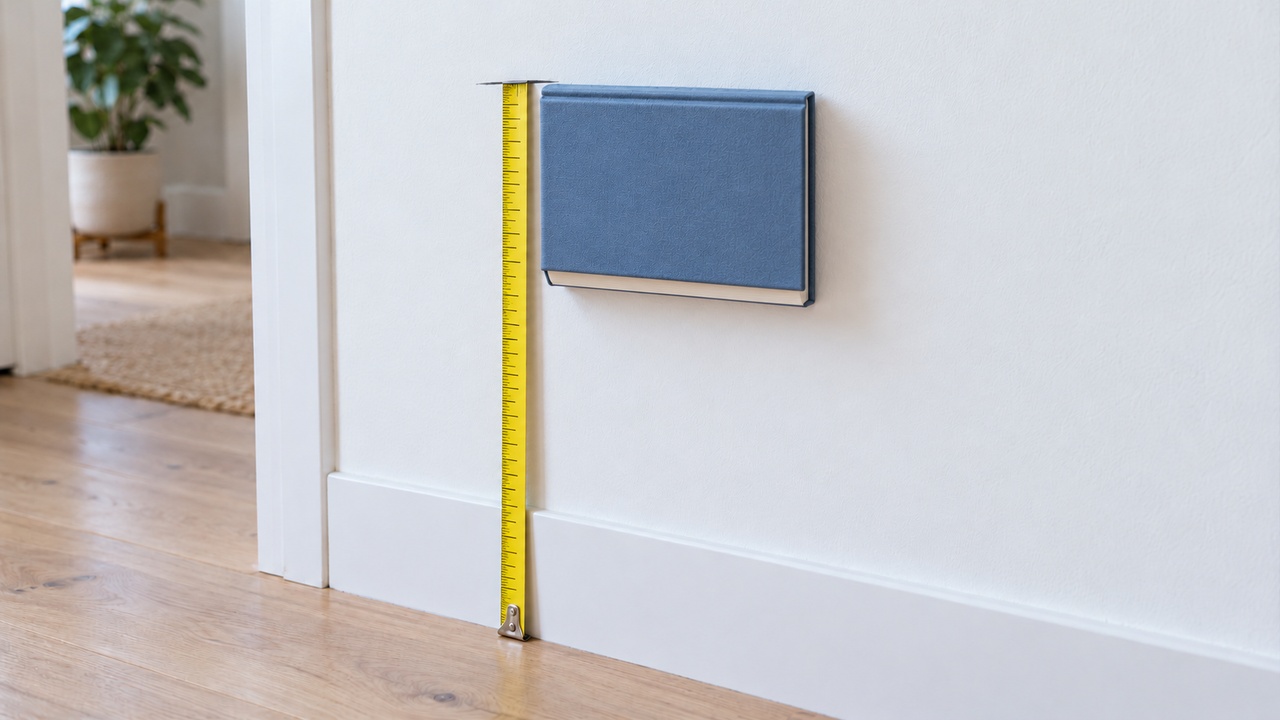
Write down height too. You need height to find the wheel size row and inseam to choose between two bikes in that row.
Seat height check: how high should a kid’s bike seat be?
Compare your child’s inseam with the bike’s lowest saddle height. Guardian’s formula is minimum seat height = inseam + heel lift, where the heel lift depends on experience:
| Rider | Seated, feet on the ground | Lowest seat height should be |
|---|---|---|
| First pedal bike, no balance bike | Both feet flat | At or below the inseam |
| First pedal bike after a balance bike, timid | Both feet flat | At or below the inseam |
| First pedal bike after a balance bike, confident | Heels up to 2 in off the ground | Up to inseam + 2 in |
| Second pedal bike or later | Heels 2-3 in off the ground | Inseam + 2-3 in |
The same Guardian guide also carries an older rule for a first pedal bike: heels 1-2 in off the ground at most, with timid riders closer to 1 in. Both versions put a first-time rider within 2 in of flat feet.
Worked example from Guardian’s own numbers: its 16 in bike has an 18.5-23.5 in seat range, while its product page lists a 16.25 in minimum leg length. A child at that 16.25 in minimum sits with heels 2.25 in up, past Guardian’s own 2 in limit for a first pedal bike. A child with an 18 in inseam on a first pedal bike needs the seat at 18 in, which the bike can’t reach. A confident balance bike graduate with the same inseam can ride it with heels 0.5 in up and has 5 in of seat height left to grow into. Size from the seat range, not the chart minimum.
Guardian also recommends setting the seat “as close to the bike’s minimum seat height as possible” when a child starts on a new bike, then raising it as they grow. Prevelo gives the same direction from the other side: children who are learning are more sensitive to seat height, so err toward the smaller bike.
Watch for the seat post’s minimum insertion mark. If you need to raise the seat past it, the bike is too small.
Standover check: can your child straddle the bike?
Have your child stand over the bike in front of the saddle, both feet flat, and lift the bike by the bars until the top tube touches. Icebike’s rule of thumb, not a maker figure: at least 1 in (2.5 cm) of daylight for path riding and 2 in (5 cm) for dirt and trails. Our kids bike size calculator uses the 2 in figure for its standover target.
Makers publish standover in their geometry charts. Specialized lists 405 mm (15.9 in) for the Riprock Coaster 16, 520 mm (20.5 in) for the Riprock 20 and 593 mm (23.3 in) for the Riprock 24. Compare that number with the inseam, then do the standing test on the real bike. A child who has to tip the bike sideways to put a foot down needs a lower frame.
Many kids’ bikes fail this rule at the bottom of their size range. Specialized’s Riprock Coaster 16 has a 15.9 in standover, but its chart starts the bike at 36 in of rider height, and woom’s chart pairs a 37 in child with an inseam of about 15-16 in. If the seat check passes and your child can stand over the bike with both feet down, the seat check wins. On step-through or low-slung frames, where the top tube sits well below the saddle, skip the standover check.
When to size up and when to size down
Size down for a first pedal bike. woom says that when a child might fit two sizes, it has “often found it’s better to shoot for the stars with the smaller bike,” and it advises against skipping a size even for a confident rider, because a bigger bike also means more weight to handle. Prevelo says a new rider should err toward the smaller bike and an experienced, confident rider can go larger.
| Your child | Pick | Why |
|---|---|---|
| Learning to pedal | Smaller | Feet flat on the ground for starts and stops (Guardian, Prevelo). |
| Timid | Smaller | woom finds a smaller bike easier to maneuver and less intimidating, and a larger one harder to stop and start. |
| Rides trails or rough paths | Smaller | woom notes a too-big bike is “less ideal for off-road riding.” |
| Rides pump tracks or dirt jumps | Smaller | Prevelo says many riders go down a wheel size on its Bravo jump bikes. |
| Confident, rides without help, inseam in the top half of the smaller bike’s range | Larger, if heels sit 2-3 in up at the lowest seat | Better leg extension for longer rides (Guardian). |
| You want the bike to last | Current fit, at the low end of the bike’s range | woom reports that a child who starts at the low end of a bike’s height range fits it for about two years. |
A bike bought to “grow into” fails the seat check today. Guardian tells parents to buy for current fit and warns that a too-large bike makes it harder for a child to build riding skills and confidence.
Bike weight: why it matters more for kids
A child moves a much heavier bike relative to their own body than an adult does. Prevelo explains that a heavy bike is harder for a small child to balance, pedal, turn and pick up after a fall, because the child makes up a smaller share of the bike-plus-rider weight. The table puts makers’ published weights against the CDC median weight for a child near the middle of each size’s age range. Child weights are the 50th percentile of the CDC 2000 weight-for-age table (wtage), boys and girls averaged. The percentages are Icebike’s math.
| Wheel | Child (median weight) | Lightest listed | Heaviest listed | Bike as % of child’s weight |
|---|---|---|---|---|
| 14 in | Age 4 (35.5 lb) | Prevelo Alpha One, 11.3 lb | Guardian 14 in, 16.0 lb | 32-45% |
| 16 in | Age 5 (40.2 lb) | Prevelo Alpha Two, 12.1 lb | Specialized Riprock Coaster 16, 20.1 lb | 30-50% |
| 20 in | Age 7 (50.8 lb) | Prevelo Alpha Three, 16.9 lb | Guardian 20 in Large, 22.9 lb | 33-45% |
| 24 in | Age 9 (63.7 lb) | Prevelo Alpha Four, 19.2 lb | Guardian 24 in, 25.5 lb | 30-40% |
| 26 in | Age 11 (81.0 lb) | Prevelo Alpha Five, 21.5 lb | Guardian 26 in, 26.8 lb | 27-33% |
For comparison, a 30 lb bike comes to 17% of a 180 lb adult’s weight. Makers don’t weigh bikes the same way: Prevelo lists weights without pedals, and woom’s EXPLORE 5 and 6 come fully equipped with a rack and fenders. woom’s 16 in GO 3 weighs 13 lb and its 20 in GO 4 17.2 lb, close to Prevelo.
Icebike’s guidance: between two bikes that both pass the seat check, take the lighter one, and treat a bike over 40% of your child’s weight as a reason to size down or shop again. A child at the light end of the CDC range feels that weight even more.
Kids bike size calculator
Our kids bike size calculator turns height, inseam, age and confidence into a starting wheel size and a standover target of inseam minus 2 in. It picks the wheel from height bands: under 39 in gets 12 in, 39-45 in gets 16 in, 45-51 in gets 20 in, 51-58 in gets 24 in and 58 in or taller gets 26 in. For a new rider within 2 in of the bottom of a band, it drops one size. Otherwise it keeps the size and tells you to start with the saddle at its lowest. A median 5-year-old (43 in) learning to pedal gets a 16 in wheel, the same as the age table above.
The calculator has no 14 in band, so for a child of 37-43 in, check the 14 in bikes in the tables above as well. It treats any inseam under 12 in as 12 in; for a toddler that small, use the balance bike chart.
Kids bike fit checklist

Run through this on the actual bike, with your child in riding shoes and a helmet.
- Height falls inside the maker’s range for this model, not only for the wheel size.
- Inseam measured with the book method in the last month.
- Lowest seat height is at or below the inseam for a first pedal bike, or no more than 2-3 in above it for an experienced rider.
- The seat can rise at least 2 in before the seat post’s minimum insertion mark, so the bike lasts through a growth spurt (Icebike guidance).
- Standing over the bike, feet flat, the top tube clears the crotch by 1 in or more (2 in for trails).
- Seated, knees don’t hit the handlebars when your child turns the bars.
- Your child can squeeze both brake levers hard from the grips. If the bike has a coaster brake, read woom’s case against them in our balance bike size guide.
- Bike weighs no more than about 40% of your child’s weight (Icebike guidance).
- Your child can start, stop and turn in a tight circle without help.
- Helmet fits. Our guide to toddler and youth bike helmets covers sizes and features.
Shopping for a bigger kid? Our 24-inch bike picks cover the most common size for ages 9 to 11, and our guide to measuring bike wheel size helps you identify a used bike’s size.
Sources
- Trek Bicycle. Precaliber kids’ bikes: choosing the right size (accessed October 15, 2026). Height and age ranges for 12, 16, 20 and 24 in wheels.
- Specialized Bicycle Components. Kids’ bikes: Bike Sizing Chart, and spec pages for the Riprock Coaster 16, Riprock 20 and Riprock 24 (accessed October 15, 2026). Height and age chart (graphic), weights, standover heights.
- woom. What Size is Right? and spec pages for the GO 2, GO 3, GO 4, EXPLORE 5 and EXPLORE 6 (accessed October 15, 2026). Inseam and height chart, measuring method, size overlap, skipping a size, ages, weights.
- Guardian Bikes. Kids Bike Sizing Guide and spec pages for the 14 in, 16 in, 20 in Small, 20 in Large, 24 in and 26 in bikes (accessed October 15, 2026). Leg length method, seat height by rider experience, 16 in seat range, ideal height, minimum leg length, ages, weights.
- Prevelo Bikes. Prevelo Kid Bike Sizing and Knowledge Base: Why does a kids’ bike’s weight matter? (accessed October 15, 2026). Inseam ranges, minimum saddle heights, weights without pedals, rider experience guidance.
- Cleary Bikes. Cleary Bikes Suggested Size Chart, Internet Archive copy of January 26, 2025 (accessed October 15, 2026). Inseam ranges. The page carries a “Cleary is closed” banner, and clearybikes.com no longer serves the chart.
- Centers for Disease Control and Prevention, National Center for Health Statistics. CDC Growth Charts Data Files: stature-for-age and weight-for-age percentiles, ages 2 to 20 (accessed October 15, 2026). Heights and weights by age used in the age and weight tables.


This was SUCH a helpful article. After read your article, I can get the right size for my 3 year old little boy. But I think if your child is less than 5, wearing the helmet will affect their head, I mean is cervical spine so be careful. Thanks so much for this article.
How do you think wearing a helmet will affect their head?
If you think the helmet can reshape his head, what do you the concrete will do? Everyone, of every age, should wear a helmet when bicycling. Saved my neighbor’s life.
Helmets are interfering with their vestibular development. I trained my boy like I was trained, like my father was trained; like his father before him and his father before him; like, in fact, every human since the invention of bikes, when it wasn’t considered a life-threatening, permanent-brain-damage-imminent-defcon-1-lethal activity. Once he was fluent in riding the bike (a few days), and if we’re in sight of cops or finger-wagging busybodies (we live in Southern California so this is basically everybody), and because it’s the law (naturally), we don the least offensive helmet we could find. Yes, helmets give bikers a false sense of safety, and make drivers less cautious around them, but a stupid, reactionary, illogical law-which-wasn’t-invoked-due-to-any-particular-uptick-in-brain-injuries is still the law. Considering that brain injuries just from falling down while walking, and from driving, are vastly more common than from falling off a bike, I’m surprised we’re not all forced to wear helmets while walking around and driving. Wait, nevermind. Forget I mentioned it. P.S. My kid has, miraculously, managed to cheat death despite sometimes riding without a helmet. We’re reckless devil-may-care types that way. We’ve preemptively made funeral arrangements and his headstone will read “THEY TOLD US SO.” So, relax.
A really helpful, well written article. Loved James’ response to Paul Nelson’s- hilarious. I sincerely doubt that Mr Nelson’s concern that wearing a bike helmet is going to affect the shape of his kid’s head is warranted – unless children’s helmets are made of cast iron in the US? In the UK we just shove any old flimsy polystyrene lid on and hope for the best..
You’re an idiot, sorry to say. Yea, we all did all of the devilish stunts when we were kids BEFORE people knew better. Same as why we were not vaccinated back then either. Now science, and more common sense has caught on. If you have ever seen a TBI child (traumatic brain injury) you will invest in the safest helmet that you can find. Sure it’s easier to not have one on, but if they learn WITH a helmet and develop the mindset that this is just what you do when you ride a bike, it will be the same as when you ride in a car—when I was a child many cars did not even come with seat belts—that’s how uninformed we were. Now we wouldn’t think of placing a baby on the front seat of the car, or let a toddler hang his head out of the window–because we know better. Get with the times, and keep your children safe.
It hasn’t been suggested that bike helmets should be banned. Holland and Denmark are countries with unusually high levels of everyday cycling, winter and summer, and in both countries few adult cyclists wear a helmet ( or Lycra, for that matter ). Injuries,including head injuries, in Holland and Denmark are at a far lower rate than in those places where helmets are compulsory. This is almost certainly because there is more general acceptance of cycling among car drivers, most of whom will be regularly using a bike themselves. Children in these countries generally do use a helmet, because the chances of a child coming off are considerably greater than for an adult, and they have less road sense. But most adult riders do not, and they ride to work in ordinary clothes. Cycling is not seen primarily as a leisure activity, or a competitive sport, but as a convenient means of getting around the locality.
With regard to motorist behaviour, experiments carried out by British safety organisations have established that overtaking motorists in general give significantly greater clearance to a bike rider wearing a long haired wig than to one wearing a helmet, and that clearances are not affected by the rider wearing hi-vis clothing or otherwise.
By far the greatest cause of fatal injury to cyclists, by the way, is overtaking vehicles turning across their path, and a helmet doesn’t help much in such cases.
None of this says that you shouldn’t wear a helmet if you feel that it helps. It does protect your head in certain kinds of fall, the point being whether that kind of fall is significantly probable for adults riding sensibly. On the other hand it has been well established that those countries which make helmets mandatory experience a marked fall in overall cycling, which in turn leads to its own downsides, worse general health and increased burning of fossil fuels.
Questions for James: Did I read this right?? What F’n driver is going to be LESS concerned about a biker’s safety just because they’re wearing a helmet? What evidence do you have to support this ridiculous assertion? While I might agree with the spirit of your reply that we’re all a little too damn over-sensitive these days, why would you care enough about bike helmets to diatribe about it here, especially if it makes one kid even A LITTLE safer??
If you’re that passionate about it, contact your local representative and help draw up a bill outlawing bike helmets and maybe YOU can be grandfathered out since you come from such a long line of bad-asses. I’m a kid of the 70’s and guarantee I did all of the reckless, devil-may-care, stupid ish you sarcastically reference here. Admittedly, I’d piss myself if my kids did half of the the stuff I and my brother did. But while my brother only had scratches and bruises that have long since healed, I’m left with the reminder of my daredevil days EVERY DAY of my adult life. To this day I have no memory of what happened but I was told that I got tangled with another kid and flipped over my handle bars and landed directly on my dome. I do remember slowly waking up on my back on the asphalt and seeing my brother’s face as the fog cleared. This is some 35 yrs ago and for my efforts I got a concussion, a night in the hospital and a quarter size plug in my head where hair has REFUSED to grow ever since. Maybe not a big deal to someone as hardcore as you…just battle scars, right, tough guy? Point is that it doesn’t always have to be a traumatic brain injury. The law of averages says your kid will fall off a bike at some point in their riding career…and you’re a fool to think falling off a moving bike can be compared to falling while walking (smh). That comparison is just dumb. I don’t care who says what or how it may interfere with their vestibular development, and I hope it never happens to you or yours, but mine will have helmets on at all times for that one time where someone else makes a mistake that may cause my kid to wreck. But hey, If you’re that badd-ass, be a rebel and simply refuse to make your kids wear a helmet. Just save the diatribe on the final line of a post that’s about sizing the right bike for your kid. I don’t think anyone here is interested.
James,
Thanks for your opinion about not wearing a helmet. You sound like a guy that hit his head one too many times on the pavement.
Hugs and Kisses xoxo
Good article on the bikes but for all the parents who read this and are unsure about the risks of their kid wearing a helmet or not, I thought I’d offer a few thoughts in a balanced argument. I grew up riding the bikes in the 70s and fell often. I was a daredevil. It’s almost impossible to tell how much my loss of neurons affected me. I started racing bikes in the 80s and wore helmets then, even when it wasn’t fashionable.
In my 40s, I loaned my bike helmet to my daughter who had grown out of her child-size and needed an adult sized helmet. The following week I went out on my bike, realised I hadn’t bought a new one, couldn’t be bothered to adjust the straps again, so took a chance. A huge tree had fallen down in the forest on a downhill section, round a bend. I saw it at the last moment. I don’t know how long I was knocked out for. Some guy found me there. I was off work with brain damage for a couple of weeks, could hardly stand, remember stuff, even speak fluently. The effects started to reduce after a month. I feel very lucky.
I now have a young daughter again. She has been riding on the back of my bike since about 13 months old. Before that, the spine and neck muscles are too soft. She always has a helmet on (Nutty Kids helmets are super cool). They only weigh 200g. She loves it. It’s comfortable – if it wasn’t, that would be a sign of risk for the vertebrae that supports it. I am more concerned if she falls asleep on the back seat as the neck can go at an angle. Now she’s nearly 2.5yrs, it’s less of an issue.
Don’t cheap out on helmets please parents. And spend some time adjusting the straps so that it fits properly. If the kid falls and the helmet pushes up or comes off, it was a false protection all along. Just chucking on any bit of foam in the expectation you are just fulfilling some compliance obligation (even if it is peer pressure) is negligent behaviour. Kids and adult brains are the same: they are gelatinous organs which are highly vulnerable to the effects of sudden deceleration. All other risks balanced out, a helmet is your best mitigation for brain damage or death.
In addition to being entertaining and well written, JAMES IS RIGHT! His position is NOT simply “I didn’t wear a helmet as a kid, therefore kids don’t need them now.” Children getting head injuries from riding bikes has always been, and still is, almost nonexistent. Personally, from my limited experience riding BMX bikes in the 70s n 80s, I took some bad spills as did everyone, but not once did I or anyone I knew get any type of serious head injury.
James’ point about helmets giving a false sense of security is completely reasonable; there are many other safety deices/features for which there is ample evidence where “safety features” result in less safety. Crosswalks are a perfect example – google it if you don’t believe me – its well known among traffic engineers. There are LOTS of studies that indicate that crosswalks at many types of intersections often INCREASE the likelihood of pedestrians being hit crossing the road. Why? False sense of security, as James said.
This false sense of security effect turns out to be a factor precisely where there is LESS risk. For example, crosswalks at busy intersections do generally reduce accidents. Whereas crosswalks at less busy intersections generally increase accidents. Without getting too much into the weeds here, it has to do with the psychology of having safety devices that fit the risk of the activity. Its entirely unconscious, but people are slightly less careful when they walk in a crosswalk, vs. no crosswalk. Or when they wear a helmet, vs. not wearing a helmet. Its human nature.
I haven’t seen any good data out there, and I doubt there is any, since people at not inclined to challenge a well-intentioned public safety policy… but I suspect helmet requirements for kids riding in parks and neighborhoods has not decreased head injuries, and its entirely possible its increased these injuries.
Not surprisingly, the more that cyclists are exposed to traffic, the more the benefits of helmets will outweigh the negative implications of helmets. I have no doubt that helmets do improve safety for those cyclists who ride regularly on streets at relatively high speeds in and out of traffic. Same thing with mountain biking on steep rough terrain, or high speed motorized bikes – helmets make sense. But an 8 year old riding his bike in his couldesac? Take the helmet off – he/she is as safe or safer, and they’ll probably have a better experience.
Wow. That’s a lot of spew, based on no knowledge whatsoever. Helmets are the single most effective means of avoiding serious head injury when riding any kind of wheeled transport – whether your family has ever benefitted from them, or not.
James. I respect the fact that generations of your family, have been instructed in Bike riding, by the very best. It seems, to me, that the reason so many believe/insist on, Helmets, is because there are so many other people that have not had such exposure to Life’s Instructions. It’s from them that my child’s helmet is meant to protect.
“bicycle‐related head injury is a significant contributor to hospitalisations and death worldwide.” (Ivers, Systematic reviews of bicycle helmet research, 2007) This review included five well conducted case‐control studies and found that helmets provide a 63–88% reduction in the risk of head, brain and severe brain injury for all ages of bicyclists. Helmets were found to provide equal levels of protection for crashes involving motor vehicles (69%) and crashes from all other causes (68%). Furthermore, injuries to the upper and mid facial areas were found to be reduced by 65%, although helmets did not prevent lower facial injuries. The review authors concluded that bicycle helmets are an effective means of preventing head injury.
But you’d know better. So, fuck science.
Seriously?? If your kid is only going to be riding the bike for 1-2 hours at a time, that’s going to screw up their head?
I hope you really don’t believe what you said. If you feel that a helmet will compromise your child’s head, think of what the cement on the sidewalk will do—get with the times and keep your child safe.
Been a cyclist for 40 years(since 3) a helmet has saved my life many times, the helmets of 40 years ago were very different, heavy and some of them made of leather and rubber, I can only tell you if you love your kid, procure he or she wears a helmet when riding a bicycle, you will thank god or who you believe to when he only gets a head ache and bruces. I really hope you never regret not making your child wear a helmet.
I think they are too young to wear the helmet, because their bone still longer soft.
My child wore a Doc band helmet as an infant to fix her head shape, she had to wear it 23 hours a day. Wearing a bike helmet for riding is not going to reshape a 3 year olds head. They will not even fit a Doc band after 18 months.
Totally agree. If a helmet could reshape your head, I don’t want to imagine what sleeping on a hard mattress could do.
are you serious, or just kidding? If a helmet can change the shape of your child’s head, what do you think the asphalt on the street will do?
Wearing their helmet could be the difference between a fractured skull and headache if they fall off at full speed.
Totally agree!
totally agree—then you read that the child “survived” the accident, but don’t know that a lot of them no longer can function normally, sometimes a hard impact can cause them to go blind, or have enough of a brain injury so severe that the never walk, talk or do anything “normal” again. It’s such a sad sight to see a child who was injured in a small enough accident that should’ve just given them a heache end of in a nursing home for the rest of their lives.
Is your kid going to be wearing his helmet 24/7?
No.
Is he/she wearing a custom cranial helmet MEANT to re-shape the skull?
No.
So don’t worry about skull deformities.
Make your kids wear helmets. Teach them good habits when they are young.
… and their bone is very resilient. Having a helmet on their head for the short period of time is NOT going to reshape their head. I’d rather have my child be safe than pound their “soft bone” into the concrete and suffer a life changing event. Where is your thought process? Darn suspect I’d say.
Doctors do use helmets to help re-shape a child’s head when they have severe craniosynostosis which is when one or more of the seams (sutures) in a baby’s skull close before the baby’s brain has fully formed. The brain continues to grow but the child’s skull doesn’t where closed & the head becomes very abnormally shaped and interferes with brain development. Those children wear a helmet CONSTANTLY in order to re-shape the skull (like kids who wear braces to straighten/reshape their bite). Having said that, wearing a helmet for the short periods kids ride their bikes will NOT change the shape of their scull. So put a helmet on your child and quit worrying about that. What you should worry about is how not wearing a helmet puts them at risk for a concussion or a brain bleed or perhaps something far worse. I grew up in the days of no helmets, flew over the handle bars hitting my head, was unconscious and sustained a severe concussion. A traumatic brain injury (TBI) can have lastly consequences (learning disabilities or other medical issues). I was lucky that didn’t happen to me but it could have so it’s better to be safe by putting a helmet on your child than face the alternative and maybe end up saying, “I wish I had…”
If your kid’s helmet is so tight that it creates enough pressure on their head that you are afraid it will reshape it, then you bought them the wrong size helmet.
My son is almost 4 but very tall for his age. Buying his first bike for Christmas so I can’t exactly let him try them all out. On both the height and inseam, my son is on the lowest range number for the 16′. Just worried it will be too big. Any advice?
Really depends on whether he can reach the ground on a 16′ bike (so he can ride and stop safely). If he can do that, I don’t a 16′ bike would be a bad choice.
His height is 43 and his inseam is 18 if that helps.
Great information! Very helpful. I had to chuckle at the last section where in bold it reiterates that kid’s should ALWAYS wear helmets… yet one of the first pics of the family biking along a leaf covered trail- not one of them’s wearing a helmet.
Finger pointing aside, since those pics were clearly promotional, I’m so glad to have this info as our kids are also getting bikes for christmas and won’t be able to get on them until Christmas day.
Good point. Didn’t notice that before (the photos are stock photos).
Be careful when adding aftermarket suspension forks to a bike that didn’t come with them from the factory. Sometimes the head tube angle can become dangerously steep when the suspension is at full compression. This, in very extreme situations can cause a head tube to become compromised, leaving the rider in a bad spot!
Good point. Thanks.
Adding a suspension fork slackens the head tube angle, usually a lot on a bike not meant for a suspension fork (as the frame is built for a shorter fork). When the fork compresses, you will likely not even get back to stock geo. That said, I can’t imagine a situation where I would recommend adding suspension to a bike not designed for it, which rules out virtually all consumer level bikes (as opposed to more boutique/higher end Brand’s and bikes).
As a cycling advocate, and apparently a grammar nut, contact me if you’d like some help with some typos in here.
Thanks for a good article
Very clearly communicated article, thanks for taking the time. So it’s Christmas eve and I just finshed assembling my 8 yr old daughters first full size bike. Its a 20″ Mongoose Byte Girls’ Bike and with an inseam of 24″ im beginning to think maybe i needed to get a bigger bike?
My considerations though, are that:
1. She’s still not learned to actually ride a bike without training wheels, so getting her something she could control and felt comfortable riding was top priority.
2. Ideally i wanted to get a lightweight bike as she is pretty wiry (all legs), basically for the same reason as mentioned above. But my budget was really tight so here we are,
I guess what im asking most is, would it be better to just return this bike for a more appropriate size since every chart i’ve seen says she’s borderline too long for this one, or just stick with the smaller bike as it might appear less intimidating, lighter and easier to handle, or go ahead and get the 24″ inch since apparently it’s the most appropriate size for her going forward? I’m torn
Sounds like the 20″ might soon be too small for your daughter, so maybe it would be a good idea to exchange it for a 24″ so she can keep using the bike for as long as possible (as long as she can ride a 24″ safely, i.e. that a 24″ isn’t too big for her).
Hello I want to buy a bicycle for my sister. She’s 8 years old. I don’t know which bicycles that I should to buy for her. please recommend me to buy it thanks
Really depends on what she wants and what she is going to use it for?
How tall do you think is too tall for a 24″? I’m looking into bikes for my small 11 year old. He’s been riding a 20″ BMX (it’s a pretty long frame), but needs something different as we head into better weather. I’m just trying to figure out how long a 24″ might last him…
Hi, Please help!
My almost 5 years old son been avoiding riding bicycle until now, he have a new bike in the garage (been there over a year! unattached) now he have decided to have a go…
His 12″ bike seams to small and he really have a problem when pedalling. Due to salesman advice the bike is right size for him , he have a good balance skills but if I insist on getting another bike I should get 14″ one.
My question is is it necessary to go size by size on bikes or can we go straight to size 16″ BMX bike? My son is 109cm tall.
Thank you.
It’s not necessary to go size by size, but it’s super important that he can reach the ground properly on a 16′ bike (i.e. that the bike is safe for him to ride on).
Good article. I went and test fit my almost 9 year old on some mountain bikes over the weekend. He is just about 4’8″ with a 25″ inseam. He seemed to be about to outgrow a number of the 24″ bikes. I’m afraid he would outgrow the 24″ bike too soon for it to be worth the money for a decent bike. He tried a 24″ fatbike that fit him really well but with the fat tires it essentially had 26″ diameter wheels and a longer top tube than most 24″ bikes. Any thoughts? Thanks.
I wish there was more support for the 18 inch wheel size. Some manufacturers are really starting to support it. My 7 year old is too small for a 20 inch bike to be not scary for her but her 16 and larger extent her 12 are just too small.
I wish I could find her an inexpensive cruiser at 18 inch wheels
Hi. My husband weighs around 110kgs and was advised to ride a bike. What are the types of bikes which cater to that weight and also durability? Is BMX good for that too? It’s mainly on the road. Thank you.
My daughter just 2 years can I teach her to ride a bike? if can maybe I will chose one small bike for training her.
HI I AM A TWEEN AND I AM TALL 5 FEET 6 INCHES. WHAT BIKE SIZE DO I GET???????????
The worst way to size a child’s bike is by frame size since the frame size will vary from bike to bike meaning the stand over height and distance from saddle to pedal can vary even with bikes of the same wheel size. since i own and run a bike shop i may seem a bit biased but finding a reputable independent bike shop in your area to buy your child’s bike can yield excellent results . Most shops will offer a good choice of models and sizes of bikes that are professionally assembled to offer a safe and easy riding experience and let me tell you most bikes these days more than ever need a a pros touch . not to mention you can usually test drive the bikes outside as they were intended and have the bike setup to your child’s needs especially in regards to saddle height,handlebar reach and brake lever reach .
correction …i meant to say the worst way to buy a child’s bike is by wheel size alone
Thank you for the article. I’m purchasing a bicycle for my three-year old grandson and wanted to make sure I am getting the correct size. Is there any preference on helmets? Is a Target brand okay? What should I look for in a helmet?
Thanks.
I have a very tall 8yr old daughter who, almost overnight, started riding her way-too small bike like a champ. I’m weighing the pros and cons of a mtn bike vs BMX and what wheel size if I go mtn bike. Based on being very tall 8 yr old, I think 24 inch is best except she’s very new to riding.
I’m not considering her type of riding as a factor in which type of bike to get…..daddy has both a mtn bike and BMX-style bike (29’er) bike and I’m leaning toward a BMX for its simplicity, weight, lower stand over height and length of time she can ride it.
Now that I’ve given all the details to help with a recommendation, my question is
Mountain vs BMX and which wheel size for each bike.
Thanks in advance for any advise and RIDE ON!
The major question on 20 inches and up is WHERE your kid is going to (mostly) ride.
For us this has changed what is good general advice significantly.
Where I live the roads are simply too dangerous and the ones that aren’t don’t link up.
We have some cycle paths that suffer the same problems in linking up.
However we are blessed with a local “trail centre”. No cars and in theory no pedestrians either.
We really started when he was almost 6. (Before this his steel ‘bike like object’ was a hindrance to him enjoying whereas he was already doing tricks on a scooter) .. but one day (after seeing older kids at school he wanted a real bike.. so I cut the “ride without stabilisers deal”) – 2 minutes later my wallet felt the first pinch of many.
We got a 6 speed. He barely got on the 20 but it was just safe enough.
We started off on a 10 mile ride (on a flat canal towpath). He decided to cycle back so it became a 20 mile ride. (I’ll add he wasn’t particularly fit … he’s tall for his age)
We then quickly ran out of “safe” …. and started offroad.
For us our local conditions turns a lot on it’s head.
Gears are a must … as soon as possible. Whereas he could have done the towpath on a fixed speed he wouldn’t have averaged the 15 mph he did on his way back but more importantly once we moved offroad he wouldn’t be able to ride 3/4’s of the trails.
He was riding red confidently very quickly… but then suspension quickly became a game changer … as he rode more and more aggressively which drove the move over to a 24er
By this time he was 6 1/2 and 1m22 (4′ and change) but the hire guys at the trail centre let him try out a 24 incher. About 9 months after just getting on a 20 he just got on a 24.
As per the advice in the article…. we went for a bike with Air Forks. (As it happened I found a bike with a decent Frame and Air forks)
This came with cranks that were WAY too long (152mm) …. so initially we used the cranks from his 20 incher.
At this point my wallet started feeling the pinch.
I shortened a set of adult cranks to 140mm (with the right cranks it’s a lot easier than you’d think) and got rid of the front mech.
After this the bike transformed. Off came 3kg of heavy/weak components and due to me having spares forr my own bike and the magic of “used” on eBay and a bit of timing (people selling nearly new 10 speed because they are moving to 11 speed) on went 1kg of better quality components.
Again WHERE we ride had a huge influence.
The local trail centre is great but known for the mix of sticky mud and sand and has lots of roots and 1′ dropoffs… and this had proven a constant issue on his V-brakes.
Adjusting them for hand size leaves a tiny gap that quickly shows up any lack of true in the wheel. Combine that with sand in a sticky mud and it’s a horrible sound.
So not because of performance (the v brakes had all the stopping power needed) but because I was constantly re-truing his wheels to 1mm tolerance I switched to hydraulic disk brakes.
This is another geographical thing… I mention it as it means the wheels and frame need to be ready for disc brakes. An alternative is to add weight and use 36 hole/spoke+ wheels… and/or bigger tires but again down to what you want to use the bike for.
For those interested we ended up losing 2kg (4.4lbs) from the bike and a single 1×10 speed set-up. A 30T ring on the front and a 36/40 on the rear – the 40 being an expander that goes on for real mountains.
Another 1kg +of weight loss would possible for more money…and that would take it to sub 19lbs with a 7lb fork and his 20 incher is still in use as he only rides the 24er on trails.
But the main point here is look to where you expect to ride and the conditions.
If they can safely get on a bigger frame then it might be better for offroad.
For those who may follow on a similar path: For what it’s worth I’d start off with the frame/forks/wheels and upgrade everything in one go. Trail riding is hard on the cheaper components and in 9 months we got through 3 rear mechs and 2 shifters and it would have been cheaper to start off with the stronger (and lighter) components.
Hi Mads,
Firstly, this is probably the best article I have found in regards to bicycles for young children. Very clear and concise information, so thank you very much for taking the time to write it!
My 4 y.o. currently rides a 14″ wheel BMX. Based on his size and in-seam he could possibly ride a 16″ or 20″ bike (this one being slightly big). Three cycle shops I have been to have given three different opinions on the next step of his riding journey – one says get a 16″, another says get a 20″ and the last says if he still can ride his existing bike keep it as long as possible then get a 20″.
I am considering holding off on getting a new bike but want to know if there could be any potential issues if he rides a bike that is starting to get too small for him?
Thanks in advance for your advice.
Very informative article. Thank you!
Which brand is light weight for a 24 inch bike? Can you let me know how to make sure a helmet fits properly?
Hi, i have a concern around choosing the right bike… All articles talk about wheel size and very few on the frame sizes. U fortunately i have to buy a bike online (small city – no bike shops) and i don’t know if a Bmx bike pf 18.5 top tube lenght or 20 inches top tube lenght will be too big. Wheels on both are 20 inches. My son is 6 amd a half, 128 cm, and 56 cm inseam… As we’re buying online it’s difficult to know if it’ll be too big…. Help please ????
My Girl is 6 years old but they are very tall for their age and here are a couple of things which I am not sure so checking here:
1. She needs a bike with training wheels as she is going to ride the bike after almost 2-3 years
2. What size of bike that would suit her best, should I go to nearby store to find this or if you could help
Regards,
Kamy
hi
great article. my daughter is 3, just thinking of getting her a first bike, she looks too big on the radio flyer she has now.
when you say a child’s feet should should be able to straddle the middle of the bike, while feet are flat on the ground, do u mean with the child already on the seat, or off the seat in a stopped position?
thank you
This is so helpful!!! Could you give any recommendations for a decent bmx bike for an 8 year old boy around $250?
Thank you Mads Phikamphon for sharing this article.
My daughter won’t buy wrong bike anymore. Because I had followed your introduction 🙂
Hi, looking for sizing for a cruiser for my 16 year old daughter. She’s a bit tiny for her older sisters 26 inch Raleigh. She’s 4 ft 11 inches, 98 pounds with a 27 inch inseam. Wears only a size 3 shoe. Looks like they make the cruisers in a 20inch, 24 inch and the 26 inch. Which would be best for her? Her sisters Raleigh 26 inch has the large balloon tires so I’m not sure if that is making a difference in her being comfortable on it? Thanks for any help.
hi im 12 and i am a boy who is really into road racing i am about 5 feet tall and my mom and i need help finding a good bike for me to use please answer back
thank you very much in advance
Hi Mads, I would like to thank you for providing this article, it’s given me a great start on what I need to look at to find a bike for my son who loves to ride. Due to my budget, I usually shop for his bike’s at the local pawn shop, which is isn’t always the best fit, but the best I can do because he’s always in need of a new bike.
I’ve been considering a foldable bike for his next birthday, they’re lightweight which from what I’ve read and quite easily adjusted to suit the rider. I’m not certain which would fit him best, I’ve never seen one to know. I’m going with what I’ve been able to find online so far. My son is approx 5′ and continues to grow at a rate I can’t keep up with. He’s never quite managed to master the gears on any his mountain bike’s, which concerns me but he rides what is available and loves it. His safety is my number one priority, so I haven’t a clue where to begin… aside from wearing a helmet and ensuring he can touch the ground.
Yes I’m adamant that everyone wear helmets, especially after being the recipient of head injuries. I grew up hearing ” It’s like riding a bike…” It took me 7 year’s of getting back on, falling more times than I thought possible before I could stay upright for longer than than ten seconds. It’s still hard to balance, hard being an understatement. Riding a bike wasn’t the only thing affected, I’m sure you can tell I’m mentally disabled by what I’ve written here. Writing this has been time consuming, exhausting beyond anything a person who hasn’t very literally lost their mind could begin to imagine. That said, please protect your children, don’t take their life before it begins. I’m astonished by the adults who are debating whether they should have their child wear a helmet while on a bike, scooter, skates, hoover board..! Seriously, where’s the confusion, it should be the law for everyone, even at a young age. It’s every adult’s responsibility to ensure that you set a good example for all children by always wearing a helmet.
I believe helmets should be provided like car seats, so everyone has a helmet to wear while on any wheels. Sadly that’s not available where I live, not yet, but I do my best to provide helmets as well as bike’s which safely function to those who want to ride. In the meantime my son wants for game consoles, but not for time racing around outdoors with his friends who are given both bikes and helmets to enjoy their youth.
I do apologize for the novel I’ve written, but maybe it can open the eye’s of anyone who begins to think twice about the importance of wearing protection. I’m sentenced to an existence, I don’t get live since I lay paralyzed in my mid twenties. I’ve seen the horrific results of a little one out for a quick ride… Extensive head trauma, numerous surgeries, strokes, covered in bandages and casts. Even celebrated his 4th birthday from the comfort of his hospital bed. No person is the exception, anyone is a candidate. I promise that the shape of a persons head is the last thing on their on their mind, after suffering from a traumatic brain injury is focused on why. I wish I could do so much, but I can’t anymore, I don’t know how and if I’m lucky enough to accomplish a task, I’ll most likely will forget within the hour. If that’s what you want for children, you should take a good look at yourself at the very least.
If my personal opinion isn’t welcome here, I’ll understand if this disappears or is redacted to be acceptable.
My question is what are the pros and cons of foldable bikes. Are there any area’s in shopping online for a bike which I should be concerned about. Should a foldable bike be on my list of possibilities, or should I cross those off. I might be able to swing $200 maybe a little more, so where would you recommend I begin.
Hi,
Thank you for this guide, it is very helpful. On the 5th picture, there is a little girl with pink shorts on a pink bike. This bike looks absolutely perfect for my daughter. Is it please possible to know the brand and the model?
Thanks!
What a great article!
My son is 8 years old and almost 5 ft tall and is a stocky kid. He loves riding bikes but it’s been a challenge because he shot up 2 1/2 inches this year and according to your chart, we’re gonna need a bigger bike! Lol. Sounds like a trip to the bike store is necessary if only to get an idea what wheel size he’s ready for! BMX seems like the way to go for him..we really need something sturdy but that is not too complicated since he is still young. Any suggestions?
Thanks!
Molly
Hi I have an 11 year old son who cannot cycle a bike. I want to get one for him that I could take the pedals off of and try to get his balance. He’s 5ft 1″ tall. What would be the best size bike for him in this regard. He wouldn’t cycle up to this point and has now decided he wants to but he’s too big and heavy for me to hold him up until he gets his balance. Any help would be appreciated. I don’t know the measurement of his inside leg.
Read your article, which has lots of helpful info and thanks for that. My almost 5 year old has been using a glide bike for the past 3 years and is doing very well at the balance and steering part. Time to progress to a pedal bike. Went to our local bike store and I was absolutely shocked at the weight of the bikes she tried. Tried a Trek, Cannondale, and a BMX of some sort and they were all much heavier than my own bike. With the training wheels, she did alright but has some learning to do in the pedalling department. I worry that the training wheels will make her focus less on balance and steering but trying to learn to pedal those tanks requires them I think at least at first. Can you recommend any brands that are the lightest weight? I was hoping to just go straight to pedal bike without training wheels.
Absolutely agree about the BMX! At first, I didn’t think this could be the best bike for kids, but the Mongoose BMX totally change my mind.
I purchased it for my 9 year old brother and are very pleased. I would definitely recommend the purchase of this bike
This information was quite useful when I bought my children’s bikes recently. Thank you. (A small request though; proofread and edit. Grammar issues are distracting)
i have a complete noob 14 yo son who of course knows everything – for a first bike i expect 24″ is the go, and from the article, a bmx would be appropriate
any sage advice on this plan ? noting that he will have his own very strong ideas on the subject
Hi ,
My son is going to be 7 years old this month and he has just begun to ride his bike which was kept unattended from a long time now .He is riding the bike pretty well however since he is tall and the bike is not appropriate for him anymore i am planning to gift him a new one on his birthday but i am little scared if it would be a good idea to give him a big bike all of a sudden as he has just started to ride the bike.
Please suggest.
I am looking for bikes for my two 8 yr old boys and this was the most helpful article so far. Wow, great info to take into the store with. Thanks.
Hi, trying to but a bike for my toddler who is 3. This will be his first bike so I’m not sure which one to get. He is 3’2″ and 37lbs. Im thinking 14″, 16″ or balance bike. I showed him pictures of the balance bike and he didn’t like it but when I showed him his favorite characters bike like spiderman, captain America he was super excited. I put that in bc u said they should like the bike. Do u think a regular bike is the best choice to start with or the balance bike? Thanks for any advice.
In my opinion,you should get a balance bike first,then move onto a small bike,had my daughter on the balance bike for a year,and she’s nearly on a small pedal bike at 3 without stabilisers,taught my first daughter without stabilizors too.I don’t really see the point of stabilizors,I think they make learning to ride a bike take much longer.Hope this helps.
Very informative post, it’s very useful and I’m really enjoyable to read. thank for share this with us
Thanks for your best article I must say that you got very interesting content here ,
it useful and helpful before people make decision on that purchase ,
really appreciate thanks for your sharing !!!!!
Awww, man!! I just “purchased” my sons first bike for his 3rd birthday through a rewards program at my work. I cannot return it. I think i bought it too big!!! He is 38″ tall and it is a 16″ bike with training wheels. Im soooo sad! Any ideas or suggestions??
What type a bike would be good for an eight year old boy first time rider? Looking for something light weight and not too big since we live in an apartment. Please help need some guidance on how to choose a bike? Should the bike have training wheels?
Thanks for this very good and worth sharing article.
You are really best. thanks for this.
I definitely enjoyed every bit of it and I have you bookmarked to see new information on your blog. I would like to see more posts like this.
That’s Really Lovely to read first we need to know about bicycle and which bicycle is perfect for our kids
Hello, I want to buy a bicycle for my sister. She’s 12 years old. I don’t know which bicycles that I should buy for her. please recommend me to buy it thanks
Thank you for sharing this article. I would like to see more posts like this.
Great article nice work
Keep it up
Thanks
Regarding the helmet debate; as a swimming coach and PE instructor I teach all my students how to tuck and roll, plus lifesaving skills for in and around water. SO all you who are wagging your fingers in the face of those who enjoy the freedom of cycling and prefer not to use helmets, have you taught your kids how tro fall without hurting themselves? Whether running, walking, skateboarding, cycling etc. the technique is the same. If you haven’t then please get off your high-horses and leave us lesser mortals alone….
I would like to see more posts like this. I definitely enjoyed every bit of it and I have you bookmarked to see new information on your blog.
Most of this article is fine. But the ONLY safety tips are “teach your kid how to be safe” and “make sure they always wear a helmet”?? Gosh, I’m glad you put ten milliseconds of thought into that!
The helmet selling comments are amazing too. One guy claims his helmet has saved his life several times?? Americans ride about fifteen million miles per bike fatality on average. Either this guy is the world record worst bike rider, or he’s full of manure. Wait, let’s check the annual bike fatality count since helmets became so ridiculously popular… Yep, pedestrian deaths actually dropped faster than bike deaths. All those broken helmets don’t show up as fewer deaths. He’s full of manure all right.
Here’s the first problem. Bike riding has NEVER been a big risk for serious head injury. Look up the lists of causes of brain injury and how many injuries from each cause. Bike riding usually doesn’t even make the list, because so many more injuries come from falling around the house, riding in cars, just being a pedestrian and so on. So why scare people into thinking riding a bike is sure to cause brain trauma? Answer: just to sell helmets. And the big effect of this? Kids don’t ride nearly as much as they used to. They don’t like the helmets, and their parents scare them away from the good exercise. You can see it in their bellies.
Here’s the second problem. Its no trouble at all to find families biking with helmets but riding wrong-way on the road. Its even easier to find kids riding after dark with no lights. Or kids zooming into crosswalks in front of cars. Or turning left from the right curb. Or blowing stop signs.
So when a kid rides wrong way into the grille of a 35 mph SUV, what are you going to say at his funeral? “At least he was wearing a helmet”?
Wow… I must say this is a definitive guide. Very helpful information. I bought a balance bike for my 2 years old son and this size guide helped a lot! 🙂
Thanks for shairing.
Thanks for your best article I must say that you got very interesting content here ,
Thank you for this buying guide! Very helpful for a dad to a 2 year old.
This site was… how do I say it? Relevant!!
Finally I have found something that helped me.
Thanks!
Love it
Although I partially disagree to some of the information displayed here, I still think this text is great and there are a lot more to learn from here. Thank for your insightful content. Looking forward for more!
my child is 2years old and has a height of 94cm. should i go for the 12″ or 14″? Any ideas
Excellent Post ! I would like to thank for the efforts you have made in writing this post. Thanks
Nice post. I found so many interesting stuff in your blog especially its discussion. thanks for the post.
The article is really good and informative. Thanks for sharing such a good post with us.
Thanks for sharing such kind of great info related to how we selected bikes for kids according to their age factor, so that they could handle and learn/enjoy easily bike rides. I really appreciate your article and i also share this article with others who don’t know about these guides related to the right choice to pick appropriate and affordable bikes with all ages kids.
I teach all my students how to tuck and roll, plus lifesaving skills for in and around water. SO all you who are wagging your fingers in the face of those who enjoy the freedom of cycling and prefer not to use helmets, have you taught your kids how tro fall without hurting themselves? Whether running, walking, skateboarding, cycling etc. the technique is the same.
Hi there,
Is there a major difference in size between a junior bike with 26inch wheels to a 14 inch frame Ladies bike with 27 inch wheels. For my 12 yr old daughter, she is 5ft 2 inches
Do you go by age or height? my daughter is 8 years old but is 4 ft 5 1/2 in tall, I don’t want to buy to big , as well I don’t want to buy too small.
A 20-inch bike is usually ideal for children because riding this size can be uncomfortable for adults. The size of a bike has a direct effect on the comfort and efficiency of the ride.