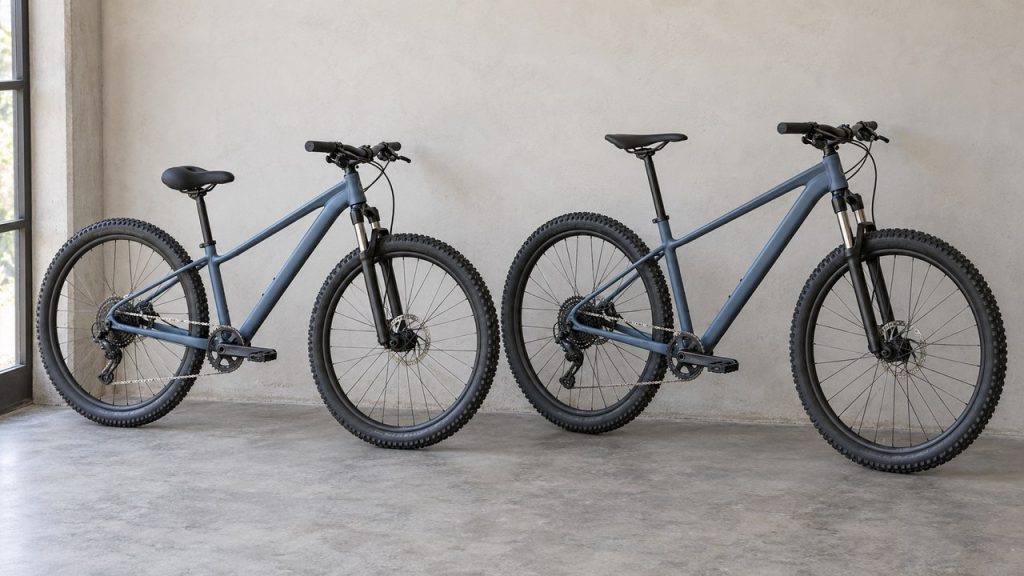
Is there a difference between men’s and women’s bikes?
At most brands today, the frame is the same. What we call a “men’s bike” is usually a unisex bike, and the women’s version, where one exists, changes the parts you touch: the saddle, the handlebar width, the crank length, sometimes the brake levers, plus smaller sizes and different paint. Liv, Giant’s women’s brand, still designs its own women’s frames. Even there, its road and mountain bikes land within 6 mm of Giant’s unisex models in stack and reach at size M. Hybrids are the exception: Liv’s Alight puts the bars 50 mm higher and 45 mm closer than Giant’s Escape.
So a woman can ride a “men’s” bike, a man can ride a women’s bike, and the choice comes down to size and touch points. The numbers below come from the makers’ own spec sheets, checked in October 2026.
What differs: Liv vs Giant, part by part
Liv and Giant belong to the same company and use the same size letters, which makes them a fair test. The table pairs each Liv model with the closest Giant unisex model at the same price level: Avail 3 vs Contend 3 (road), Tempt 2 vs Talon 2 (hardtail mountain) and Alight 3 vs Escape 3 (hybrid).
| Part | What a women’s model usually changes | What the Liv vs Giant specs show |
|---|---|---|
| Frame reach and stack (size M) | Older women’s frames used a shorter top tube and taller front end | Road: 377 vs 378 mm reach, 569 vs 563 mm stack. Mountain: 432 vs 436 mm reach, 602 vs 606 mm stack. Hybrid: 365 vs 410 mm reach, 606 vs 556 mm stack. |
| Standover (size M) | Lower top tube | Road: 744 vs 774 mm. Mountain: 708 vs 709 mm. Hybrid: 749 vs 754 mm. |
| Smallest size | Extra-small sizes added | Liv’s Avail 3 spec list adds an XXS, though Liv publishes no geometry or rider height for it; Giant’s Contend 3 starts at XS. In 2018 Trek’s Domane ALR 4 Disc Women’s started at a 44 cm frame against 50 cm for the men’s version. |
| Saddle | Women’s saddle model | Road: Liv Approach vs Giant Approach. Hybrid: Liv Sport vs Giant ErgoContact. |
| Handlebar width | Narrower bar | Road: 380 vs 400 mm (XS), 400 vs 420 mm (M), 420 vs 440 mm (L). Mountain: same 690 mm (XS) and 750 mm (S, 29 in), then 750 vs 780 mm (M). Hybrid: 600 vs 640 mm (S), 640 mm on both at M. |
| Crank length | Shorter cranks on small sizes | Road: 165 vs 170 mm (XS), 170 vs 172.5 mm (M). Mountain: identical by size (165 mm XS, 170 mm M). Hybrid: 165 vs 170 mm (XS and S), 170 mm on both at M. |
| Brake levers | Short-reach levers | Road: Shimano Claris on both. Hybrid: Shimano EF41 on both. Mountain: the Tempt’s Tektro levers are listed “for small hands”; the Talon uses a different Tektro model. |
| Stem | Shorter stem | Road: 100 mm on both at M by the spec lists, though Liv’s geometry chart gives the Avail 90 mm. Mountain: 50 vs 60 mm at M. Hybrid: 90 vs 75 mm at M, so the Liv stem is longer. |
| Grips | Smaller or shaped grips | Hybrid: Liv Connect Ergo vs Giant Sole-O. Mountain: Giant Sole-O on both. |
| Paint and name | Women’s colors and branding | Liv and Giant use different paint and names on every model. |
Component sizes come from each model’s spec list and frame numbers from its geometry chart. Liv’s and Giant’s own pages sometimes disagree with themselves. The Talon 2 geometry chart prints a 690 mm bar for every size, while its spec list gives 780 mm from size M up. The Avail 3 geometry chart lists a 90 mm stem at M against 100 mm in its spec list, and the Escape 3 chart lists 90 mm against 75 mm. The table uses the spec lists, since they describe the parts on the bike.
On road and mountain bikes, the frame barely moves. The Liv versions change the bar, the cranks on small sizes, the saddle and, on the road bike, 30 mm of standover. On the hybrid, the frame itself changes, and you sit in a different position. Two of the most repeated “women’s bike” features hold up poorly. Short-reach levers appear on one pair of three. Stems point both ways: shorter on the Liv mountain bike, longer on the Liv hybrid, and equal or 10 mm shorter on the road bike, depending on which Liv chart you trust.
Why most brands dropped women’s frames
Through the late 1990s and 2000s, brands built women’s frames on a rule of thumb: women have longer legs and shorter torsos than men of the same height, so they need a shorter top tube. Trek sold its version as WSD (Women’s Specific Design), and Santa Cruz launched “The Juliana” in 1999, according to a 2019 Pinkbike market report.
Fit data did not back the rule. Specialized studied measurements from more than 8,000 Retül bike fits and concluded that body proportions vary as much within a gender as between them. Its Head of Human Performance, Todd Carver, said “there is likely more difference between two male cyclists, than a male and female.” Specialized now designs all its bike platforms for all riders and keeps gender-specific products only where its data shows a difference, such as its women’s saddle and gloves. It also measured the sit bones of 95,000 riders and specs 143 mm and 155 mm saddles across its size range, which it says fit 85% of riders.
Trek reached the same place. When it launched the Domane Women’s line in 2018, Bikerumor reported that the bikes used “the exact same geometry” as the men’s Domane, with different saddles, narrower bars, shorter stems and sometimes shorter cranks. Trek’s line at the time: “a women’s bike is any bike that a woman rides.” Trek’s US women’s bikes page now describes its range as “gender-neutral and women’s models” that differ in touch points such as saddles and handlebars. The first 23 bikes it listed on October 15, 2026 all carried unisex model names.
Who sells women’s bikes today
- Liv says it starts with women’s body data. Its founder, Bonnie Tu, told Pinkbike in 2019 that Liv draws on the PeopleSize anthropometric database and NASA research, and builds “the frame around” women’s bodies instead of tweaking another bike. The table above shows where that leads in 2024-2025 models: near-identical road and mountain frames, a more upright hybrid, and different parts throughout.
- Canyon launched women’s road geometry in 2017 and mountain geometry in 2018, with a higher stack and shorter reach based on body measurements its customers entered when ordering (Pinkbike, 2019). Its US women’s bikes page returned a 404 when we checked in October 2026, so open the current geometry chart of any Canyon you consider.
Two women’s lines built on shared frames have closed. Yeti announced in 2019 that it would end its Beti line with its 2020 models; it told Pinkbike the Beti bikes used its standard frames with different crank lengths, bar widths, grips, saddles and a rear shock tune for lighter riders. Juliana sold women’s mountain bikes on Santa Cruz frames with its own parts and paint, and its brand manager told Pinkbike in 2019, “We don’t believe in women’s specific geometry.” Juliana’s website now says Juliana-branded bikes will no longer be produced.
Where the “ladies’ bike” came from
The split started with clothing and custom. Roger White, a curator at the Smithsonian’s National Museum of American History, says the high-wheel bicycle of the 1880s “became a man’s bicycle because of cultural perceptions.” By the 1890s the safety bicycle, with its diamond frame and equal-size wheels, had become standard, and safety frames made room for skirts.
The Science Museum in London holds an Elswick lady’s bicycle built between 1894 and 1896, with a dropped V-shaped frame “that could be stepped through in a skirt or dress.” The museum estimates that by 1896 a third of orders to British bike makers were for this type. The Smithsonian adds that the cycling craze boosted the “rational clothing” movement, and the most daring women rode in bloomers.
That is why the step-through is still called a “women’s frame.” Today you will find step-through frames on city bikes, e-bikes and cruisers sold to everyone. They suit any rider who wears a skirt or coat, carries a child seat, or has stiff hips or knees.
Can a woman ride a men’s bike?
Yes. Most “men’s” bikes are unisex frames: Specialized designs every platform for all riders, and Trek describes its women’s models by their touch points. Pick the size by your height and inseam, then change the parts that don’t suit you: the saddle first, then the bar width and, on small frames, the crank length. Under about 5’2″ (Icebike’s rule of thumb for where unisex size ranges start to run out), check the smallest size a unisex model offers before you fall for it. Women’s lines often start a size lower, as the XXS in Liv’s Avail 3 spec list and Trek’s 2018 Domane Women’s at 44 cm show.
Skip a unisex bike if the smallest size still puts the bars too far away after a shorter stem. That rider gains the most from a brand that adds sizes at the small end.
Can a man ride a women’s bike?
Yes. Nothing in a women’s frame limits a male rider of the right size. Three things to check: the saddle (a women’s saddle may not fit your sit bones or anatomy, so budget for a swap), the bar width (the Liv Avail’s bar runs 20 mm narrower than the Giant Contend’s in sizes XS, M and L), and the size range. Liv’s Avail and Tempt stop at size L, so a taller man may run out of sizes. A step-through frame works for anyone, and some riders pick one on purpose for city riding.
Are girls’ and boys’ bikes different?
Kids’ bikes are sized by wheel diameter, such as 16, 20 or 24 inches, not by gender. A girls’ model may use a step-through frame or different paint, but the step-through helps any small child get on and off. Choose by your child’s inseam and the bike’s lowest saddle height. Our kids bike size calculator does that match for you.
Which should you buy? A decision list
- You are 5’2″ to about 5’10” with average proportions: buy either. Compare reach and stack on the geometry charts and ignore the label. At size M, the Liv and Giant road and mountain frames above sit within 6 mm in reach and stack.
- You are under about 5’2″: start with brands that offer XXS or XS frames, which often means a women’s line. Our women’s bike size chart lists the rider-height range for each size by bike type.
- You have a short inseam for your height: compare standover. The Liv Avail M stands 30 mm lower than the Giant Contend M.
- You want to sit upright for errands or short rides: look at a city or comfort hybrid, and compare stack. The Alight M sits 50 mm taller at the bars than the Escape M.
- You ride in a skirt, or swing your leg over with difficulty: a step-through frame from any brand.
- You are tall, or a man looking at a women’s model: check that the largest size covers your height first.
- A women’s and a unisex version share the same frame: buy the one with parts that fit you, or the cheaper one, and swap the rest.
- Your only complaint on your current bike is saddle pain: try a different saddle before you shop for a new bike.
Touch-point swap checklist
The height bands in the list above are Icebike’s rules of thumb, read off Liv’s and Giant’s size ranges; check the maker’s chart for the bike you want.
These changes turn a unisex bike into a good fit for most riders, or a women’s bike into a fit for a man. Work through them in order, since each one changes how the next feels.
- Saddle height. Set it before anything else with the bike saddle height calculator, then fine-tune on the bike.
- Saddle shape and width. Measure your sit bones (many shops have a pad for this). Specialized’s sit-bone data shows the 143-155 mm range covers 85% of riders, so most people do not need an extreme width.
- Handlebar width. Trek’s road product manager told Pinkbike in 2019 that a different bar size is “almost more impactful than the frame size.” Ask the shop to swap the bar before you ride the bike home.
- Crank length. Small riders on unisex bikes often get the same cranks as a medium size. Check what your inseam suggests with the crank length calculator.
- Brake lever reach. If you stretch to reach the levers, ask the shop to adjust or swap them. Liv’s purchase price includes a basic fitting that covers shifter and brake lever position, and Giant’s dealers set up its unisex bikes the same way.
- Stem length. If you still reach too far with the saddle set, a shorter stem brings the bar closer without changing the frame.
- Suspension. Lighter riders need a lighter setup. Specialized’s 2016 women’s Camber and Yeti’s Beti bikes used a lighter shock tune on the same frames. On an air-sprung fork or shock, set it for your own weight using the maker’s setup guide.
We list no prices here because part prices change by model and shop. A shop that sells you a new bike will often swap a saddle or bar at the point of sale; ask before you pay.
For frame size by height and inseam across every bike type, use the main bike size chart.
Sources
- Liv Cycling. Avail 3 (2025), Tempt 2 (2025) and Alight 3 (2024) geometry and specifications. Checked October 15, 2026.
- Giant Bicycles. Contend 3 (2025), Talon 2 (2025) and Escape 3 (2024) geometry and specifications. Checked October 15, 2026.
- Liv Cycling. About Liv.
- Specialized. Beyond Gender (English text on Specialized’s China site; the US page now redirects). Retül fit data, sit-bone data and saddle widths.
- Trek Bicycle. Women’s bikes. Checked October 15, 2026.
- Zach Overholt, Bikerumor. Trek adds Domane Women’s line, bikes get WSD touchpoints but standard geometry. January 25, 2018.
- Sarah Lukas, Pinkbike. Where Have All the Women’s Bikes Gone? A Look Inside an Ever-Changing Market. October 14, 2019. Interviews with Specialized, Trek, Yeti, Juliana, Canyon and Liv.
- Aoife Glass, BikeRadar. Unveiled: the new women’s Specialized Camber mountain bike. July 2016.
- Juliana Bicycles. Home page announcement that Juliana-branded bikes will no longer be produced. Checked October 15, 2026.
- Smithsonian Institution. How the 19th-century bicycle craze empowered women and changed fashion.
- Science Museum Group. “Elswick” Lady’s Bicycle, 1894-1896.