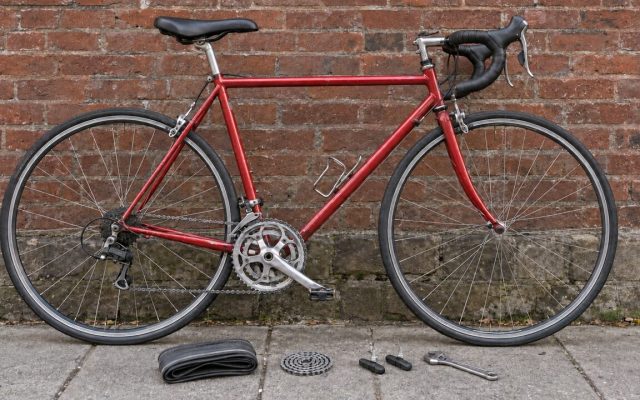
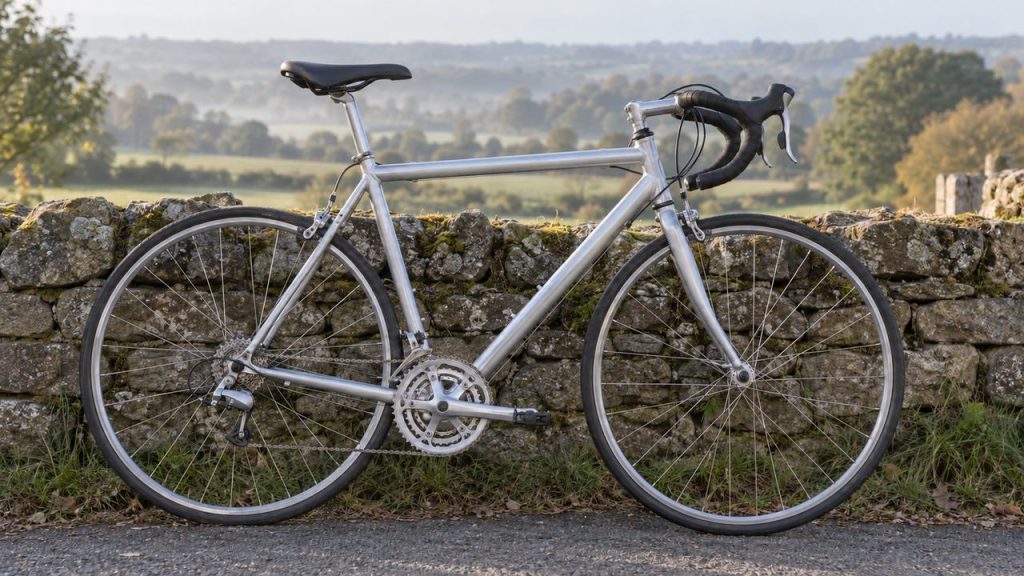
The Trek 1000 is the entry-level aluminum road bike Trek sold in two runs, 1987 to 1992 and 2000 to 2007. A used 1000 is worth buying if the frame, fork and rims pass the checks below and the price leaves money for tires, a chain and cables. Bicycle Blue Book’s used estimate for a 2005 model is $115 to $118, about 18% of its $630 price new.
The 2000s bikes have welded Alpha aluminum frames, Shimano Sora 8-speed shifters built into the brake levers, and 700 x 25c tires. The older ones use bonded (glued) aluminum tubes and 6- or 7-speed gearing, and Trek’s 1987-1991 specs list separate shift levers, mounted on the down tube on the 1987-1989 frames. Those bikes need a different inspection, so start by working out which one you have.
Trek 1000 model years and specs
We built this table from the catalogs and spec manuals in Trek’s own archive. Trek printed no prices in those years, so the list prices come from BikePedia, and the 2006-2008 rows come from BikePedia because Trek’s archive stops at 2005. Trek lists 700 x 25c tires on every 1000 we read except the 1000C (700 x 28c) and the 2005 1000 WSD T (650 x 25c). Skip the table if your bike says 1.2 on the frame: BikePedia lists no 2008 1000 and a 2008 Trek 1.2 at the same 8-speed tier, and the last row covers it.
| Year | Frame and fork | Shifting | Gearing | Weight / price new | Source |
|---|---|---|---|---|---|
| 1987 | Bonded Trek TX aluminum with internal investment-cast lugs; chromoly fork | SunTour New Cyclone 7000 derailleurs, Accushift indexed levers | SR SXC-250 52/42; SunTour 13-24 6-speed freewheel | 21.1 lb | Trek 1987 catalog |
| 1988 | Trek/Alcoa 6061-T6 aluminum, aluminum seat lug; chromoly fork | Shimano Light Action derailleurs, S.I.S. indexed levers | SR 52/42; Shimano 14-28 6-speed freewheel | Not listed | Trek 1988 brochure |
| 1989 | Trek/Alcoa 6061-T6 aluminum, aluminum seat lug; chromoly fork | SunTour Edge, 7-speed Accushift | SR Edge 52/42; SunTour Alpha 13-26 7-speed freewheel | Not listed | Trek 1989 brochure |
| 1990 | Trek/Alcoa 6061-T6 aluminum, aluminum seat lug, dropout eyelets; chromoly fork | SunTour Blaze, 7-speed Accushift Plus | SR Blaze 52/42; SunTour 13-26 7-speed freewheel | Not listed | Trek 1990 brochure |
| 1991 | Bonded Alcoa 6061-T6 aluminum | SunTour Edge, Accushift Plus | 52/42; 13-28 7-speed | Not listed | Trek 1991 spec manual |
| 1992 | Aluminum (the construction line is cut off in Trek’s archived scan) | Shimano 7-speed S.I.S. and HyperGlide | 52/42; 13-28 7-speed | Not listed | Trek 1992 spec manual |
| 1993-1999 | No 1000 in Trek’s 1993 to 1999 spec manuals. Trek’s entry aluminum road bike was the 1100 in 1993, the 1200 in 1994, the 1220 from 1995 to 1998 and the 1200 T in 1999. | ||||
| 2000 (1000 T) | Trek Alpha aluminum; aero chromoly fork; 1 in headset | Shimano Sora STI, 8-speed | Cyclone 52/42/30; SunRace 11-28 | 23.9 lb / $629.99 | Trek 2000 spec manual; price BikePedia |
| 2001 | Alpha aluminum, oversized aero tubes; chromoly aero fork; 1 in headset | Sora STI, 8-speed | Cyclone 52/42/30; SunRace 11-28 | Not listed / $649.99 | Trek 2001 catalog; price BikePedia |
| 2002 (1000 T) | Alpha aluminum with a new round oversized down tube; aluminum fork; 1 1/8 in threadless headset | Sora STI, 8-speed | SR Superbe 52/42/30; SunRace 11-28 | 22.5 lb / $659.99 | Trek 2002 technical manual; price BikePedia |
| 2003 (1000, 1000 Flat Bar) | Alpha aluminum; alloy fork with alloy steerer; 1 1/8 in headset | Sora STI (Shimano 220 on the flat bar) | Suntour Superbe 52/42/30; SRAM 5.0 11-28 | Not listed / $599.99 | Trek 2003 catalog; price BikePedia |
| 2003-2004 (1000 C) | Alpha aluminum; aluminum fork; extra top-mounted brake levers, 700 x 28c tires; 2004 adds a Bontrager Race CX bar (the suspension seatpost was already on the 2003 bike) | Sora STI, 8-speed | 52/42/30 triple | 24.2 lb (2004) | Trek 2003 catalog and 2004 spec manual |
| 2004 (1000 T) | Alpha aluminum; aluminum fork | Sora STI, 8-speed | Bontrager Sport 52/42/30; SRAM PG-850 12-26 | 22.5 lb / $579.99 | Trek 2004 spec manual; price BikePedia |
| 2005 (1000 D, 1000 T) | Alpha SL aluminum; Bontrager carbon fork | Sora STI; Tiagra rear derailleur | 53/39 double (1000 D) or 52/42/30 triple; SRAM PG-850 12-26 | Not listed / $629.99 | Trek 2005 spec manual; price BikePedia |
| 2005 (1000 WSD T) | Alpha SL aluminum; Bontrager carbon fork; 650 x 25c wheels | Sora STI; Tiagra rear derailleur | Bontrager Sport 52/42/30; SRAM PG-850 12-26 | 19.5 lb | Trek 2005 spec manual |
| 2006 | Alpha SL aluminum; Bontrager carbon fork | Sora; Tiagra rear derailleur | Bontrager Sport 52/42/30; 12-26 | Not listed / $689.99 | BikePedia |
| 2007 | Alpha SL aluminum; carbon fork with alloy steerer | Sora STI; Tiagra rear derailleur | Bontrager Sport 52/42/30; 12-26 | Not listed / $679.99 | BikePedia |
| 2008 (Trek 1.2) | Alpha White aluminum; carbon fork with aluminum steerer | Shimano ST-2203, 8-speed | Bontrager Sport 50/39/30; 12-26 | Not listed / $769.99 | BikePedia |
Vintage Trek’s color list includes a 1986 1000, but Trek’s own 1986 brochure and catalog list no 1000 and no aluminum road bike. The 1987 catalog is the first Trek listing we found.
Bicycle Blue Book lists a “1993 Trek 1000” at $699 new, with bonded Easton ProGram tubing, a Tange chromoly fork and a Shimano RX100 32/42/52 triple. Trek built no 1000 that year. Those parts match the Trek 1100: Trek’s 1992 manual lists the 1100 with bonded Easton E9 ProGram tubing, a Tange cro-moly fork and a 32/42/52 Shimano 7-speed group, and the 1100 appears again in Trek’s 1993 manual.
How to tell which Trek 1000 you have
- Lugs at the joints: a bonded 1987-1992 frame. Trek’s 1987 catalog calls the 1000 “bonded” with internal investment castings, its 1988-1990 specs list an aluminum seat lug, and its 1991 manual reads “Bonded/Alcoa 6061-T6”. A screw-on freewheel (SunTour or Shimano) points to 1987-1990.
- Brake levers that also shift (Sora STI) and a chromoly fork: 2000 or 2001.
- Aluminum fork and a threadless stem: 2002 to 2004.
- Carbon fork and “Alpha SL” on the frame: 2005 to 2007.
- Small 650c wheels: the 2005 1000 WSD T, Trek’s women’s version. It explains listings that describe a Trek 1000 with “26 inch” wheels.
- Flat bar, top-mounted brake levers or 28 mm tires from the factory: a 1000C or a 1000 Flat Bar, Trek’s upright versions.
If the decals are gone, the crank, cassette and fork narrow a bike to a two- or three-year window in the table. The serial number under the bottom bracket shell settles it.

How much does a Trek 1000 weigh?
Between 19.5 and 24.2 lb, depending on the year and version, from the weights Trek printed:
- 1987 1000: 21.1 lb
- 2000 1000 T: 23.9 lb
- 2002 and 2004 1000 T: 22.5 lb
- 2004 1000 C: 24.2 lb
- 2005 1000 WSD T: 19.5 lb
Trek did not say which frame size it weighed. Expect a big frame to weigh a little more.
What size Trek 1000 do I need?
Trek’s 2004 spec manual gives a rider height for each 1000 T frame size. The 2000s bikes ran from 43 cm up to 60-63 cm, so this 2004 chart is a fair starting point for other years from 2000 to 2007, but it is exact only for 2004 frames.
| Frame size | 43 cm | 50 cm | 52 cm | 54 cm | 56 cm | 58 cm | 60 cm | 63 cm |
|---|---|---|---|---|---|---|---|---|
| Rider height, in | 65.2 | 67.3 | 68.4 | 70.3 | 71.4 | 73.3 | 75.6 | 77.7 |
| Rider height, cm | 166 | 171 | 174 | 179 | 181 | 186 | 192 | 197 |
The bonded bikes came in 50-60 cm (1987), 50-62 cm (1988-1989) and 47-62 cm (1990-1992) frames. Stand over the top tube with your feet flat; you want a little clearance.
What is a Trek 1000 SL?
None of Trek’s U.S. spec manuals and catalogs we read, from 1987 to 2005, lists a model called the 1000 SL, and neither do BikePedia or Vintage Trek. Trek built the 2005-2007 frames from “Alpha SL” aluminum, and owners and sellers often call those bikes the 1000 SL. Treat a U.S. listing titled “Trek 1000 SL” as a 2005-2007 1000 and confirm with the carbon fork. Trek may have used the name on bikes sold outside the U.S.
What does “Alpha” mean on a Trek 1000?
Alpha is Trek’s name for its aluminum road tubing from 2000 on. “Alpha frames are aluminum,” Trek’s 2002 technical manual says. The same manual lists two bottle mounts on every size except the 43 cm and rack and fender eyelets on the rear dropouts, which makes a 2000s 1000 a fair commuter. The search terms “Trek Alpha 1000” and “Trek 1000 Alpha series” all point to the 2000-2007 bikes.

Is a used Trek 1000 worth buying?
Yes, for commuting, fitness riding and learning road riding, if it fits you and costs well under a new bike. A 2004 1000 T weighed 22.5 lb in Trek’s spec manual. Trek lists the least expensive model in its Domane AL Gen 4 line, the Domane AL 2, at 22.82 lb in a 56 cm frame and $1,199.99 (October 2026). For the same weight, the 1000 costs about a tenth as much.
The 1000 gives up three things to a new bike: rim brakes that stop worse in the wet, 25 mm tires where the Domane AL 2 ships with 32 mm, and gearing that tops out at 8 speeds. The double-chainring 1000 D has a lowest gear of 40 gear inches in Trek’s chart, a hard climb for a new rider. The triples go down to 28-31 gear inches.
Skip it if you want to race, ride steep climbs on a double, or want tires wider than the 28 mm Trek fitted to the 1000C. Skip a bonded 1987-1992 frame if you have no way to check the joints, or if you want modern shifting: those bikes use 6- and 7-speed rear hubs and down-tube or separate shift levers, so newer gearing means a new wheel and shifters. Our used road bike buying guide covers sizing and the test ride.
What is a Trek 1000 worth?
About 18% of its price new, for a rideable bike. The 2000-2007 bikes listed at $579.99 to $689.99 new. Bicycle Blue Book’s previous used estimate for a 2005 1000 ($630 new) was $115 to $118 when we checked on October 14, 2026.
Use this method to price one:
- Date the bike with the table above and find its price new. For a bonded 1987-1992 bike, Trek printed no price; use Bicycle Blue Book’s “1993 Trek 1000” entry ($129 to $133 used, $699 new) as the nearest sales-data anchor. It describes an 1100, the next model up, so treat it as a ceiling for a 1000 of that era.
- Run it through the calculator below. For a $630 bike nine or more years old in good condition, it returns about $113, with a range of $93 to $134. The calculator stops depreciating at 18% of the original price from year nine on, which is why it lands near Bicycle Blue Book. Ignore the calculator’s 1-, 3- and 5-year table; it does not apply to a bike this old.
- Price every part the bike needs at your local shop (tires, chain, cassette, cables, bar tape, brake pads) and subtract the total.
- Add value only for parts a buyer will pay for, like newer wheels or fresh tires.
Bike Resale Value Calculator
Estimate a used-bike asking range from original price, age, bike type, and condition.
A bike that a shop has already serviced is worth the estimate plus the parts and labor it received, not more. A bonded bike with corroded joints is worth only its parts.
Walk away if the asking price is more than the estimate plus the parts and labor the bike still needs.
Used Trek 1000 inspection checklist
Take a rag, a flashlight, a chain checker and a tape measure. Check the frame and fork first, since a bad frame ends the sale. Everything after that is a cost to subtract.
- Bonded joints (1987-1992). Clean each spot where a tube enters a lug. A gap, a dark line or white powder (aluminum corrosion) at the edge of a lug means the bond may be failing. Walk away.
- Welds (2000-2007). Shine a light on the welds at the head tube, the bottom bracket, the seat cluster and the rear dropouts. A hairline crack that crosses a weld or runs along a tube ends the sale. Paint chips do not.
- Fork. Chromoly forks (1987-2001) can bend in a crash; sight down the blades and check that the wheel sits centered. Do not buy a bent aluminum fork (2002-2004) on the promise of a straightening job. On a carbon fork (2005-2007), look for cracks or deep gouges at the crown and dropouts.
- Headset. Squeeze the front brake and rock the bike forward and back. A knock means a loose or worn headset. The 2000-2001 bikes use a 1 in headset; 2002 and later use 1 1/8 in threadless.
- Chain. Measure it with a chain checker. Park Tool says to replace chains on 10-speed and lower drivetrains by 0.75% wear, and every Trek 1000 is 8-speed or lower. At 0.75% or more, expect to buy a cassette too, because a new chain often skips on worn cogs. Our chain wear estimator predicts when the next chain will need checking from your miles and weather.
- Rear spacing. Measure the gap between the rear dropouts. Trek’s 2000 spec manual lists a 130 mm hub on the 8-speed 1000 T, and Sheldon Brown notes that 6- and 7-speed hubs generally use 126 mm. He also says a 126 mm frame that is “aluminum, carbon fiber or held together by glue” should not be spread, which rules out cold-setting a bonded 1000 to fit a newer wheel.
- Rims. Rim brakes wear the braking surface. Run a fingertip across it; a concave surface means the rim is near the end of its life. Spin each wheel and watch the gap to the brake pads for wobble.
- Brakes. Pads go hard with age. Squeeze each lever; it should stop well short of the bar.
- Shifting. On a stand or with the rear wheel lifted, shift through every gear in both directions. If a lever still will not click into every gear after new cables, price a replacement shifter.
- Size. Check the frame against the size chart above before you ride it.
Skip the rest of the list once the frame or fork fails. No price on parts fixes a cracked weld or a failing bond.

Trek 1000 upgrades: what is worth the money
Spend on parts you touch and parts that wear: tires, chain, cassette, brake pads and contact points. Stop before the total passes about half the $1,199.99 price of a new Domane AL 2. Past that line, the new bike gives you disc brakes, 32 mm tires and a warranty.
| Upgrade | Worth it? | Why | Check first |
|---|---|---|---|
| Fresh 28 mm tires | Yes, if they fit | A wider tire at lower pressure rides softer. Trek fitted 700 x 28c to the 2003 and 2004 1000C. | Space at the brake caliper, fork crown and chainstays |
| Chain and cassette | Yes, once the chain reaches 0.75% | Shimano still makes 8-speed parts. Trek’s current Domane AL 2 uses an 8-speed Shimano HG31 11-32 cassette. | Count the cogs; 1987-1990 bikes need a 6- or 7-speed freewheel |
| Brake pads | Yes | Old pads harden; fresh pads restore stopping power | The 2004 1000 T shipped with cartridge pads |
| Clipless pedals | Yes, if you ride often | Trek’s specs list toe clips and straps on the 1000 in every year we read | Your shoes |
| Saddle and bar tape | Yes, if they hurt | You feel both on every ride | Saddle height before you replace the saddle |
| Bigger rear cog for lower gears | Sometimes | The double 1000 D bottoms out at 40 gear inches | Your rear derailleur’s largest cog. Trek ran a Sora GS derailleur with an 11-28 on the 2000 and 2002 1000 T. |
| 9-speed conversion | Rarely | New shifters, chain and cassette for one more gear | Price the shifters first; they are most of the bill |
| 11- or 12-speed conversion | No | Needs a new rear wheel or freehub, shifters and derailleurs | Price the parts against a new bike |
| Carbon wheels | No | They cost more than the bike is worth | None |
| Disc brakes | Not possible | Every 1000 has rim brakes and no disc mounts | None |
Check the fit before you buy wider tires; measure the tightest gap and enter it in our tire clearance checker with the width you want. Trek’s 1988 and 1989 brochures list the original Matrix CD-2 700 x 25c tires at 100 psi. Set a new pair by rider weight with the road bike tire pressure guide instead.
Lowest gear by Trek 1000 version
Gear inches show how hard a gear feels: a lower number is easier to climb in. Trek printed gear charts for 1991, 1992, 2000, 2002, 2004 and 2005. We calculated the others on the same basis, and the table marks them.
| Version | Lowest gear | Gear inches |
|---|---|---|
| 1987 | 42 x 24 | 46 (our math) |
| 1988 | 42 x 28 | 40 (our math) |
| 1989-1990 | 42 x 26 | 43 (our math) |
| 1991-1992 | 42 x 28 | 41 (Trek chart) |
| 2000-2003 triple | 30 x 28 | 28-29 (Trek 2000 and 2002 charts) |
| 2004-2007 triple | 30 x 26 | 31 (Trek chart) |
| 2005 1000 D double | 39 x 26 | 40 (Trek chart) |
| Domane AL 2 Gen 4 | 34 x 32 | 28 (our math) |
Try a different cog or chainring in our gear ratio calculator before you buy parts. Skip the gearing change if you ride flat roads; the original range covers them.
Trek 1000 vs the Domane AL 2: the closest current Trek
Trek does not sell a direct replacement for the 1000. The Domane AL 2 Gen 4 fills the same slot: the entry model of Trek’s aluminum Domane line, still with an 8-speed Shimano drivetrain.
| Trek 1000 (2004-2005) | Domane AL 2 Gen 4 | |
|---|---|---|
| Frame | Alpha or Alpha SL aluminum | Alpha 100 aluminum |
| Shifting | Shimano Sora STI, 8-speed | Shimano Claris R2000, 8-speed |
| Crank and cassette | 52/42/30 or 53/39; SRAM PG-850 12-26 | Shimano RS200 50/34; Shimano HG31 11-32 |
| Brakes | Dual-pivot rim brakes | Tektro C550 mechanical disc |
| Tires | 700 x 25c | 700 x 32 mm Bontrager Kwaremont Comp |
| Weight | 22.5 lb (2004 1000 T) | 22.82 lb (56 cm) |
| Price new | $579.99-$629.99 | $1,199.99 (October 2026) |
The new bike wins on braking in the rain, tire width and gear range, and the two weigh about the same. If you already own a sound 1000, put tires, a chain and brake pads on it before you shop for a Domane AL 2. If you are choosing between the two drivetrains, our Claris vs Sora comparison covers the shifters. Skip the new bike if your 1000 passed the frame checks and you ride dry roads.
Sources
- Trek Bicycle. Catalog archive (accessed October 14, 2026). Trek 1000 specs read from the 1987 catalog, 1988 brochure, 1989 brochure, 1990 brochure, 1991 spec manual and 1992 spec manual; the 1986 brochure and 1986 catalog (no 1000); road model lists in the 1993 to 1999 spec manuals (1993, 1994, 1995, 1996, 1997, 1998, 1999).
- Trek Bicycle. 2000 Specifications, 2001 catalog, 2002 Technical Manual, 2003 catalog, 2004 Specifications Manual and 2005 Specifications. Frame, fork, drivetrain, weights, rider heights, hub spacing and gear charts.
- Trek Bicycle. Domane AL 2 Gen 4 (accessed October 14, 2026). Price, weight and components.
- Park Tool. When to Replace a Worn Chain (accessed October 14, 2026). Chain wear limits by drivetrain.
- Sheldon Brown. Shimano Cassettes and Freehubs. Hub spacing by speed count and the warning against spreading a 126 mm frame that is aluminum, carbon fiber or glued.
- BikePedia (bikepedia.com). Trek 1000 spec pages for 2000 to 2007 and the 2008 Trek 1.2, read October 14, 2026; list prices for 2000-2008 and the 2006-2008 rows. We cite it without a link because the site’s security certificate expired in 2021.
- Vintage Trek. Trek Bike Models by Year and Color (archived October 12, 2025). Paint colors by year.
- Bicycle Blue Book. 2005 Trek 1000 and “1993 Trek 1000” value guides (accessed October 14, 2026). Market estimates, not a spec source.