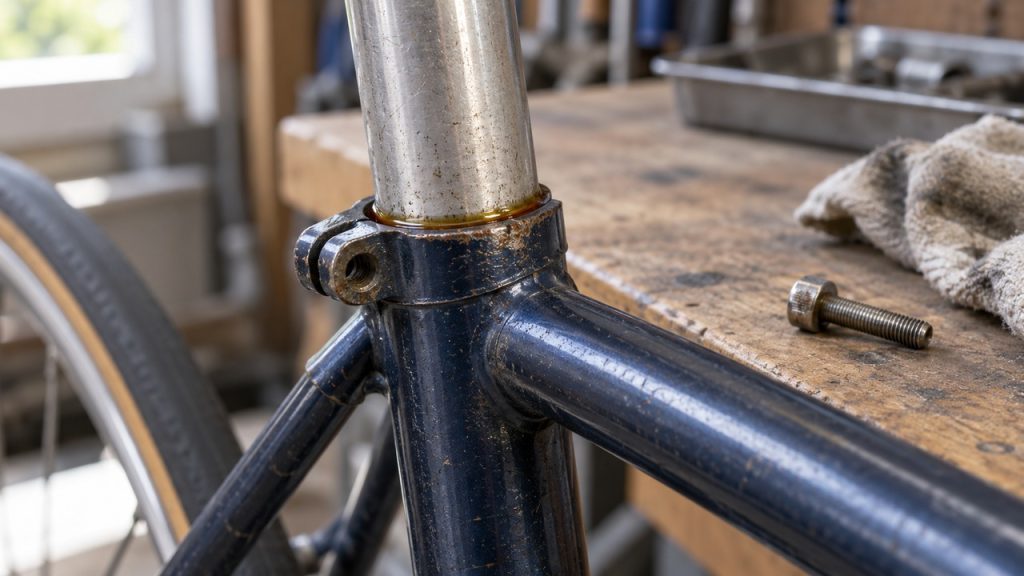
To remove a stuck seatpost, take the seat binder bolt all the way out, soak the joint with penetrating oil overnight, then twist a round metal post using the saddle as a handle. Sheldon Brown’s rule is to turn before you pull: you can put far more force into a turn than a straight pull, and once a post turns, it usually comes out. If that fails, the next step depends on what the frame and post are made of. A torch that frees a steel post from a steel frame can ruin a heat-treated aluminum frame, and the hacksaw method that saves a steel frame is off-limits for a carbon post.
Find your frame and post in the table, work down the escalation steps in order, and stop at the line for your materials. If the saddle only tilts or slides and the post itself moves fine, you have a clamp problem instead: see why a bike seat keeps tilting.
Why seatposts get stuck
Most stuck posts are corroded in place. Park Tool says posts bond inside frames “especially” when an aluminum post sits in a steel frame, through an exchange of ions between the two metals, and that a galvanic reaction also bonds an aluminum post in a carbon frame or a carbon post in a steel or aluminum frame. Sheldon Brown’s page adds that aluminum oxide swells a corroded post to a larger diameter.
The other cause is mechanical. Sheldon Brown lists two signs to check before you pull hard:
- A bulge in the seat tube where the post ends, from an oversized post forced in. Run your fingers down the tube to feel for it.
- An out-of-round post where it leaves the frame, from an overtightened binder bolt. Thomson, the post maker, says an overtightened collar can make a post elliptical. A post like this may turn only a few degrees, and forcing it can jam it tighter.
Either sign sends you to the frame-builder section below. In every other case, grip the post through a saddle. Sheldon Brown says nothing holds a post as well as a saddle clamp, and he rules out pulling with a pipe wrench or locking pliers.
Safe and destructive methods for each frame and post
| Frame / post | Why it sticks | Try, in this order | Never | Basis |
|---|---|---|---|---|
| Steel frame, steel post | Rust | Bolt out; penetrating oil overnight; twist; pry the seat lug ears apart a little; hot water on the seat tube, then Sheldon Brown’s torch as a last resort; vise and twist; cut the post out | A saw cut that reaches the seat tube | Sheldon Brown (oil, prying, torch); Park Tool (cut-out) |
| Steel frame, aluminum post | Aluminum oxide bond | Bolt out; mild acid (lemon juice or cola), then rinse; twist; CO2 or dry ice inside the post; vise and twist; cut the post out | Heat on the seat tube: the post expands about twice as much as the steel and locks tighter | Sheldon Brown (oil “almost useless” on aluminum oxide); Park Tool (acid) |
| Aluminum frame, aluminum post | Oxide on both surfaces | Bolt out; acid or oil, then rinse; twist; hair dryer on the seat lug while CO2 chills the post; vise and twist; cut the post out | Torch or heat gun. Drain cleaner or lye. Prying the seat lug ears. | Armao (heat and T6 aluminum); John Allen (lye, prying) |
| Carbon frame, aluminum post | Galvanic corrosion | Bolt out; acid or oil, then rinse; twist; CO2 inside the post only; push-off (step 5); then a shop | Any heat on the frame. Lye. Sawing. Prying. Honing or sanding the seat tube. | Park Tool (no honing carbon); Sheldon Brown’s page (lye for steel frames only); the other limits are Icebike’s reasoning for carbon |
| Steel or aluminum frame, carbon post | Galvanic corrosion | Bolt out; oil overnight; hair dryer on the seat lug with CO2 at the joint (Zinn); push-off; then a shop | Cutting the post out. A torch or heat gun. | Park Tool: “Do not attempt to remove a carbon post by cutting it out.” No heat is Icebike’s reasoning for carbon posts |
| Carbon frame, carbon post | Friction; carbon on carbon has no metal to corrode | Bolt out; push-off (step 5); then the frame maker or a shop | Heat. Cutting. Prying. Pulling the frame hard away from the post. | Walkowski’s letter on Sheldon Brown’s page; the other limits are Icebike’s reasoning for carbon |
| Titanium frame (general guidance) | Titanium doesn’t corrode, so suspect an aluminum post, an aluminum sleeve, or a forced fit | Bolt out; oil or acid, then rinse; twist; CO2 inside an aluminum post; vise and twist; then a builder | Heat when the post is aluminum. Prying the ears. | Zinn (corrosion); Sheldon Brown (expansion); John Allen (prying) |
Notes on the table. No titanium frame maker publishes a removal procedure that we could find, so the titanium row applies the general metal rules above. No frame maker we checked publishes a safe temperature for heating carbon to free a post, so the table keeps heat off carbon frames. Three rules are Icebike’s reasoning rather than a source’s words: chilling only the post in a carbon frame, sending saw work on a carbon frame to a shop because you can’t hone out a slip, and rinsing after acid.
Sheldon Brown’s page lists two chemicals this guide leaves out. Sheldon wrote that ammonia dissolves aluminum oxide; John Allen, who revised the page, notes that Jobst Brandt doubted it, because ammonia won’t penetrate the joint. Caustic soda (lye, sold as some drain cleaners) dissolves an aluminum post outright, and a reader describes doing it in a steel frame. It also destroys an aluminum frame, gives off hydrogen, and Allen warns it can cause blindness if it reaches your eyes. Leave lye to a frame builder.
How to remove a stuck seatpost: least to most destructive
The first five steps leave the post usable. From step 6 on, you sacrifice the post to save the frame.
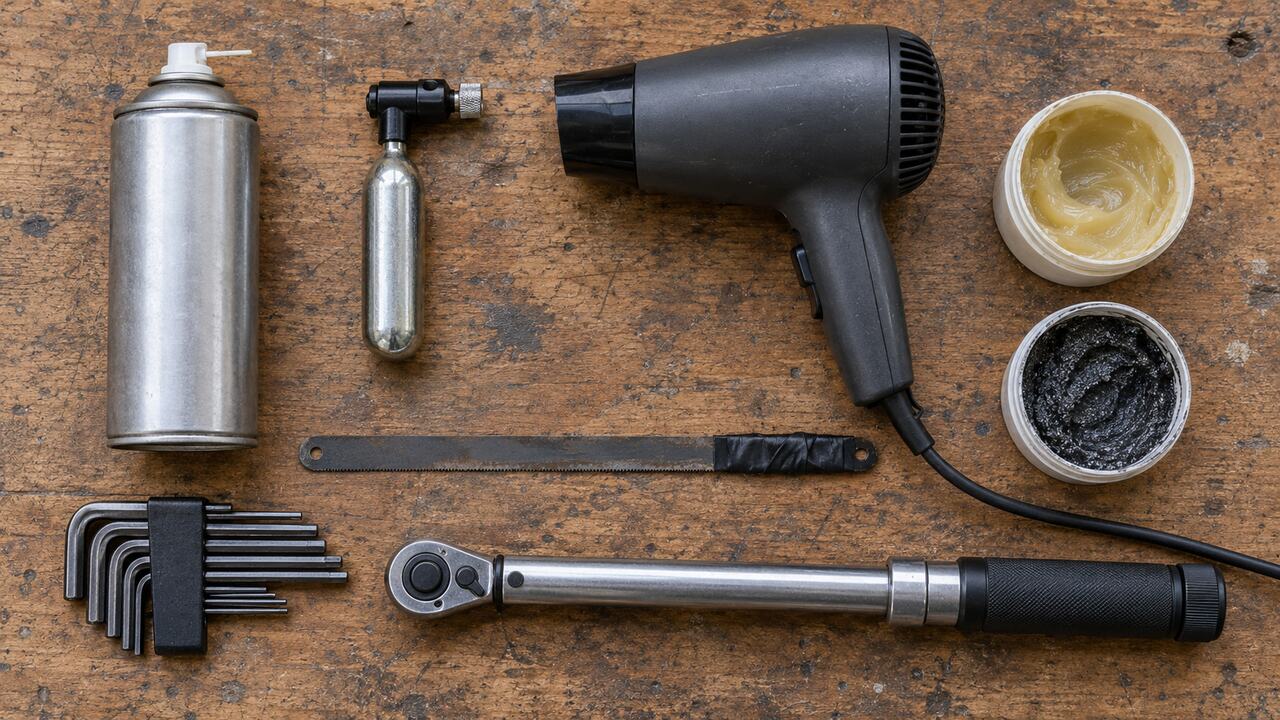
- Record your saddle height. Measure from the center of the bottom bracket to the top of the saddle, and wrap tape around the post where it enters the frame. Our saddle height calculator gives you a starting height if you lose the number.
- Take the binder bolt all the way out. Park Tool, Sheldon Brown and Lennard Zinn all start here. Sheldon Brown says that sometimes this alone frees the post. On a quick-release collar, open the lever and slide the collar off.
- Soak it overnight. Zinn turns the bike upside down, takes out the bottom bracket and squirts penetrating oil up the seat tube from below, then waits until the next day. Run oil around the top of the seat tube too. On an aluminum post, use Park Tool’s mild acid (lemon juice or cola), which attacks the alkaline bond that oil can’t. Then flush the frame with water and let it drain and dry. Acid left in a steel frame starts rust, and our rust guide explains why acids also eat into aluminum once they dissolve its oxide film.
- Twist, then pull. Leave the bike on its wheels with a foot on a pedal, stand behind the saddle straddling the rear wheel, and turn the saddle side to side while a helper holds the front wheel. If it turns, pull up as you twist and work oil into the gap. This step is for round metal posts. Cannondale’s SystemSix manual says not to twist a seatpost in or out, because cuts and scratches can make the post break, and Walkowski’s drop-shaped carbon post couldn’t turn at all. With carbon, go to step 5.
- Use cold, heat on metal frames only (never on carbon frames), or push the frame off the post.
- Cold: empty a CO2 inflator cartridge inside an aluminum post so it shrinks (Sheldon Brown), then twist at once. John Allen adds dry ice dropped into the post with the frame upside down and says the method applies to any post material; wear winter gloves and don’t touch anything it chills. In a carbon frame, chill only the post.
- Heat on metal frames: Zinn’s version, written for carbon posts, warms the seat lug with a hair dryer and discharges a CO2 cartridge at the joint between post and collar. Allen’s gentler option is hot water poured over the seat tube. Keep the dryer moving, never use a heat gun on an aluminum frame, and stop when the tube is too hot to hold (Icebike’s rule). Armao’s 200°F preheat cap for 6061-T6 comes from welding plate, so applying it to thin bike tubing is our inference, but it rules out a torch on aluminum. Sheldon Brown’s torch step is for freeing a steel or titanium post, with care for the paint. He doesn’t address brazed lugs or heat-treated steel tubing, so on a lugged or high-end steel frame, hand the torch work to a builder.
- Push-off, for carbon: Witold Walkowski freed a carbon post from a carbon frame by pushing the frame off instead of pulling the post. He set two aluminum spacer plates between the saddle clamp and the top of the seat tube, one each side of the post, backed the clamp screws out a few turns, then turned them in. The post came out with “slight finger pressure on the Allen key.” Seat the spacers square and flat on the seat tube’s top edge, turn both screws evenly, and stop if either needs more than light hand force or the clamp starts to bend. On a carbon frame, that top edge is the part you’d crack.
- Clamp the post in a vise and turn the frame (metal posts only; with a carbon post, this is a shop job). Park Tool and Zinn both describe it: remove the saddle and wheels, flip the bike, clamp the top of the post in a bench vise bolted to a solid bench, and twist the frame while a helper pulls. Park Tool warns against levering on the rear dropouts, which can bend the rear triangle. Zinn warns you can bend or crack the frame. The post is scrap after this.
- Cut the post out (metal posts only). Saw the post off a little more than an inch above the frame. Park Tool cuts it lengthwise in four places with a jab saw (a hacksaw handle that holds the blade at one end), then knocks the pieces inward. Zinn cuts a pie-shaped wedge with two cuts about 60 degrees apart, pries it out and curls the rest inward with pliers. Both warn against cutting through into the seat tube. Afterward, Park Tool hones corrosion out of a steel frame and says honing or sanding a carbon frame is not recommended.
- Take it to a frame builder or machine shop. Zinn’s last step is to have a machine shop ream the post out. He notes it only works on a round seat tube.
Carbon posts and steps 6-7. Sources disagree here. Zinn’s 2007 column, written for stuck carbon posts, clamps the post in a vise, cuts it off a few inches up and ends with the hacksaw wedge. Park Tool says: “Do not attempt to remove a carbon post by cutting it out.” This guide follows Park and makes both steps a shop job for carbon, because a crushed or cut carbon post can splinter inside the seat tube and jam tighter (Icebike’s reasoning).
When to stop and take it to a frame builder
Zinn’s advice: if you aren’t 100 percent confident, go to someone who is, or who will take responsibility if the frame breaks. Hand the bike over if any of these is true:
- The frame or post is carbon, and an overnight soak plus a twist or push-off did nothing.
- The frame is aluminum, cold and a hair dryer failed, and you won’t accept Zinn’s warning that the vise step can bend or crack a frame.
- The seat tube bulges where the post ends, or the post is out of round.
- The seat tube or post is aero, D-shaped or otherwise not round. A reamer can’t follow it (Zinn), and you can’t twist it.
- It is a suspension or dropper post. Sheldon Brown says twisting from above the mechanism can break a suspension post, so clamp below it or let a shop do it; we apply the same rule to droppers. If your dropper moves in the frame but won’t go up or down, see our guide to fixing a dropper post.
- The frame has an integrated seat mast, so the stuck part is a topper on a mast built into the frame.
- The steel frame is lugged or heat-treated and the next step is a torch.
- You see a crack, crushed fibers or paint lifting around the seat lug.
Tell the builder the materials, the post diameter and every step you’ve tried, including any acid.
Stuck seatpost questions
Will WD-40 free a stuck seatpost?
It can help with a steel post rusted into a steel frame. Park Tool says a penetrating oil or light lubricant is better than nothing, and Sheldon Brown says penetrating oil “can do wonders” on rust. On an aluminum post, he calls it “almost useless,” because oil doesn’t break down aluminum oxide. Use Park Tool’s mild acid there.
Does Coke really work on a stuck seatpost?
Park Tool says the bond is usually alkaline and that a mild acid such as lemon juice or cola can weaken it with time, and Zinn lists Coca-Cola as a stand-in for penetrating oil. Pour it down the seat tube with the bottom bracket out, then rinse and dry the frame.
Can I use a heat gun on a stuck seatpost?
Not on aluminum or carbon frames. On a steel frame with a steel or titanium post, warming the seat lug follows Sheldon Brown’s method. With an aluminum post in a steel or titanium frame, heat makes it worse; chill the post instead.
How long should penetrating oil soak?
Overnight, per Zinn. If a twist the next morning shows no movement, reapply and wait another night before you move to the steps that sacrifice the post.
Should I hammer the post up or down?
Keep the hammer away from a post you want to keep. Sheldon Brown’s first rule is never to install a seatpost with a hammer. The sources hammer only a post that is already sacrificed: John Allen pounds on a bar run through a drilled post, and Park Tool knocks in the pieces after cutting.
How to keep a seatpost from sticking again
Sheldon Brown wrote that stuck seatposts are always the result of improper installation. Prevention comes down to the right compound, enough post inside the frame, the right torque, and pulling the post now and then.
| Frame / post | Put this on the post or inside the seat tube | Source |
|---|---|---|
| Steel, aluminum or titanium frame with a metal post | Grease, or anti-seize for wet-weather bikes | Thomson: grease “works very well” for aluminum, steel and titanium. Park Tool: anti-seize resists water and corrosion better. |
| Titanium frame | Anti-seize (copper or nickel), or grease if you service it regularly | Seven Cycles, which builds titanium frames |
| Any carbon frame or carbon post | The carbon part maker’s compound, usually carbon assembly paste (a gritty compound that adds friction) | ENVE, Cannondale and Thomson specify paste or gel. Park Tool allows grease or anti-seize as a barrier for carbon and metal pairs. |
| Binder bolt threads | Grease, unless the maker says otherwise | Cannondale; Seven Cycles. ENVE says not to grease its seatpost wedge bolt. |
Grease on carbon divides the sources. Park Tool calls for “a light coating of grease, anti-seize, or other lubricant” as a barrier between carbon and metal. Zinn has written that grease won’t damage a carbon post, while John Allen says oil swells the resin. Thomson says “grease is not your friend” on carbon, because paste lets you hold carbon at a lower torque and “carbon hates compression.” Use what the maker of the carbon part specifies.
Minimum insertion. US federal rules (16 CFR 1512.15) require a permanent minimum-insertion mark at least two post diameters from the bottom of the post, about 54 mm on a 27.2 mm post by our math. Some frame and post makers ask for more: Cannondale’s Synapse Carbon manual requires 80 mm, and ENVE’s seatpost wedge instructions call for 75 mm. Use the deeper figure.
Torque. Use the number printed on the seat collar or in the frame manual, with a torque wrench. Park Tool’s chart lists Campagnolo seat binders at 4-6.8 N·m and adds that seatposts “require only minimal tightening.” Seven Cycles specifies 6.8-9.0 N·m for its titanium frames. With no printed figure, our bike torque spec finder starts seatpost clamps at 4-7 N·m and caps carbon at 5 N·m. An overtightened collar can squeeze a post out of round (Thomson).
How often to pull it. Thomson recommends inspecting the bike every 90 days and says removing, cleaning and recoating the post prevents seizing. For a carbon post in an aluminum seat tube, Zinn says to pull it after any ride in the rain. The rust guide’s seasonal checklist covers pulling and regreasing the post and draining a steel frame, which matters most on winter bikes.
With the post back in, set the saddle height from your step 1 measurement and tighten the saddle clamp to its own spec. If the saddle then creeps back on its rails, see our guide to a bike seat that keeps tilting.
Sources
- Park Tool. Seized Seatposts and Stems (accessed October 15, 2026). Ion exchange between aluminum and steel; grease, anti-seize or lubricant as a barrier for carbon and metal; remove the binder bolt; mild acid; vise method; jab-saw cut-out; no cutting carbon posts; honing carbon frames not recommended.
- Park Tool. Torque Specifications and Concepts (accessed October 15, 2026). Campagnolo seat post binder 4-6.8 N·m; seatposts need only minimal tightening.
- Sheldon Brown, revised by John Allen. 16 Ways to Unstick a Seatpost (accessed October 15, 2026). Diagnosis, saddle as handle, prying (steel only), oil versus aluminum oxide, ammonia and Brandt’s doubt, drain cleaner and aluminum frames, hot water, dry ice and CO2, torch for steel or titanium posts, expansion ratios, Walkowski’s carbon push-off, caustic soda.
- Lennard Zinn, Velo. Technical FAQ: Removing a stuck seatpost (January 2003, accessed October 15, 2026). Overnight soak from the bottom bracket, vise and frame risk, machine-shop reaming, wedge cut.
- Lennard Zinn, Velo. Permanent seatposts and what to do about them (February 2007, accessed October 15, 2026). Carbon-post procedure with hair dryer and CO2, vise and cut steps; reaming needs a round seat tube; titanium does not corrode; grease and carbon.
- Cannondale. SystemSix owner’s manual supplement (accessed October 15, 2026). No twisting a post in or out; grease the binder threads; seatpost gel for carbon.
- Cannondale. Synapse Carbon owner’s manual supplement (accessed October 15, 2026). 80 mm minimum insertion.
- ENVE. Seatpost wedge installation (accessed October 15, 2026). Carbon grit paste, 75 mm minimum insertion, no grease on the wedge.
- Thomson. How to Deal with Slipping and Seizing (accessed October 15, 2026). Grease for aluminum, steel and titanium; carbon paste for carbon; 90-day inspection; overtightened collars and out-of-round posts.
- Seven Cycles. Torque settings (accessed October 15, 2026). Anti-seize for titanium interfaces; seat binder 6.8-9.0 N·m; grease on binder threads.
- U.S. Code of Federal Regulations. 16 CFR 1512.15, Requirements for seat (accessed October 15, 2026). Minimum-insertion mark at least two seat-post diameters from the bottom of the post.
- Frank Armao, The Fabricator. Aluminum Workshop: Guidelines for preheating T6 (December 2014, accessed October 15, 2026). T6 aging at 350-400°F; 300-600°F destroys T6 properties; 200°F preheat maximum.