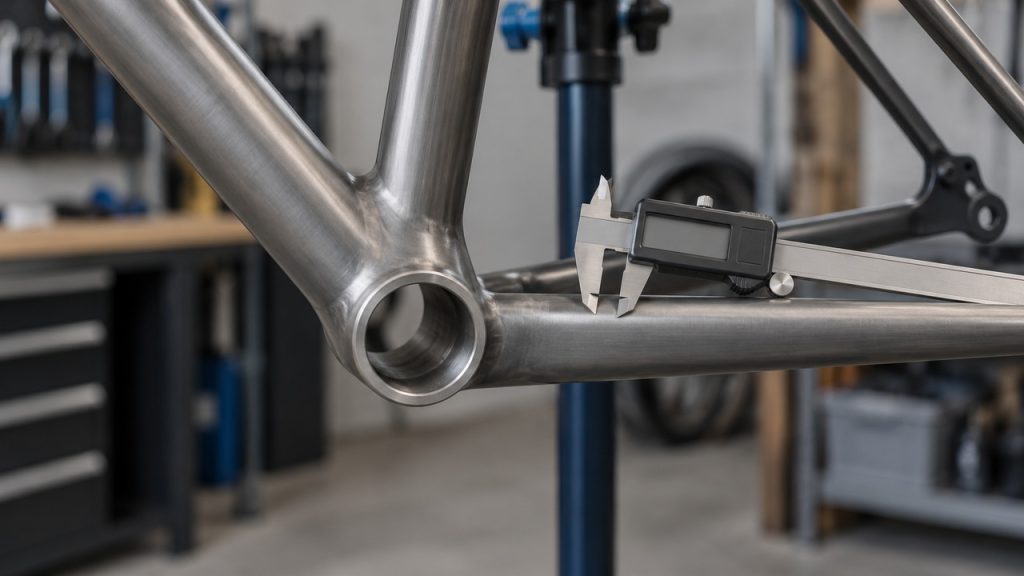
Bottom brackets come in six construction types: adjustable cup-and-cone, sealed cartridge, external cups, press fit, thread-together and one-piece. Within those, three numbers name the standard (BSA, Italian, T47, BB30, PF30, BB86/BB92 and the rest): the shell’s inside diameter, its width, and its thread, if it has one. English (BSA) threading is the most common threaded shell, at 68 mm wide on road bikes and 73 mm on mountain bikes. Measure your shell, find the row in the chart below, then check that your crank’s spindle fits it.
The chart comes from maker and service documents: Park Tool, Wheels Manufacturing, SRAM, Chris King, Enduro and Sheldon Brown’s database. Icebike did not measure frames for this page. Expect several names for one standard. Park Tool, for example, calls BB86/BB92 “PF41”, BB30 “PF42” and PF30 “PF46”, after the shell bore in millimeters.
Bottom bracket types at a glance
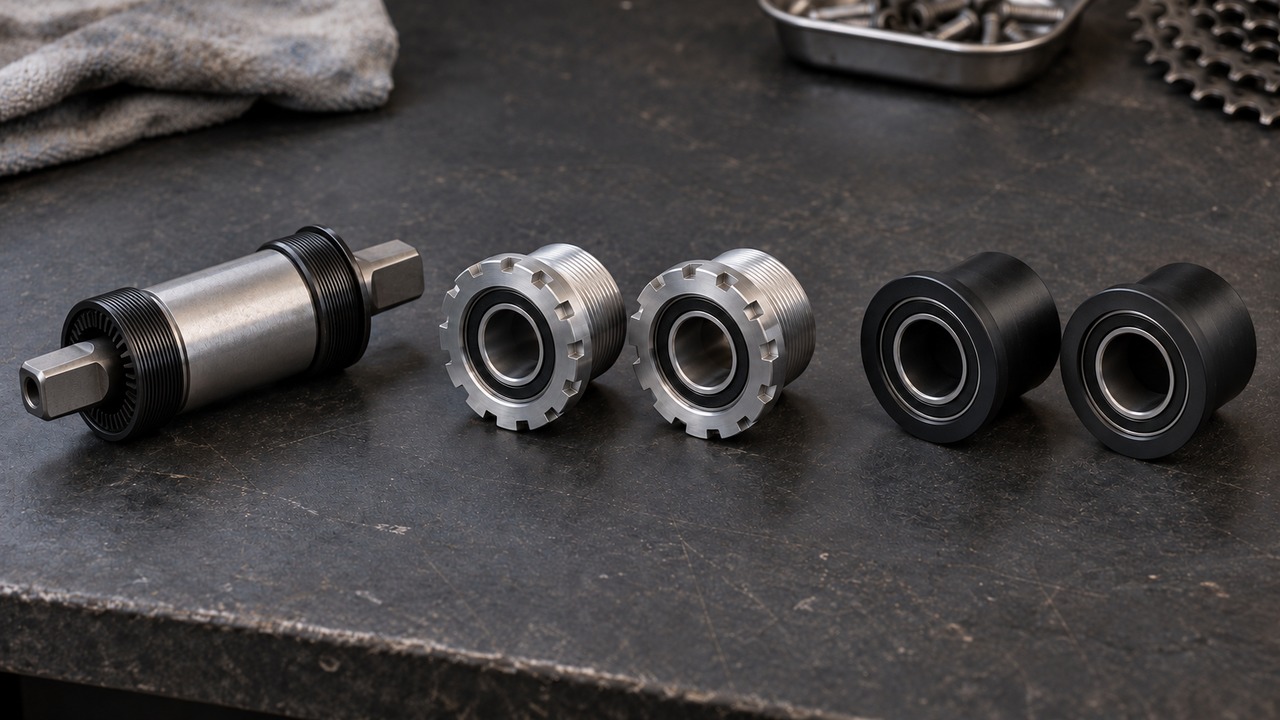
- Adjustable cup-and-cone: ball bearings run in cups that thread into the shell. The left side has a separate notched lockring for adjusting play, and the whole unit comes apart for service (Park Tool).
- Sealed cartridge: spindle and bearings sit in one sealed unit that threads into the shell. The spindle ends are square taper, Shimano Octalink or ISIS.
- External cups (thru-spindle): threaded cups hold cartridge bearings, and the crank’s own spindle (24 mm, GXP, DUB or 30 mm) passes through them. The bearings sit outside the shell or inside it.
- Press fit: cups or bare bearings press into a smooth, unthreaded shell. No tool fittings show from outside.
- Thread-together: two halves screw into each other inside a smooth press-fit shell, so both cups show tool fittings even though the frame has no threads.
- One-piece (American or Ashtabula): the crank arms and spindle are one part, and the bearings come out with the crank.
Two older or specialist setups use these parts in a different way. Cottered cranks, on many older bikes, hold the arms on the axle with wedge-shaped cotters and a nut. An eccentric bottom bracket puts a normal bottom bracket inside an offset cylinder that turns in an oversized shell, which tensions the chain on tandems and on solo bikes with a rear disc brake or an internal-gear hub (Sheldon Brown).
Bottom bracket standards chart
Shell ID is the inside diameter of the bare frame shell with the cups out. Widths are nominal, measured face to face across the shell. “Spindles that fit” lists crank spindle sizes with a bottom bracket made for that shell; the next sections explain each spindle.
| Standard | Also called | Shell ID | Shell width | Threads | Spindles that fit |
|---|---|---|---|---|---|
| BSA threaded | English, BSC, ISO, British, “Euro” on BMX | About 33.7 mm (Wheels: 33.6-33.9 mm) | 68 mm road, 73 mm MTB, 83 mm downhill, 100 mm fat bike | 1.37 in x 24 TPI; drive side is left-hand | Square taper, Octalink and ISIS cartridges; 24 mm; GXP; DUB; 30 mm only with 30 mm-specific cups such as Chris King ThreadFit 30 |
| Italian | ITA, “36×24” | About 35 mm | 70 mm | 36 mm x 24 TPI; both sides right-hand | Square taper cartridges; 24 mm (Shimano lists SM-BBR60, BB-RS501 and BB-R9100 for 70 mm threaded shells); DUB (SRAM DUB Italian 70); Campagnolo Ultra-Torque |
| T47 outboard | T47 external; Chris King “24x” and “30x” | About 46 mm | 68 mm, 73 mm. Wheels also lists T47 shells at 83 and 100 mm. | M47 x 1.0; drive side is left-hand | 24 mm, GXP, DUB, 30 mm. The bearings sit outside the shell. |
| T47 inboard | T47 internal, T47i; Chris King “24i” and “30i” | About 46 mm | 85.5-86.5 mm; Chris King also lists 92 mm | M47 x 1.0; drive side is left-hand | 24 mm, GXP, DUB, 30 mm. The bearings sit inside the shell. |
| BB30 | PF42 (Park); BB30A; Specialized alloy OSBB | 42 mm | 68 mm road, 73 mm MTB, 83 mm Cannondale MTB, 120 mm Cannondale fat bike; BB30A 73 and 83 mm; alloy OSBB 68 and 84.5 mm | None. 6806 bearings press straight into the frame against circlips or machined stops. | 30 mm; DUB (SRAM DUB BB30); 24 mm and GXP with adapter bottom brackets |
| PF30 | PF46 (Park); PressFit 30; PF30A; Cannondale Ai | 46 mm | 68 mm road, 73 mm MTB, 83 mm, 100 mm fat bike; 61 mm on Specialized carbon OSBB road frames | None. Plastic or aluminum cups press in. | 30 mm; DUB; 24 mm and GXP with reducing cups |
| BB386EVO | PF46 (Park); BB392EVO is the 92 mm version | 46 mm | 86.5 mm (BB392EVO: 92 mm) | None | 30 mm; DUB (SRAM DUB BB386 86.5); 24 mm and GXP with reducing cups |
| BBright | Press Fit version is PF46; Direct Fit version is PF42 | Press Fit 46 mm; Direct Fit 42 mm (Cervelo R5ca only) | 79 mm, 11 mm wider on the non-drive side | None | 30 mm; DUB (SRAM DUB PF30 79-A); 24 mm with BBright adapters |
| BB86 / BB92 | PF41 (Park); Shimano Press-Fit; PF24; PF86, PF92; BB89.5, BB107, BB121, BB132 | 41 mm | 86.5 mm road; 89.5 and 91.5-92 mm MTB; 104.5-107 mm downhill; 121 and 132 mm fat bike | None | 24 mm (the design size); GXP; DUB (SRAM DUB PF 86.5, 89.5 and 92); 30 mm with a 30 mm-bearing bottom bracket |
| Trek BB90 / BB95 | Trek direct fit | 37 mm bearing bore with stops built into the shell | 90.5 mm road, 95.5 mm MTB | None. Bearings press straight into the frame. | 24 mm and GXP (24 x 37 and 22 x 37 mm bearings). SRAM lists no DUB bottom bracket for BB90. |
| ISIS Overdrive | None common | About 46.5 mm | 68-100 mm | M48 x 1.5; drive side is left-hand | ISIS spline spindle. Now mostly on exercise bikes. It does not take T47 parts. |
| French | None common | About 34 mm | 68 mm | M35 x 1.0; both sides right-hand | Obsolete (Park Tool). Needs French-thread parts. |
| Swiss | None common | About 34 mm | 68 mm | M35 x 1.0; drive side is left-hand | Obsolete (Park Tool). Needs Swiss-thread parts. |
| American | Ashtabula; one-piece crank | 51.5 mm cup bore | Not given in our sources | None. Bearing cups press into the frame. | One-piece crank. Adapters can step the shell down to take English-threaded bottom brackets. |
| BMX Spanish / Mid | Spanish press fit; Mid press fit | Spanish 37 mm; Mid uses 41.2 mm bearings | Not given in our sources | None. Bearings press straight into the frame. | Spanish: 19 or 22 mm spindles |
Three frame-specific standards sit outside the chart. Wheels Manufacturing lists Look BB95 at 65 x 90 mm (Look parts only), Wilier BB94 at 37 x 93 mm, and Colnago ThreadFit 82.5, a threaded shell whose aluminum inserts turn it into a 41 x 86.5 mm BB86 shell.
What bottom bracket do I have?
Check the frame maker’s spec first; SRAM’s own bottom bracket chart tells you to consult the frame manufacturer or measure the parts. If the spec sheet is gone, these five checks name the standard.
- Read the cups with the cranks on. Park Tool’s rule: tool fittings mean a threaded or thread-together bottom bracket, and no fittings means press fit. Fittings are notches around the outside, splines inside, or pin holes on the face. Other clues: cups stamped “36×24” are Italian; arrows on the cups usually mean English; a notched lockring on the left side means an adjustable cup-and-cone unit; a large nut holding a one-piece crank means American (Ashtabula).
- Count the notches on external cups. Sixteen notches about 44-45 mm across point to Shimano Hollowtech II, SRAM GXP and many other 24 mm cups. Twenty-four notches point to a SRAM DUB cup. Cups 50-54 mm across with 12 or 16 notches usually belong to T47 or another 30 mm system; Park names the tools for them BBT-47.

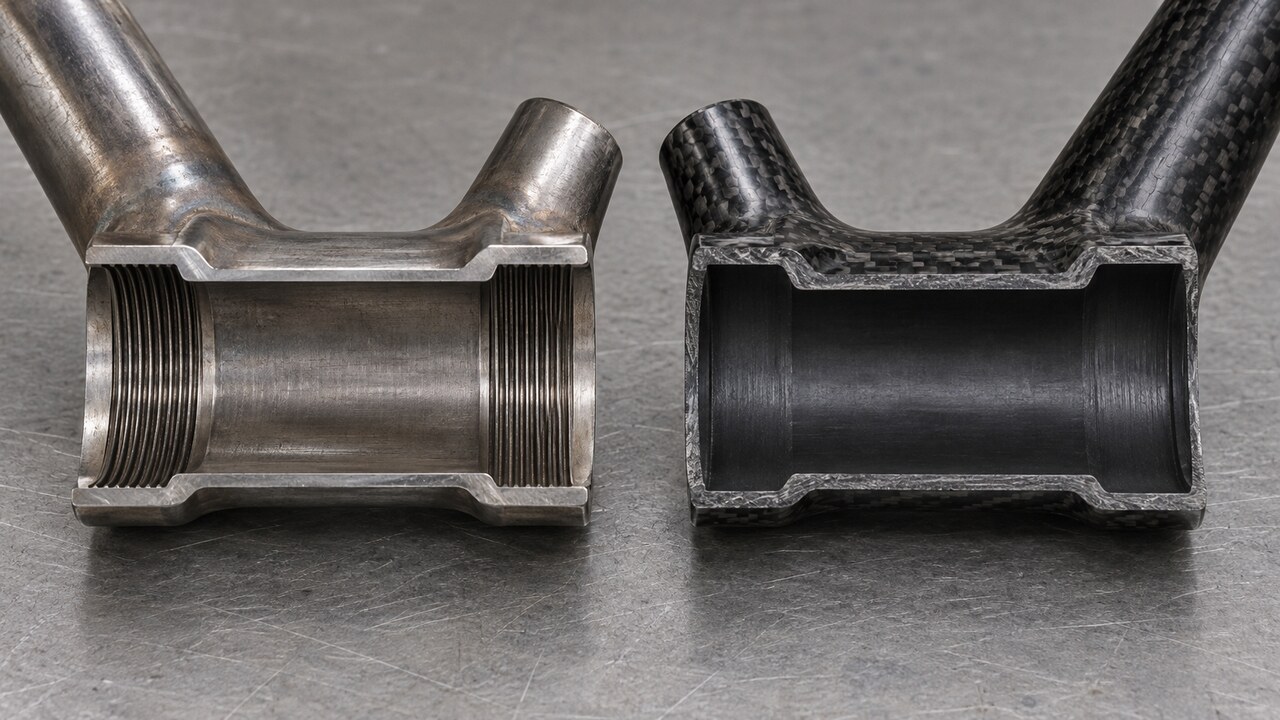
Illustration: a cartridge bottom bracket, external threaded cups with tool notches, and press-fit cups with none. - Remove the cranks and cups, then look inside. Threads or a smooth bore? Do not skip this step: a thread-together bottom bracket has tool fittings but sits in a smooth press-fit shell, because its two halves screw into each other inside the frame.
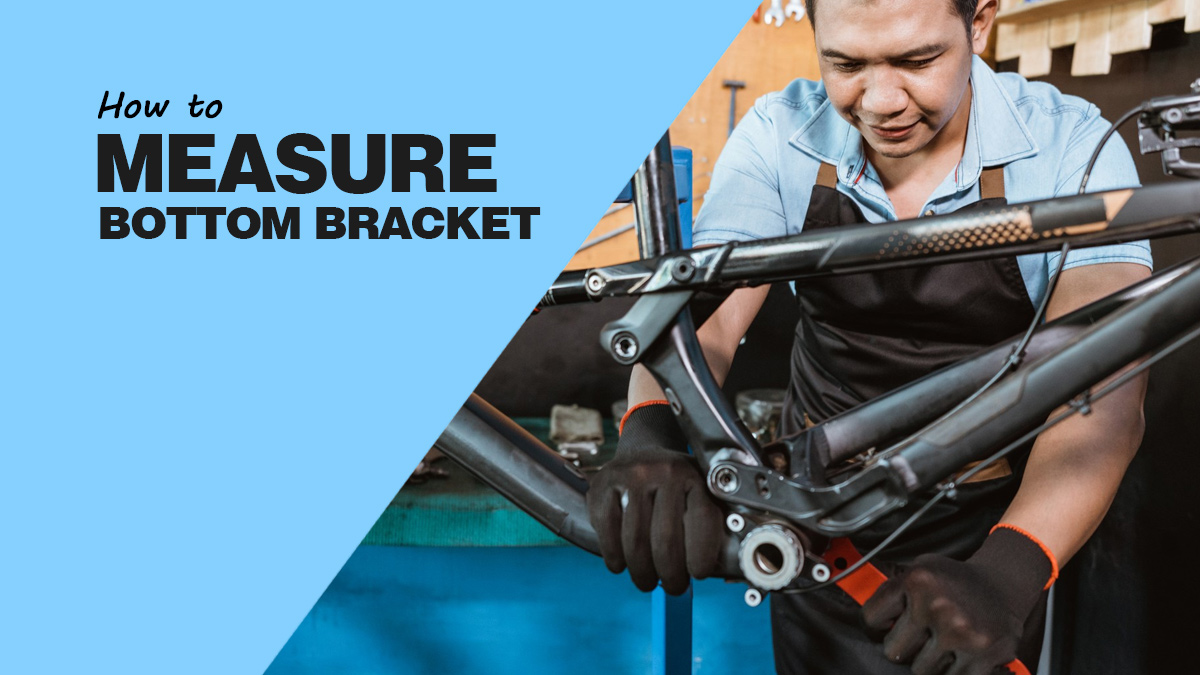
- Measure the shell width and the inside diameter with calipers, cups out. For width, set the outside jaws on the two machined end faces of the shell and read face to face. For the inside diameter, set the inside jaws across the bare bore. The 41 mm and 42 mm press-fit bores differ by 1 mm, so read the caliper to a tenth of a millimeter. Our guide to measuring a bottom bracket has more on using calipers.
- Match the numbers in the table below, then measure the crank spindle (next section).
| Threaded? | Shell ID | Width | You have | Do not confuse it with |
|---|---|---|---|---|
| Yes | About 33.7 mm | 68, 73, 83 or 100 mm | BSA (English) | Raleigh 26 TPI on old British 3-speeds: the diameter matches but the pitch does not, so threads bind after a few turns (Sheldon Brown) |
| Yes | About 34 mm | 68 mm | French (both cups right-hand) or Swiss (drive cup left-hand) | BSA: an English cup may seem to thread in on the left side but sits loose (Sheldon Brown) |
| Yes | About 35 mm | 70 mm | Italian | BSA cups fall through an Italian shell |
| Yes | About 46 mm | 68 or 73 mm | T47 outboard | ISIS Overdrive (about 46.5 mm, coarser 1.5 mm thread), found on exercise bikes |
| Yes | About 46 mm | 85.5-86.5 or 92 mm | T47 inboard | T47 outboard: same thread, different cups |
| Yes | About 46 mm | 83 or 100 mm | T47 (Wheels lists these widths) | Check whether the cups for your frame put the bearings inside or outside the shell |
| No | 37 mm, with bearing stops inside | 90.5 or 95.5 mm | Trek BB90 / BB95 | Spanish BMX, also 37 mm, on BMX frames |
| No | 41 mm | 86.5 mm to 132 mm | BB86 / BB92 family (PF41) | BB30 at 42 mm; Mid BMX bearings at 41.2 mm |
| No | 42 mm | 68, 73, 83, 84.5 or 120 mm | BB30 (BB30A if the non-drive side runs 5 mm wider; 84.5 mm is Specialized alloy OSBB; 120 mm is Cannondale fat bike) | PF41 at 41 mm |
| No | 42 mm | 79 mm | BBright Direct Fit (Cervelo R5ca) | BBright Press Fit at 46 mm |
| No | 46 mm | 61, 68, 73, 83 or 100 mm | PF30 | BB30 at 42 mm, the most common mix-up |
| No | 46 mm | 79 mm | BBright Press Fit | Nothing else in the chart measures 46 x 79 mm |
| No | 46 mm | 86.5 or 92 mm | BB386EVO / BB392EVO | BB86 / BB92 at 41 mm |
| No | 51.5 mm cup bore | Varies | American (Ashtabula) | Nothing else uses a bore this large |
BSA (about 33.7 mm) and French or Swiss (about 34 mm) differ by less than Wheels’ own BSA range of 33.6-33.9 mm, so a caliper cannot tell them apart. Read the markings on the old cups, or try a known English cup by hand and compare what happens with Sheldon Brown’s symptoms in the last column.
Asymmetric shells sit off-center. Wheels lists BB30A and PF30A at 5 mm wider on the non-drive side and BBright at 11 mm; SRAM also sells DUB bottom brackets for an asymmetric 77 mm T47 shell (T47 77-A). If the total width matches no row, measure from the seat tube’s centerline to each shell face to find the offset.
Crank spindle compatibility
The shell decides the bottom bracket’s outside; the crank decides its inside. Measure the spindle where the bearing sits, or the bearing’s inside diameter, and match it here. Skip this table if you are replacing a bottom bracket with the same model.
| Crank interface | Spindle diameter | Examples | Fits these shells | Watch for |
|---|---|---|---|---|
| Square taper | Tapered square, JIS or ISO | Older and budget cranks | BSA and Italian cartridge bottom brackets | JIS and ISO tapers differ: ISO cranks don’t slide as far onto JIS spindles, and JIS cranks can bottom out on ISO spindles (Sheldon Brown). Pick spindle length for chainline. |
| Octalink and ISIS | Splined, part of the cartridge | Shimano Octalink; ISIS Drive | BSA and Italian cartridges | Spindle length must match the crank and chainline. |
| 24 mm | 24 mm | Shimano Hollowtech II, FSA MegaExo, Race Face EXI, Rotor 3D24 | BSA, Italian, T47, BB86/BB92 and BB90/BB95 directly; PF30, BB386EVO, BBright and BB30 with adapter bottom brackets | FSA MegaExo spindles can measure up to 24.07 mm; Wheels sells 24.07 x 37 mm bearings for them. |
| GXP | 24 mm drive side, 22 mm non-drive side | SRAM and Truvativ GXP | The same shells as 24 mm, with a GXP bottom bracket | The crank passes through a 24 x 37 mm drive bearing and stops against a 22 x 37 mm non-drive bearing, so it needs a GXP-specific bottom bracket. |
| SRAM DUB | 28.99 mm per Park Tool (Wheels rounds to 29 mm) | SRAM DUB, since 2018 | SRAM makes DUB bottom brackets for BSA, Italian 70, T47, BB30, PF30, BB386, BBright (PF30 79-A) and BB86/BB89.5/BB92 | No DUB option for Trek BB90/BB95, per SRAM. DUB crank types (MTB, MTB Wide, Road, Road Wide, Super Boost+, DH, Fat) take different spacers; SRAM etches the type on the spindle. |
| 30 mm | 30 mm | BB30/PF30 cranks, Race Face Cinch, Rotor 3D30 and 3D+, Cannondale Hollowgram, FSA BB386EVO, Specialized S-Works FACT, Campagnolo Over-Torque | BB30, PF30, BB386EVO, BBright, T47 directly; BSA and BB86/BB92 only with 30 mm-specific bottom brackets | Praxis M30 spindles step from 30 mm to 28 mm on the non-drive side and need a Praxis-compatible bottom bracket. |
| Campagnolo Ultra-Torque and Power Torque | 25 mm | Campagnolo road cranks | Italian or BSA cups (Sheldon Brown); BB30 and PF30 with adapters (Wheels makes Campagnolo adapters) | Ultra-Torque bearings press onto the spindle, not into the cups. |
Diameter is half the check. Wheels Manufacturing points out that crank spindles have bearing landings machined for a limited range of shell widths. If you fit a crank whose spindle is much wider than your bottom bracket, check that both bearings still sit on the landings. Many external bottom brackets cover two widths with spacers: SRAM’s DUB BSA 68 MTB and DUB BSA 73 MTB share one part number, 00.6418.015.000. If you are swapping cranks anyway, our crank length calculator gives a starting arm length from your inseam.
Tools for each bottom bracket type
Park Tool matches threaded tools to the cup’s fittings, and press-fit removers to the bearing’s inside diameter. A caliper reading within about 1 mm is enough to pick a threaded tool, according to Park.
| Bottom bracket | Fitting to look for | Park Tool |
|---|---|---|
| Cartridge: Shimano square taper and Octalink, SRAM, FSA, Sunlite, Suntour | 20 internal splines, 31.5 mm | BBT-22 or BBT-32 |
| Adjustable cup-and-cone | Notched lockring 44-46 mm; pin holes; 36 mm or 16 mm wrench flats | HCW-5 (lockring), SPA-1 (pin holes), HCW-4 (36 mm flats), HCW-11 (16 mm flats) |
| Shimano Hollowtech II, SRAM GXP, Chris King ThreadFit 24, many 24 mm cups | 16 notches, 44-45 mm OD | BBT-69.4 (also BBT-169, BBT-19.2, BBT-9) |
| Shimano XT MT800, Ultegra BBR60/72 | 16 notches, 41-42 mm OD | BBT-59.3 |
| Shimano XTR BB91/93/94, Dura-Ace R9100 | 16 notches, 39-40 mm OD | BBT-49.3 or BBT-29 |
| SRAM DUB threaded cups | 24 notches, 45-47 mm OD | BBT-79.3 or BBT-179 |
| Race Face Cinch, Rotor 30 | 12 notches, 45-47 mm OD | BBT-79.3 or BBT-179 |
| FSA MegaEvo, Wheels Mfg | 16 notches, 48-50 mm OD | BBT-27.3 or BBT-29 |
| Praxis M30 | 12 notches, 48-50 mm OD | BBT-35-12 or BBT-135-12 |
| Chris King ThreadFit 30 and T47, Rotor | 12 notches, 50-53 mm OD | BBT-47-12 or BBT-147-12. Chris King’s own tools: TBB006 for T47 24x and 30x, TBB007 for T47 24i and 30i. |
| Large-diameter cups from Enduro, SRAM, CeramicSpeed | 16 notches, 52-54 mm OD | BBT-47-16 |
| Campagnolo cartridge | 6 notches, 43 mm OD; or 12 internal splines, 23 mm | BBT-4; BBT-5/FR-11 for the splined type |
| Press fit, 24 mm or 22/24 mm bearings (BB86/BB92, reducer cups) | No fittings; bearing ID 22-24 mm | BBT-90.3 to remove |
| Press fit, 25-28.99 mm bearings (SRAM DUB, Campagnolo) | No fittings; bearing ID 25-29 mm | RT-1 to remove |
| Press fit, 30 mm bearings (BB30, PF30, BB386EVO) | No fittings; bearing ID 30 mm | BBT-30.4 to remove (some cases need RT-1) |
| Installing any press-fit bottom bracket | Not applicable | HHP-2, HHP-3 or BBP-1.2. BBP-1.2 includes drifts for most standards; BBT-30.4 includes PF46 and PF42 drifts; BBT-90.3 includes PF41 drifts. |
| Trek BB90 / BB95 | No fittings | Park covers BB90/BB95 in its press-fit removal guide and picks the remover by bearing ID. Wheels sells replacement bearings only. |
| American (Ashtabula), Spanish and Mid BMX | Pressed bearing races | Punch and hammer |
Add a digital caliper (Park DC-1 or DC-2) for the measurements and a torque wrench for threaded cups. Tighten cups to the figure printed on them or in the maker’s manual; our guide to clicking and creaking noises covers what a loose cup sounds like and how to fix it. When the cranks go back on, the bike torque spec finder lists crank pinch bolt torque.
Threaded vs press fit: what changes when you service it
Threaded (BSA, Italian, T47). The cups unscrew. On English and T47 shells the drive-side cup has a left-hand thread, so it comes out clockwise; the non-drive cup comes out counterclockwise. Both Italian cups come out counterclockwise. Spacers under the cups set the position, so note them before you pull the cups.
Press fit (BB30, PF30, BB86/BB92, BB386EVO, BBright, BB90/BB95). You drive the cups or bearings out with a hammer and a remover, then press new ones in. Park Tool warns that striking the tool can deform the cup and bearing, and that manufacturers assume a removed press-fit bottom bracket should be replaced. Budget for a new one each time it comes out.
Thread-together units fit press-fit shells: the two halves screw into each other inside the shell. Park treats them like threaded bottom brackets for tool choice.
T47 keeps threads but uses a 46 mm bore, so 30 mm cranks fit. Chris King, which says it helped develop T47, describes it as an answer to press-fit bottom brackets it calls imprecise and often loud.
Common questions
Are all bottom brackets the same size?
No. A bottom bracket has to match the frame’s shell ID, width and thread, and the crank’s spindle diameter. The chart above has 15 rows, and BSA alone comes in four common widths.
Is BSA the same as English?
Yes. Park Tool lists BSA, BSC, BC, ISO, British, English and the BMX term “Euro” as names for the same 1.37 in x 24 TPI thread.
What is the difference between BB30 and PF30?
The bore. BB30 shells measure 42 mm and take bearings pressed straight into the frame. PF30 shells measure 46 mm and take cups that hold the bearings. Both were built for 30 mm spindles, but their bottom brackets do not swap.
Is BB92 the same as PF92?
Yes. Wheels Manufacturing lists PF92 as Trek’s name for the same 41 mm shell, and Park files it under PF41. Despite the name, Wheels gives the shell width as 91.5 mm, and SRAM’s DUB chart lists both 89.5 and 92 mm.
Can I fit a 30 mm crank in a BSA frame?
Yes, with a 30 mm-specific threaded bottom bracket. Chris King’s ThreadFit 30, for example, fits 30 mm and DUB cranks in BSA shells. A standard 24 mm Hollowtech II bottom bracket will not take a 30 mm spindle.
Does SRAM DUB fit every frame?
It covers the common standards. SRAM’s charts list DUB bottom brackets for BSA, Italian, T47, BB30, PF30, BB386 and the BB86/BB92 family. For Trek BB90, SRAM lists no DUB option and points to its GXP crank. Older French, Swiss, American and BMX shells are not on SRAM’s list.
Sources
- Park Tool, Bottom Bracket Standards and Terminology (2019): English, T47, PF41, PF42, PF46, BB90/BB95, Spanish, Mid, American, ISIS Overdrive, Italian, French, Swiss and Raleigh thread specs, shell IDs and aliases.
- Park Tool, Bottom Bracket Identification: tool fittings vs press fit, thread-together units, cup-and-cone, one-piece cranks.
- Park Tool, Bottom Bracket Tool Selection: Threaded and Thread-Together: notch counts, cup diameters and tool numbers.
- Park Tool, Bottom Bracket Tool Selection: Press Fit: remover by bearing ID, including the 28.99 mm DUB range.
- Park Tool, Bottom Bracket Removal & Installation: Press Fit: removal and press tools, replacement after removal.
- Park Tool, Bottom Bracket Removal & Installation: Threaded: thread directions, spacers, “36×24” marking.
- Wheels Manufacturing, Bottom Bracket Standards: shell ID, widths, aliases and notes for BSA, BB90/95, BB86/92, BB30, BBright, OSBB, BB30A, PF30, PF30A, Ai, T47, 386EVO, 392EVO, Colnago, Look, Wilier, ISIS Overdrive, Italian.
- Wheels Manufacturing, Crankset Standards: spindle diameters and bearing sizes by crank, bearing landings.
- SRAM, DUB Road Bottom Bracket Compatibility Map (PDF, Rev G) and DUB MTB Bottom Bracket Compatibility Chart (PDF): DUB options by shell, BB90 note, part numbers and spacers.
- SRAM, DUB T47 Bottom Bracket and DUB Italian Bottom Bracket: T47 68, 77 and 85.5 shells; Italian 70.
- Chris King, ThreadFit T47 30x, ThreadFit T47 24i, ThreadFit 30 and Threaded Bottom Bracket Installation Tools: shell widths per model, BSA 30 mm fit, tool numbers.
- Enduro Bearings, BKS-0249 T47-Internal bottom bracket: 85.5-86.5 mm T47 inboard shells.
- Sheldon Brown, Bottom Bracket Size Database: thread directions and widths for British, Italian, French, Swiss and Raleigh; mixed-thread symptoms; JIS vs ISO tapers.
- Sheldon Brown, Cottered Cranks and Glossary E-F (“Eccentric”): cotters; eccentric bottom brackets on tandems, singlespeeds and internal-gear bikes.
- Shimano, 2024-2025 Specifications (PDF, archived copy; PDF page 150, printed page 147, Bottom Bracket HOLLOWTECH II, Road): SM-BBR60, BB-RS501 and BB-R9100 listed for 68 and 70 mm threaded shells.