
If your bike won’t shift, glance at the derailleur hanger from behind, then start with the shift cable and its barrel adjuster. If the chain is slow to climb to bigger rear cogs, turn the barrel adjuster counter-clockwise a quarter turn at a time; if it is slow to drop to smaller cogs, turn it clockwise. A stiff or gritty lever means the cable drags in its housing and needs cleaning or replacing. If the trouble started after the bike fell on its right side, suspect a bent hanger before any adjuster, and on electronic shifting, check the battery first.
Name the direction first. In the rear, bigger cogs are easier gears; in front, the small chainring is easier. “Won’t shift down” means different things to different riders, so this guide names the cog. It covers derailleur bikes; for gears inside the rear hub, and for which lever does what, see how to shift gears on a bike.
Find your symptom
Lift the rear wheel, turn the cranks, shift, and find your row. Park Tool says the basic adjustments (limit screws, indexing and B-screw) take care of most shifting problems.
| What happens | Likely cause | Quick check | Fix |
|---|---|---|---|
| Shifting went bad right after you refitted the rear wheel | Wheel not fully seated in the dropouts, or the quick release or thru-axle is loose | Is the axle all the way into both dropouts? | Reseat the wheel and close the quick release or tighten the axle |
| Rear: slow or late shifts to bigger cogs; common on a new bike or after a new cable | Too much cable slack | Smallest cog, one click: does the chain move one cog? | Barrel adjuster counter-clockwise |
| Rear: slow shifts to smaller cogs, or the chain ticks against the next bigger cog | Too much cable tension | Shift through every cog and listen | Barrel adjuster clockwise |
| Rear: slow in both directions; the lever feels stiff or gritty | Friction in the cable or housing | Free the cable from the housing stops and slide the housing along it | Clean and lube, or fit a new cable and housing |
| Rear: stuck in the big cogs; the lever clicks but the derailleur won’t come back | Cable dragging so hard the derailleur spring can’t pull it back, or a gummed or seized derailleur pivot | Release the cable at the pinch bolt; does the derailleur spring back on its own? | New cable and housing; clean and lube the pivots, or replace the derailleur |
| Rear: won’t reach the largest cog | L-limit screw too tight, or too much cable slack | The L-screw test, below | Loosen the L-screw in quarter turns, then recheck indexing |
| Rear: won’t reach the smallest cog | H-limit screw too tight, or cable tension holding the derailleur | Turn the H-screw out a few turns, then the barrel clockwise | Reset the H-screw, then the indexing |
| Rear: no adjustment works, or shifting went bad after a fall or a knock | Bent derailleur hanger | From behind: is the hanger parallel to the wheel? | Realign to within 3 mm with a gauge, or replace the hanger |
| Cassette rocks or clicks on the hub, and the gears wander | Loose cassette lockring | Wheel off: wiggle the cassette by hand | Tighten the lockring with a lockring tool, at least 40 N·m or the maker’s figure |
| Lever moves with no resistance, and nothing shifts | Snapped cable, or the cable has slipped from the pinch bolt | Look at the cable end at the derailleur | New cable; pinch bolt about 5 N·m |
| Lever won’t hold a gear, or the same click gives a different result each time | Worn or gummed shifter ratchet | Cable and housing are good, yet shifting stays random | Flush the shifter; replace it if that fails |
| Shifting stays sloppy after a careful adjustment | Worn derailleur pivots | Pull the lower cage sideways and compare with a new derailleur | Replace the derailleur |
| Trouble began after you replaced one part | Parts that don’t work together | Shifter and derailleur pairing, housing type, chain speed, largest cog | Match the parts; check the derailleur’s capacity |
| Chain skips under hard pedaling, mostly in your favorite gears | Worn chain and cogs | Chain checker | See our chain slipping guide |
| Front: slow or no shift up to the big ring | Cable too slack, H-screw too tight, cage angle off, or cage set too high | Pull the front cable by hand: does it go? | Barrel counter-clockwise, then check H-screw and cage |
| Front: slow or no shift down to the small ring | Too much cable tension, L-screw too tight, or cage angle off | Release the lever fully and watch the cage | Barrel clockwise, then check L-screw and cage |
| Front: chain goes onto the big ring, then the outer cage rubs | Front cable too slack | Big ring, smallest cog: is the chain touching the cage? | Barrel adjuster counter-clockwise |
| Front: chain falls off, outside the big ring or inside the small ring | H-screw (outside) or L-screw (inside) too loose, or cage angle off | Check the cage gaps on both end rings | Tighten that screw 1/8 turn and retest |
| Electronic: no shift at all | Flat battery, or a component not paired or faulty | SRAM AXS: do the shifter and derailleur LEDs blink? Shimano Di2: connect the E-TUBE PROJECT Cyclist app | Charge; re-pair AXS if a part was replaced; run the app’s checks on Di2 |
| Cold day: lever won’t move, or the derailleur won’t respond | Ice in the housing; on AXS, a battery below its -10 °C rating or a shift rejected below -15 °C | Did it freeze after a wet ride? Is the AXS derailleur blinking red and green? | Thaw the bike indoors, then dry and lube the cables; warm the AXS battery |
Check in this order
The order matters: Park Tool notes that indexing and limit screws generally can’t correct a bent hanger, and a dragging cable makes every adjustment look wrong.
- Wheel and hanger. The rear axle sits fully in the dropouts. From behind, the hanger and pulleys sit parallel to the wheel.
- Cable and housing. Look for rust, fraying, kinks and bent end caps.
- Chain. Measure wear and lube it; a dry chain feels sluggish when shifting.
- Indexing, with the barrel adjuster.
- Limit screws, only after the checks above.
- Parts. Then the cassette lockring, shifter ratchet and derailleur pivots.
Skip this order if the bike is electronic and nothing moves at all: go to the battery section.
Cable tension: the barrel adjuster fix
A mechanical shifter pulls or releases a set length of cable with each click. The cable pulls the rear derailleur toward the bigger cogs, and a spring pulls it back toward the smaller ones. Too slack, and the derailleur stops short of the next bigger cog. Too tight, and it pushes the chain against the cog beyond.

Turning the barrel adjuster counter-clockwise takes up cable slack and moves the upper pulley inward, toward the bigger cogs. Turning it clockwise adds slack and moves the pulley outward. The barrel can sit on the derailleur or on the shifter.
Park Tool’s indexing method:
- Shift to the largest chainring (the middle one on a triple) and the smallest rear cog.
- Pedal and click the shifter once. The chain should move one cog, no more.
- If it didn’t reach the next cog, return the lever and turn the barrel one full turn counter-clockwise. If one click moved two cogs, go back and turn it one full turn clockwise.
- Fine-tune by ear. Turn the barrel counter-clockwise until the chain starts to tick against the next bigger cog, then clockwise until the noise stops. Check every cog and correct in quarter turns.
- Shift back down to the smallest cog. If any of those shifts feel slow, one more quarter turn clockwise helps.
Park Tool’s video shows the same adjustment, limit screws included:
There is usually a range of barrel positions that shift well, so you don’t need one perfect spot. If the barrel has run out of thread, screw it fully in, back it out one or two turns, and take up the slack at the pinch bolt with the chain on the smallest cog.
A new bike that shifted well in the shop and turns slow to bigger cogs after a few rides has most likely gained cable slack: a counter-clockwise turn fixes it.
Sticky, frayed or rusted cable and housing
Grit inside the housing adds friction, and friction slows shifts in both directions. Park Tool’s cable replacement guide adds that a kinked, worn, frayed or corroded cable or housing can cause slow, inconsistent or hard shifting, or no shifting at all.
Check it. Shift to the largest rear cog, then, without pedaling, click the lever all the way back to the smallest-cog position. That leaves the cable slack. Pull the housing out of its frame stops and slide it back and forth on the cable. It should glide. Wipe the cable and add a drop of light lube, refit the housing and test again.
With full-length housing or internal routing, loosen the pinch bolt instead and pull the cable back by hand as you release the shifter. If it drags, fit new cable and housing. Replace them too if the cable shows rust or broken strands or the housing is bent. Check the cable guide under the bottom bracket, where a bare cable picks up dirt out of sight.
To fit a new cable, shift to the smallest cog front and rear, swap the cable at the shifter (some have a cover to remove), pull the slack out and tighten the pinch bolt to about 5 N·m, Park’s typical figure. Cut the cable about 30 mm long and crimp on an end cap. Then set the limit screws and indexing.
Skip housing replacement if the cable slides freely once it’s out of the stops; clean and lube instead.
Rear limit screws: when the chain won’t reach the end cogs
The H and L screws stop the derailleur at each end of its travel, mainly to keep the chain out of the spokes and off the frame. Too tight, and the chain can’t reach the end cog; too loose, and it drops off. Check the hanger before you loosen either screw.
Won’t drop to the smallest cog (H-screw)
Watch for a trap: with the chain on the smallest cog, cable tension can be what stops the derailleur, not the H-screw. To tell which, click the shifter all the way out, turn the H-screw counter-clockwise a few turns and pedal. Still not on the smallest cog? Turn the barrel adjuster clockwise a few turns. Once the chain drops, set the H-screw so the upper pulley sits directly under the smallest cog, then back the barrel out to where it was and redo the indexing.
Won’t climb to the largest cog (L-screw)
The test: put the chain on the next-to-largest chainring and the second-largest cog, then shift to the largest cog. If it won’t go, goes slowly, or runs noisy once it gets there, the L-screw is too tight. Loosen it a quarter turn at a time until the shift is clean and quiet. Then push hard on the shift lever while you watch the derailleur: the cage should not move any farther toward the spokes.
A chain that won’t reach a new, bigger cog after a cassette swap can also mean the derailleur isn’t built for it. Run the numbers in our derailleur capacity calculator before you buy parts.
Chatter or slow shifts in the biggest cogs (B-screw)
The B-screw sets the gap between the upper pulley and the cogs. Check it in the smallest chainring and the largest cog. Park Tool says most road and mountain derailleurs want 5 to 6 mm, and a hex wrench of that size works as a gauge. Some derailleurs, SRAM Eagle among them, use their own gap figure and setting method, so follow the derailleur’s manual where it differs. Tighten the B-screw to open the gap and loosen it to close it, then recheck the indexing if you made a big change. If the bike shifts well, leave it alone.
How to adjust a front derailleur
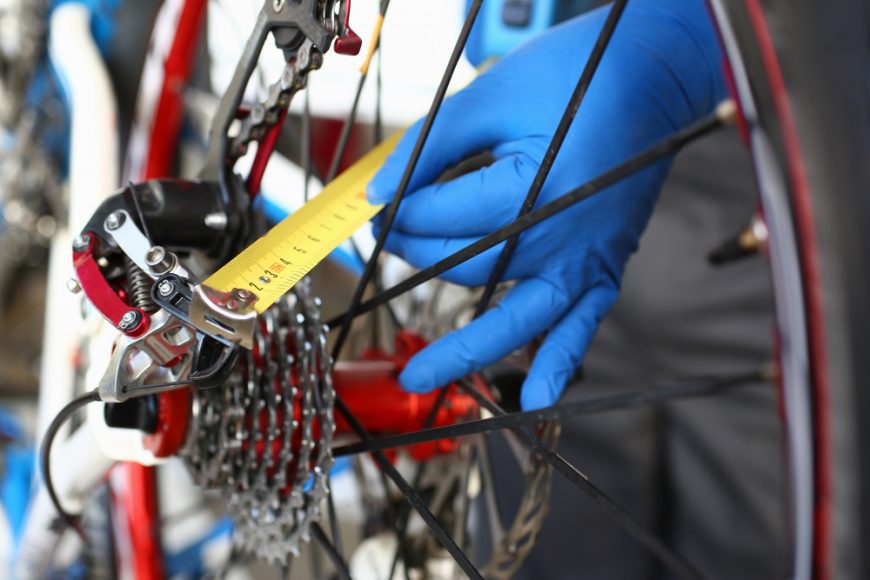
A front derailleur that won’t climb to the big ring, won’t drop to the small one, rubs, or throws the chain needs four settings checked in order: height, angle, limit screws and cable tension. Park Tool’s front derailleur procedure, step by step:
Before you start. Lube the derailleur pivots and the cable. Mounts differ: a clamp-on derailleur adjusts for height and angle, a braze-on mount allows a little of each, and plate-mounted models come with both preset. SRAM AXS front derailleurs have their own setup tool and steps in SRAM’s manual.
- Height. Pull the cable by hand until the outer cage plate sits over the big ring. The gap between the ring’s teeth and the bottom edge of the plate should be 1 to 2 mm, about the thickness of a penny. To move it, shift to the small ring to slacken the cable, loosen the clamp bolt, slide the derailleur up or down using the clamp’s mark on the frame as a reference, and retighten. Set too high, the cage shifts slowly or throws the chain over the big ring; too low, it jams the chain.
- Angle. Shift to the big ring and the smallest rear cog and look down from above. The outer cage plate should run parallel to the chain. To turn it, shift to the small ring, loosen the clamp bolt and rotate the derailleur a little without changing its height. A pencil mark on the frame helps.
- L-screw. Small ring in front, largest cog in back. The cable should be slack; if it is taut, turn the barrel adjuster clockwise. Pedal slowly and set the gap between the chain and the inner cage plate to about 1 mm, the thickness of a dime, at the tightest point of the chainring’s turn. If the chain rubs, loosen the L-screw 1/8 turn. Then pull the cable by hand to shift up a ring and let go: if the chain needs more than one crank turn to drop, loosen the L-screw another 1/8 turn; if it falls off the inside, tighten it 1/8 turn.
- H-screw. Big ring, smallest cog, with the cable pulled tight by hand (wrap it in a rag). Aim again for about 1 mm between the chain and the outer plate. If the chain rubs, loosen the H-screw 1/8 turn; if the gap is wider, tighten it. If the hand-pulled shift up is slow, loosen it a touch. If the chain goes over the top of the big ring, tighten it.
- Cable tension. On two chainrings, stay in the big ring and smallest cog: if the outer plate rubs the chain, turn the barrel adjuster counter-clockwise. On three, use the middle ring and the largest cog and close the inner-plate gap as far as you can without rubbing; counter-clockwise closes it, clockwise opens it. The front barrel usually sits where the housing enters the shift lever. Then shift through every ring.
Pull the cable by hand for limit tests, since the lever can confuse limit-screw and cable-tension problems. If the barrel has run out of thread, shift to the small ring, loosen the pinch bolt, turn the barrel fully clockwise and back out about two turns, pull the cable snug and tighten the pinch bolt to 30 to 40 in-lb.
Some rub in the big ring and smallest cog under hard pedaling is frame flex, and loosening the H-screw to stop it can let the chain come off the big ring. Leave it. If shifting stays poor, look at the chainrings for worn, bent or wobbling teeth and loose chainring bolts, and replace a bent cage, since re-bending one is difficult.
Park Tool’s front derailleur video:
A bent derailleur hanger
The hanger is the small metal tab that holds the rear derailleur to the frame. Park Tool calls it a common culprit for mysterious shifting trouble: it is built to bend in a crash, a fall or a knock in a bike rack, so the derailleur and frame don’t. Once it bends, the pulleys no longer line up under the cogs, and the barrel adjuster can’t fix that.
To check it properly you need a hanger alignment gauge threaded into the hanger. The hanger is straight when the gauge sits within 3 mm of the same spot on the rim at three points, 90 degrees apart; a 3 mm hex wrench works as the go/no-go check. A hanger bent and straightened several times can fail during alignment, so replace it then. A hanger built into the frame can’t be replaced, so take extra care with those. After any hanger work, reset the limit screws and indexing.
Skip this if the bike has never fallen or been knocked on its drive side and the derailleur hangs straight from behind.
Wheel, cassette, shifter, derailleur and mismatched parts
Wheel and cassette. Park Tool’s wheel guide warns that a wheel misaligned in the frame can cause shifting problems, so after a flat repair, reopen the quick release or thru-axle and seat the axle fully in the dropouts. A loose cassette lockring lets the cogs rock; Park tightens it to at least 40 N·m or the maker’s figure.
Shifter. Shift levers move the cable with a ratchet, and worn or grit-filled ratchet teeth stop positioning the cable consistently. Flushing may help, but replacement is the better fix. A lever that swings with no spring feel at all means the cable has snapped or slipped out of the pinch bolt.
Derailleur. Pull the lower cage sideways: sloppy pivots give inconsistent shifts and need a new derailleur. A pivot gummed with old grease or seized with corrosion stops the derailleur returning; clean and lube it, and replace the derailleur if it stays stiff.
Parts that don’t match. The common cases: a SRAM shifter that uses 1:1 cable pull paired with a Shimano rear derailleur, which no adjustment can fix; brake housing used as shift housing, which compresses and soaks up cable travel; and chains made for a different speed count, since 9, 10, 11 and 12-speed chains differ in width. Stay within one brand and drivetrain family.
Chain and cogs. A worn chain meshes poorly and shifts poorly. If the bike also skips under load, follow the wear checks in our bike chain slipping guide, and use the chain wear replacement estimator to plan the next chain.
Electronic shifting: Di2 and AXS
An electronic derailleur moves on a motor, so a flat battery stops shifting outright. The wheel, hanger, chain and limit screws still matter.
SRAM AXS
Shift once and watch the LEDs. In SRAM’s eTap AXS manual, the shifter LED blinks when it sends a shift, and the derailleur LEDs blink when they receive and make it. If the derailleurs don’t respond, SRAM says to repeat the pairing. Pairing survives battery changes; you only redo it after a component is replaced, added or removed.
The LED color on each shift shows ride time left:
| Component | Green | Red | Red, flashing |
|---|---|---|---|
| Eagle AXS rear derailleur | 5 to 25 hours | 1.5 to 5 hours | Under 1 to 1.5 hours |
| eTap AXS 33T/36T max and XPLR rear derailleurs | 15 to 60 hours | 6 to 15 hours | Under 6 hours |
| AXS shifter (CR2032 coin cell) | 6 to 24 months | 1 to 6 months | Under 1 month |
- Red and green blinking on the rear derailleur means it rejected the shift. SRAM gives two reasons: a locked-out gear (2x road systems block the small-ring and small-cog combination) or a temperature below -15 °C.
- A new coin cell that still won’t work: SRAM warns that coin cells with a bitter child-safe coating can interfere with the contacts.
- Flat after a trip: SRAM says to pull the derailleur batteries and fit the battery blocks for transport, or the battery can drain.
- The batteries swap: front and rear derailleur batteries are interchangeable, so a charged front battery can rescue a flat rear one.
Don’t push an AXS derailleur by hand to force a gear. SRAM warns this can damage the motor.
Shimano Di2
Di2 runs from a rechargeable lithium-ion battery, mounted outside the frame or hidden in the frame or seatpost, and Shimano puts a charge at weeks to months depending on how you ride. Wired systems link the parts with wires and junctions. If a Di2 bike stops shifting:
- Charge the battery.
- Check that each wire is pushed fully into its port.
- Connect the E-TUBE PROJECT Cyclist phone app. Shimano says the app, through its D-FLY wireless link, lets riders check for firmware updates and troubleshoot component issues.
Your groupset’s user manual explains its battery indicator and warnings.
Winter: frozen cables and cold batteries
Icebike’s winter note: water that gets into a cable housing on a wet ride can freeze once the bike sits in the cold. The lever then goes stiff or won’t move, or the derailleur won’t follow the cable. Bring the bike indoors to thaw rather than forcing the lever, then dry the cable and housing and lube them. If it keeps happening, fit new housing with sealed end caps. Our winter bike maintenance guide covers cables and corrosion in salt and slush.
Electronic systems have their own limits. SRAM rates its AXS battery for -10 °C to 40 °C in use, and its manual says the rear derailleur rejects shifts below -15 °C, signaled by red and green blinks. The battery can be stored down to -40 °C. Icebike’s winter note: on a ride colder than -10 °C, keep the battery indoors until you leave and expect AXS shifting to stop if the derailleur gets colder than -15 °C.
Questions riders ask
Why won’t my bike shift into the easiest gear?
The easiest gear is the largest rear cog. A bent hanger, cable slack or a tight L-screw stops the chain short of it. Check the hanger, turn the barrel counter-clockwise, then run the L-screw test.
Why is my bike stuck in the highest gear?
The highest gear is the smallest rear cog. On most derailleurs the return spring parks the chain there when nothing pulls the cable, so a snapped, slipped or frozen cable leaves you stuck in it. If the lever feels dead, replace the cable.
Why won’t my front derailleur shift to the big ring?
Park Tool lists a slack cable, a tight H-screw or a cage set at the wrong angle. Pull the cable by hand: if the chain goes up, add tension at the barrel; if it doesn’t, check the H-screw and the cage height and angle.
Can WD-40 fix sticky gears?
Not on its own. For a sticky cable, Park Tool’s fix is to wipe the cable and add a light lube, and to fit new cable and housing if it still drags. Replace a rusty cable or kinked housing outright.
Sources
- Park Tool. Rear Derailleur Adjustment (accessed October 15, 2026). Limit screw purpose, H-screw versus cable tension test, indexing steps in full and quarter turns, L-screw test, B-screw gap, video.
- Park Tool. Rear Derailleur: Advanced Troubleshooting (accessed October 15, 2026). Cable friction checks, bottom bracket guides, bent hanger, incompatible parts, dry chain, worn derailleur, worn shift levers, symptom table.
- Park Tool. How a Rear Derailleur Works (accessed October 15, 2026). Cable and return spring, barrel adjuster directions.
- Park Tool. Front Derailleur Adjustment (accessed October 15, 2026). Mount types, cage height 1 to 2 mm, rotation, 1 mm limit gaps, 1/8-turn steps, hand-pull tests, index setting for two and three rings, barrel reset, pinch bolt 30 to 40 in-lb, frame-flex rub, video.
- Park Tool. Front Derailleur: Advanced Troubleshooting (accessed October 15, 2026). Cage height and angle, bent cage, chainrings, symptom table.
- Park Tool. Rear Derailleur Hanger Alignment (accessed October 15, 2026). Why hangers bend, 3 mm alignment standard, replacing over-bent hangers.
- Park Tool. Shift Cable Replacement: Trigger Shifters (July 27, 2022). Symptoms of a worn cable, pinch bolt about 5 N·m, cable cut about 30 mm long.
- Park Tool. Wheel Removal and Installation (accessed October 15, 2026). Wheel misalignment and shifting problems, seating the hub in the dropouts.
- Park Tool. Cassette Removal and Installation (accessed October 15, 2026). Lockring tightened to at least 40 N·m or the maker’s figure.
- SRAM. eTap AXS User Manual (accessed October 15, 2026). Pairing, LED battery status, rejected shifts below -15 °C, battery operating range -10 °C to 40 °C and storage range, CR2032 shifter battery, transport battery blocks, front derailleur setup tool.
- Shimano. Di2 (accessed October 15, 2026). Lithium-ion battery mounting and life, D-FLY link to E-TUBE PROJECT Cyclist for firmware checks and troubleshooting.