
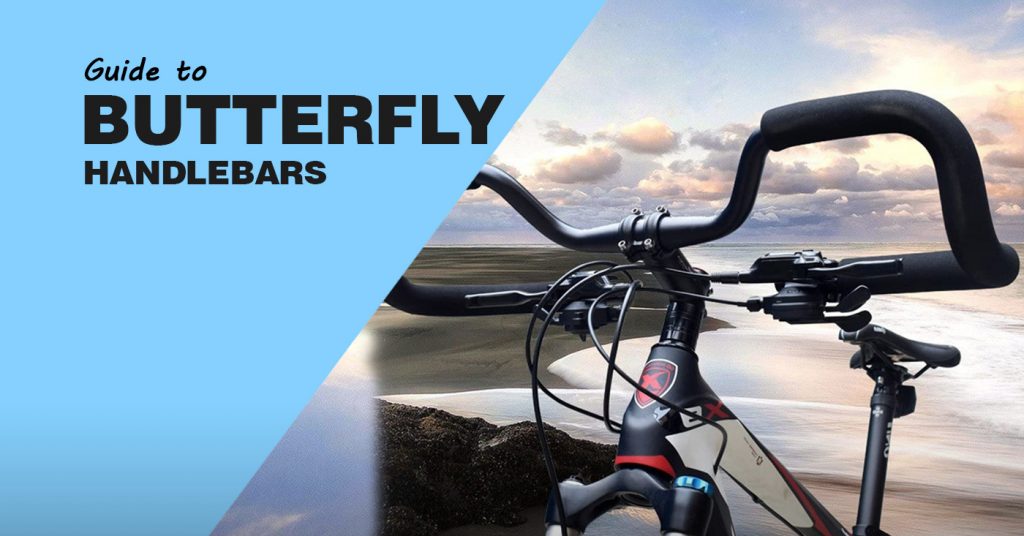
A butterfly handlebar, also sold as a trekking bar or multi-position bar, is a figure-eight loop that clamps to your stem like a flat bar. It gives you several places to hold the bar, from a stretched grip on the far loop to an upright grip beside the stem, and on most models it takes ordinary flat-bar brake levers and shifters on 22.2 mm grip sections. On a flat-bar bike, the swap usually comes down to one check: does the bar’s clamp size (25.4 or 31.8 mm) match your stem? On a drop-bar bike, plan on new brake levers and shifters as well.
This guide covers what the shape changes, who it suits, the compatibility checks that decide the purchase, how to fit one, and three bars that list their clamp and grip sizes. Icebike did not ride these bars for this page. Sizes come from Sheldon Brown’s handlebar dimension table, Shimano, TRP, Park Tool and each bar maker’s own spec page or listing, all checked on October 17, 2026.

What a butterfly bar changes
A flat bar gives you one grip: hands at the ends, wrists turned in. A butterfly bar adds three more zones, and moving between them shifts pressure to a different part of your palm and changes how far you lean forward.
- Inner grips (the bar ends): your brake levers and shifters go here. This is your braking and town-riding position.
- Sides of the loops: hands rotate to a handshake angle, thumbs up, much like holding the hoods on a drop bar.
- Far crossbar: it sits ahead of the stem clamp, so holding it stretches you forward and lowers your chest. Riders use it for headwinds and long flat stretches.
- Center section beside the stem: hands close together, body at its most upright.
Rotating the bar in the stem clamp tilts the far loop up or down. That changes the height of the stretched position without a new stem, so set the angle before you wrap grips or tape.
The trade-off is braking. BBB’s handlebar manual warns that this kind of bar lets you hold it away from the brake levers, and tells you to make sure you can reach the brakes quickly whenever you need them. On the far crossbar you have no levers under your fingers.
Two ways to handle it: put the levers on the grips you hold most (UPANBIKE’s own fitted photos put them on the inner ends) and move back to them before every descent or junction. If you ride long, steep descents with a loaded bike, a drop bar keeps the brakes under your hands in more positions.
Butterfly handlebar pros and cons
Pros
- ✓ Four places to hold the bar instead of one, so you can move pressure around your palms on long rides
- ✓ Takes flat-bar brake levers and shifters on 22.2 mm grips, so a flat-bar bike keeps its controls
- ✓ Rotating the bar in the clamp raises or lowers the stretched position without a new stem
- ✓ Sold in 25.4 mm and 31.8 mm clamp versions (BBB and UPANBIKE both list both)
Cons
- ✗ No brakes under your hands on the loops or the far crossbar, which BBB's manual warns about
- ✗ Less straight bar for a light, a computer or a bar bag
- ✗ Higher and less aero than the drops of a drop bar
- ✗ On a drop-bar bike you need new levers and shifters, because road levers clamp on 23.8 mm grips
- ✗ The bar ends can hit the top tube or your knees at full lock on a short frame
Who should fit one, and who should skip it
Fit one if:
- You ride a flat-bar touring, commuting or hybrid bike for hours at a time and want more than one place to put your hands.
- Your hands go numb or your wrists ache when you hold one position on long rides.
- You want drop-bar style hand positions but your bike already runs flat-bar brakes and shifters you want to keep.
Skip it if:
- You ride technical mountain bike trails. You need a wide bar with your hands on the levers at all times, and the loops add nothing there.
- Your bike has drop bars with integrated brake and shift levers that you like. The swap means new levers, and often new brakes or shifters (see the table below).
- You carry a large handlebar bag, a light and a computer. The loops leave less straight bar for mounts, so measure the straight sections before you buy.
Compatibility checks before you buy
Three numbers decide whether a bar fits your bike: the clamp diameter at the center, the diameter of the grip sections where levers mount, and the width. Sheldon Brown’s handlebar crib sheet lists 25.4 mm clamps with 22.2 mm grips as the standard on “the vast majority of newer bicycles with upright handlebars,” while drop bars use a 23.8 mm grip area with 25.4, 26.0 or 31.8 mm clamps.

Use the table to find your bike’s current setup and what changes with a butterfly bar.
| Your bike now | What you need for a butterfly bar | Why |
|---|---|---|
| Flat or riser bar, 25.4 mm stem clamp | A 25.4 mm butterfly bar. Move your existing levers, shifters and grips across. | Both bars use 22.2 mm grip sections, so flat-bar controls fit. |
| Flat or riser bar, 31.8 mm stem clamp | A 31.8 mm butterfly bar, or a 25.4 mm bar with a 25.4-to-31.8 mm shim. | The bar must match the stem’s clamp. BBB and UPANBIKE both sell 31.8 mm versions alongside 25.4 mm. |
| Drop bar with integrated brake/shift levers | Flat-bar shifters and flat-bar brake levers. Keep your stem if its clamp matches the new bar; a 31.8 mm road stem takes a 31.8 mm butterfly bar. | Drop-bar levers clamp on a 23.8 mm grip. Shimano lists a 23.8 to 24.2 mm clamp band for its 105 ST-R7025-R lever, so it cannot clamp tight on a 22.2 mm butterfly grip. |
| Drop bar, shifting | Flat-bar shifters whose listed derailleur type matches your derailleur. | Shimano lists a “compatible rear derailleur type” for each shifter; the ST-R7025-R reads “Road 11-speed.” Match that field, including the speed count. |
| Drop bar, rim brakes (road calipers or cantilevers) | Short-pull flat-bar brake levers. | Park Tool measures about 6 mm of cable pull from a drop-bar lever at 20 degrees of lever travel, against about 15 mm from a linear-pull lever. Mismatched pull gives weak or bottoming-out brakes. |
| Drop bar, mechanical disc brakes | Levers that match your caliper’s pull, or new calipers. | TRP sells the Spyre for “all cable actuated road levers” and the Spyke for “all linear pull levers.” Check your caliper’s model page. |
| Flat bar, V-brakes or flat-bar mechanical discs | No brake change. Move the levers. | Your levers and calipers already match. |
| Hydraulic disc brakes, flat-bar levers | Move the levers if the hoses reach. | The lever is part of a sealed system. A hose that comes up short needs a longer hose and a bleed. |
| Hydraulic disc brakes, drop-bar levers | Flat-bar hydraulic levers approved by the brake maker for your calipers, new hoses and a bleed. | This is a shop job for most riders. Ask the shop to confirm lever and caliper compatibility before you order. |
| Any bike | Enough cable housing and hose to reach the new lever position at full steering lock. | Icebike’s rule of thumb: mount the bar, turn it fully left and right, and replace any housing that pulls tight or kinks. |
The clamp size belongs to your stem, so check the stem before you order. A 31.8 mm stem takes the 31.8 mm bars directly: the BBB BHB-30OS, the UPANBIKE 31.8 mm version or the UPANBIKE 3D bar. A 25.4 mm stem takes the 25.4 mm bars. A shim adapts a 25.4 mm bar to a 31.8 mm stem (Wheels Manufacturing makes a 48 mm aluminum one for this job), but nothing works the other way: a 31.8 mm bar cannot fit a 25.4 mm clamp. Sheldon Brown’s table also lists a 26.0 mm stem clamp, the Italian drop-bar size; no butterfly bar here comes in 26.0 mm, so that stem has to go. For a change in stem length or angle, run the numbers in the bike stem length calculator first: it shows how the new stem moves your bar height and reach.
Stem, reach and steering clearance
Butterfly bars curve back toward you, so the ends can hit the top tube or your knees at full steering lock on a small or short frame. Check this before you cut any cables: clamp the bar loosely, turn it lock to lock, and watch the gap between the loops, the top tube and your knees with the cranks level. If the bar touches, a longer stem or more rise moves it forward or up. Our guide to raising bike handlebars shows how many millimeters each method adds.
Width matters too. The BBB MultiBar measures 570 mm, the UPANBIKE Trekking bar 600 mm and the UPANBIKE 3D bar 620 mm. If you are unsure what width suits your shoulders, the handlebar width calculator gives a starting figure for commuting.
Butterfly vs flat, riser, drop and swept bars
Each bar type puts your hands somewhere different and takes different controls. The grip diameters below come from Sheldon Brown’s crib sheet.
| Bar | Hand positions | Grip diameter (controls) | Body position | Typical use | Skip it if |
|---|---|---|---|---|---|
| Butterfly / trekking | 4 zones: inner grips, loop sides, far crossbar, center | 22.2 mm, flat-bar levers | Upright on the grips, stretched on the far crossbar | Touring, commuting, long days on a hybrid | You ride technical trails or need lots of bar space for mounts |
| Flat | 1 (bar ends add a second) | 22.2 mm, flat-bar levers | Fixed, moderate lean | Hybrids, city and fitness bikes | Your hands go numb on long rides |
| Riser | 1 | 22.2 mm, flat-bar levers | Higher hands, more upright than flat | Mountain bikes, comfort hybrids | You want a stretched position for headwinds |
| Drop | 3: tops, hoods, drops | 23.8 mm, road levers | Lowest and most aero in the drops | Road, gravel, fast touring | Your back or neck dislikes a low position |
| Swept-back (alt) bar | 1 to 2, hands swept back toward you | 22.2 mm, flat-bar levers | Upright, hands closer to you | City bikes, relaxed commuting, bikepacking | You want a stretched or aero position |
Hand positions describe where each shape lets you hold it; widths vary by model, so compare the maker’s figure with your current bar.

If you are choosing between a butterfly bar and a drop bar: a drop bar gives you a lower, more aero position and keeps the brakes under your hands on the hoods. A butterfly bar keeps you higher and lets you reuse cheaper flat-bar levers, but you lose the brakes whenever your hands sit on the loops or the far crossbar.
How to fit a butterfly bar
BBB recommends having a qualified mechanic fit its handlebars with a torque wrench. If you do it yourself, you need hex keys, a torque wrench and new grips or tape.
- Measure first. Note your current saddle-to-grip distance so you can compare reach after the swap.
- Strip the old bar. Remove grips, then loosen and slide off the brake levers and shifters. Leave cables attached if the housing is long enough.
- Load the controls. From the open ends of the bar, slide on any foam that covers the loops, then the brake levers and shifters. Fit the end grips last.
- Clamp it loosely. Center the bar in the stem and tighten the faceplate bolts evenly until the bar holds but still rotates.
- Set the angle. Rotate the bar until the far loop sits level or a few degrees up and your wrists stay straight on the inner grips.
- Check clearance and cables. Turn lock to lock. Nothing should touch the frame or your knees, and no housing should pull tight.
- Torque and test. Tighten the stem bolts to the figure printed on the stem. Then sit on the bike and reach for both brake levers from every hand position before you ride.

Both UPANBIKE bars ship with foam sleeves; BBB sells grips separately. If the foam wears out or stays wet after rain, bar tape or a grip made for this bar shape replaces it. Our handlebar grips guide covers grip shapes and materials if you want something firmer for the inner grips.

Three butterfly bars that list their sizes
How we chose: each bar had to name its brand and model, state its clamp diameter, and be in stock on Amazon on October 17, 2026. Where the maker publishes a spec page, its figures come first and any conflict with the listing is noted.
Icebike earns a commission on Amazon purchases made through links in this section. These picks rest on maker and listing specs, not on our riding.
BBB MultiBar BHB-30: the 25.4 mm bar with a maker spec sheet

BBB MultiBar BHB-30
Best documentedA plain aluminum trekking bar from a parts maker that publishes width, clamp, material and weight, for flat-bar bikes with a 25.4 mm stem.
Pros
- 570 mm wide, 25.4 mm clamp, per BBB's spec page
- 6061-T6 aluminum, 570 g listed by BBB
- A 31.8 mm version (BHB-30OS) exists for oversize stems
Cons
- BBB does not publish the grip diameter
- Grips sold separately (BBB pairs it with its MultiFoam grips)
BBB’s spec page lists the BHB-30 at 570 mm wide with a 25.4 mm center clamp, 6061-T6 aluminum and a weight of 570 g. The Amazon listing gives 1.23 lb, about 558 g, so the two figures differ by 12 g. BBB sells the same shape as the BHB-30OS with a 31.8 mm clamp, but we found no Amazon listing for it. Skip it if you want foam in the box: BBB sells its MultiFoam and Exclusive grips separately for this bar.
UPANBIKE Trekking Butterfly Handlebar: two clamp sizes, foam included

UPANBIKE Trekking Bike Butterfly Handlebar
Best if you need 31.8 mmA budget 6061 aluminum butterfly bar with foam and plugs in the box, and the only one here offered in both stem clamp sizes.
Pros
- Sold in 25.4 mm and 31.8 mm clamp versions, both 600 mm wide
- 22.2 mm bar ends for flat-bar levers
- Foam sleeves (500 mm, 8 mm thick) and end plugs included
Cons
- No maker spec page; every figure comes from the listing
- At 600 mm, 30 mm wider than the BBB MultiBar
The listing gives 6061 aluminum, 22.2 mm bar ends and a choice of 25.4 mm or 31.8 mm at the center, with a pair of 500 mm foam sleeves 8 mm thick and plastic end plugs. The link above is the 25.4 mm version; the 31.8 mm version has its own listing. The listing’s dimension drawing gives the same shape for both clamp sizes: 60 cm (600 mm) wide, 18 cm deep, 13 cm end section (as printed), a 22.2 mm outer diameter and a 2.2 mm wall. Skip it if you want figures from a maker spec page: the BBB has one.
UPANBIKE 3D Rest Bar: the wide riser option

UPANBIKE Butterfly Handlebar 3D Rest Bar (31.8 x 620 mm)
Widest pickA wide, raised butterfly bar for 31.8 mm stems, for riders who want the stretched position higher than a flat-profile bar gives.
Pros
- 620 mm wide with a 31.8 mm clamp
- 22.2 mm bar ends; 6061-T6 aluminum
- 120 mm rise on the listing drawing puts the far crossbar higher
Cons
- About 600 g, the heaviest figure listed here
- 31.8 mm clamp only
UPANBIKE lists this bar at 620 mm long with a 31.8 mm clamp, 22.2 mm bar ends, 6061-T6 aluminum and a weight of about 600 g, with one pair of foam sleeves. The listing’s drawing, shown in the compatibility section above, prints a 120 mm rise, so the far crossbar sits higher than on the BBB. At 620 mm it is 50 mm wider than the BBB MultiBar, so check it against the width calculator if your shoulders are narrow. Skip it if your stem has a 25.4 mm clamp.
FAQ
Are butterfly bars and trekking bars the same thing?
Yes. Makers sell the same figure-eight shape as butterfly, trekking or multi-position bars; BBB calls its version the MultiBar. Swept-back “comfort” bars are a different shape with one main grip.
Can I fit butterfly bars to a road bike?
Yes, but not with your road levers. Drop-bar levers clamp on a 23.8 mm grip and butterfly bars use 22.2 mm, so you need flat-bar shifters and brake levers that match your derailleur and brakes. See the rim brake and disc rows in the compatibility table, and our cantilever vs V-brakes guide for how lever pull differs between brake types.
Do butterfly bars work on a mountain bike?
They fit if the clamp matches: both bikes in this page’s photos are mountain bikes with butterfly bars. On technical trails, keep a flat or riser bar so your hands stay on the brakes.
Sources
- Sheldon Brown, Bicycle Handlebar and Stem Dimension Crib Sheet, checked October 17, 2026: https://www.sheldonbrown.com/cribsheet-handlebars.html
- Shimano, 105 ST-R7025-R dual control lever specifications (clamp band 23.8-24.2 mm; compatible rear derailleur type Road 11-speed), checked October 17, 2026: https://bike.shimano.com/products/components/pdp.P-ST-R7025-R.html
- Park Tool, Travel Agent Installation and Adjustment (cable pull of drop-bar and linear-pull levers), checked October 17, 2026: https://www.parktool.com/en-us/blog/repair-help/travel-agent-installation-and-adjustment
- TRP Cycling, Spyre mechanical disc caliper, checked October 17, 2026: https://trpcycling.com/products/spyre
- TRP Cycling, Spyke mechanical disc brake, checked October 17, 2026: https://trpcycling.com/products/spyke
- BBB Cycling, MultiBar BHB-30 specifications, checked October 17, 2026: https://bbbcycling.com/en_en/bhb-30-multibar
- BBB Cycling, MultiBar OS BHB-30OS specifications, checked October 17, 2026: https://bbbcycling.com/en_en/bhb-30os-multibar-os
- Wheels Manufacturing, 31.8 – 25.4 Handlebar Shim (48 mm, machined aluminum), checked October 17, 2026: https://wheelsmfg.com/31-8-25-4-handlebar-shim.html
- BBB Cycling, handlebar manual (PDF): https://resource.pon.bike/asset/c1801aa9-1141-4b01-a51d-c600ae5e6581/BHB_Handlebar_manual_preview-pdf.pdf

Honestly, I don’t like butterfly bars. The brakes are way to close to me and I need an extremely long stem! Like I need probably a 210mm stem or longer (do those even exist???). My stem right now is 100mm plus tye reach of the handlebars. I sit comfortable on my bike.
I think a neutral position, which road bars provide, not an overhand grip like mtb’s or these butterfly bars, are better
It’s not without reasons called a neutral grip.
I would either go for a road bar for touring or maybe a mtb bar. Butterfly bars are heavy and awfull.
Never ever.
Oh, and they look hideus. Absolutely ugly as hell. Please don’t use them.
Great insights on butterfly handlebars! I love how they offer a comfortable grip for long rides. I hadn’t considered the added versatility, though I can see how the wider design could be a bit unwieldy in traffic. Thanks for breaking down the pros and cons!