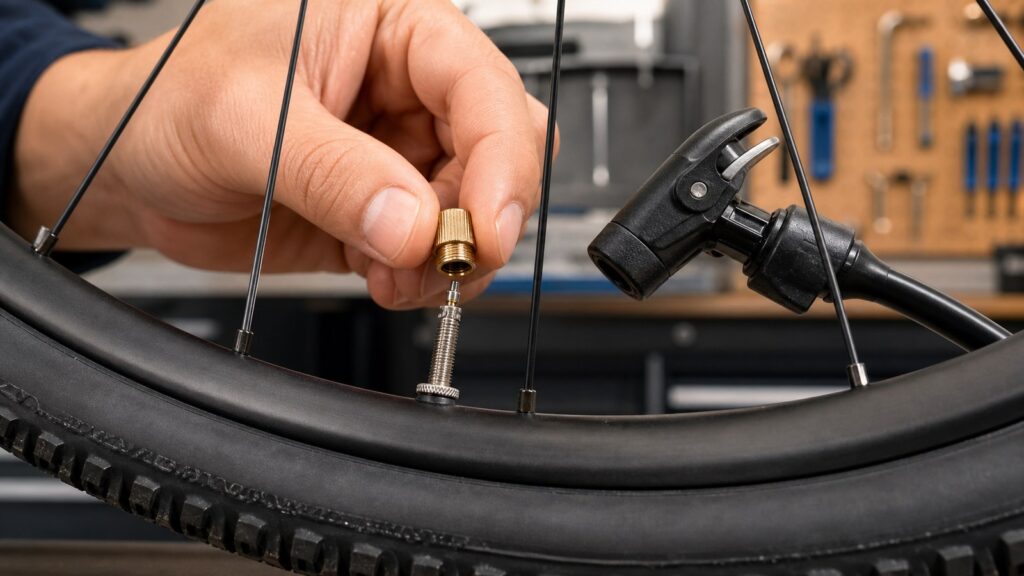
A Presta valve adapter is a small brass sleeve that screws onto an opened Presta valve so a Schrader pump head, a car compressor or a gas-station air hose can fill the tire. First check which valve you have: a thin stem with a knurled nut at the tip is Presta, a car-style valve with a pin inside is Schrader, and a wide base with a narrow top and a large knurled ring is Dunlop (Woods). To pump any of them, open the valve if it is Presta, push the matching pump head on straight, lock the lever and stop at a pressure inside the range printed on the tire.
Jump to: how to use a Presta valve adapter | pumping steps for each valve | floor pump, mini pump, CO2 or compressor
If the tire takes no air at all, or takes air and goes flat again, start with our bike tire won’t inflate guide instead.
Which valve does your bike have?
Look at the top of the valve and at its width. Presta stems measure about 6 mm across and Schrader stems about 8 mm (Park Tool, Schwalbe). The rim hole follows the valve: 6.5 mm for Presta and 8.5 mm for Schrader (Schwalbe Tech Info, Michelin).
| Valve (other names) | How to spot it | Stem and rim hole | Open it before pumping? | Pump head that fits |
|---|---|---|---|---|
| Presta (Sclaverand, French, SV) | Thin stem, threaded near the top. A small knurled nut sits on a pin at the very tip. | 6 mm stem, 6.5 mm hole | Yes. Unscrew the tip nut. | Presta side of the head |
| Schrader (car, auto, AV) | Looks like a car tire valve. A spring-loaded pin sits inside the threaded mouth. | About 8 mm stem, 8.5 mm hole | No | Schrader side, or a gas-station hose |
| Dunlop (Woods, English, Dutch, DV) | Wide base like a Schrader, a narrow top, and a large knurled ring holding the core in. | About 8 mm body, needs the larger hole | No. Leave the ring alone. | Presta head |
| Tubeless valve (Presta type) | Presta tip, a rubber seal at the base, a rim nut, and often a removable core with two wrench flats. | 6 mm stem, 6.5 mm hole | Yes, like any Presta | Presta side |
| Schwalbe Clik Valve | A dust cap that pulls off instead of unscrewing. Standard on several Schwalbe tubes, or fitted as a conversion. | Matches the valve it converts | No. The head clicks on. | Clik head or Clik adapter; a push-on Presta head also works |
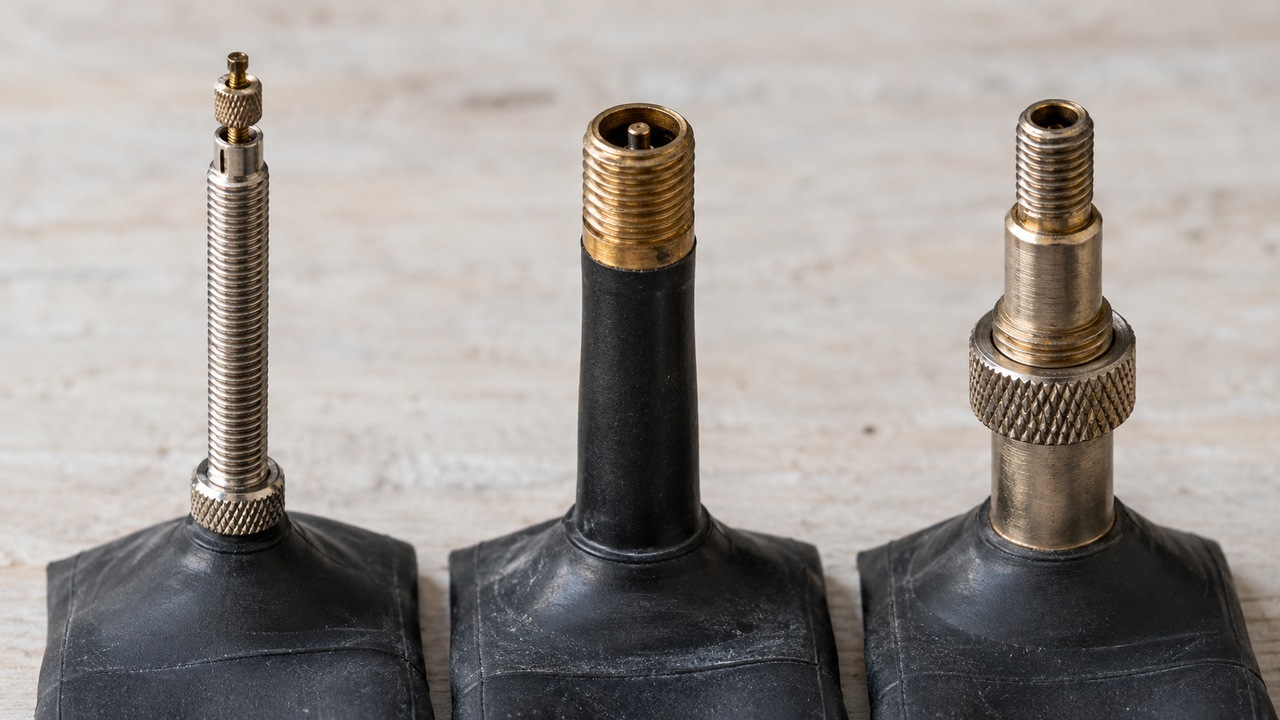
Where you will see each one: Presta is the valve on mid and higher priced road and mountain bikes (Park Tool). Michelin places Schrader on commuter, leisure and some mountain bikes, and it fills at a gas-station compressor. Dunlop turns up on less expensive bikes sold outside the United States, with England, Germany, the Netherlands, Sweden, Finland and Japan on Michelin’s list. Schwalbe also names a fourth type, the Italian Regina valve, which looks like a Presta and is used almost only in Italy.
Which type is better? Schwalbe says air-retention differences between the three are a thing of the past. What matters is that the valve fits your rim hole and your pump. Presta weighs about 4-5 g less and needs a smaller hole, which suits narrow rims. Michelin rates Schrader as the easier valve if you rarely adjust pressure.
Can you swap one valve type for another?
Skip this if you are buying the same valve your bike came with. Otherwise, it works in one direction only. A Presta tube fits a Schrader rim with a valve hole reducer, but a Schrader valve will not pass through a 6.5 mm Presta hole (Michelin). Use the reducer: Schwalbe’s Tech Info warns that a Presta tube in an oversized hole often tears off where the metal edge cuts the stem, and that some rims have a 6.5 mm hole on the outside but 8.5 mm on the inside.
Presta valve adapters: what they do and when they work
A Presta-to-Schrader adapter threads onto the top of the Presta stem and gives it the outside shape of a Schrader valve. It has no valve of its own. Air still has to pass the Presta valve, so you must open the tip nut before the adapter goes on. Schwalbe lists a gas station plus a small adapter as a way to check and set tire pressure.
| Your valve | Your air source | Works? | What you need |
|---|---|---|---|
| Presta | Floor pump with a dual or Presta head | Yes | No adapter. Open the tip nut and use the Presta side. |
| Presta | Schrader-only pump, gas-station hose, car compressor | With an adapter | Presta-to-Schrader adapter screwed onto the opened valve |
| Presta on a deep rim | Any pump | Only if the stem is long enough | A 60 or 80 mm valve, or a valve extender. With a removable core, use an extender that threads into the valve’s inner thread (Park Tool). |
| Schrader | Schrader head or gas-station hose | Yes | Nothing |
| Schrader | Presta-only head | No | Flip the head’s insert, use the other hole, or use another pump. |
| Dunlop | Presta head | Yes | Nothing. No need to loosen the ring (Park Tool). |
| Dunlop | Schrader-only pump | Not with that head | Icebike’s advice: use a pump with a Presta or dual head, since the maker guides only confirm Presta heads on Dunlop. |
| Schwalbe Clik Valve | Clik head, or a pump fitted with Schwalbe’s Clik head adapter | Yes | The adapter fits the Schrader slot of a head that already takes car valves (Schwalbe). |
| Schwalbe Clik Valve | Normal Presta pump | Push-on or clamp heads only | Screw-on heads do not fit, and Schwalbe says you cannot read pressure this way. |
| Presta tube in a Schrader-size rim | Any | Fits, with a risk | A valve hole reducer, so the hole edge cannot cut the stem |
The adapter works one way only. A Presta-only head cannot fill a Schrader valve, because a Schrader fitting has to press the pin inside the valve with a plunger, as Park Tool describes it.
How to use a Presta valve adapter
- Take off the cap.
- Open the valve. Unscrew the knurled tip nut counterclockwise until it stops. It stays on the pin.
- Press the tip for a second. A short hiss tells you the valve opens and is not stuck.
- Thread the adapter on by hand, clockwise, until it is snug. Skip the pliers; the thin Presta pin bends easily.
- Push the Schrader head or gas-station chuck straight on and lock it. Add air in short bursts and check the pressure after each one. That is Icebike’s rule, because a car hose fills a small bike tire far faster than a hand pump.
- Finish. Pull the head off, unscrew the adapter, tighten the tip nut with your fingers and refit the cap.
Using a car compressor or a station machine with a pressure preset? Set the target, then check it with your own gauge. Park Tool’s instructions for its shop inflator note that the gauge does not show true tire pressure while air is flowing, so stop and read it with the trigger released.
Icebike’s advice: you can leave the adapter threaded on between rides once the tip nut is closed. The adapter holds no air by itself.
When the adapter hisses or the tire stays soft
- The tire takes no air and the gauge jumps high: the tip nut is still closed or the valve is stuck. Icebike’s explanation: the pump is pressurizing only its own hose. Remove the adapter, open the nut and press the tip.
- Air hisses at the adapter: it went on crooked or is loose. Back it off and start the thread again by hand.
- Air hisses at the chuck: the head is not pushed far enough onto the adapter. Push it straight down and lock it.
- Air hisses from the tip after you remove the adapter: the valve core loosened. A removable Presta core has two wrench flats; snug it with a core tool or a small adjustable wrench.
- The valve sinks into the rim when you push: fit the rim nut, finger tight only. It stops a soft tire’s valve from falling inside.
How to pump a bike tire, valve by valve
Before you start, find the pressure range printed on the tire sidewall. Mount the tire with that label next to the valve and you can read it while you pump. The steps below assume a floor pump; the next section covers mini pumps, CO2 and compressors.
Presta valve (including Presta tubeless)
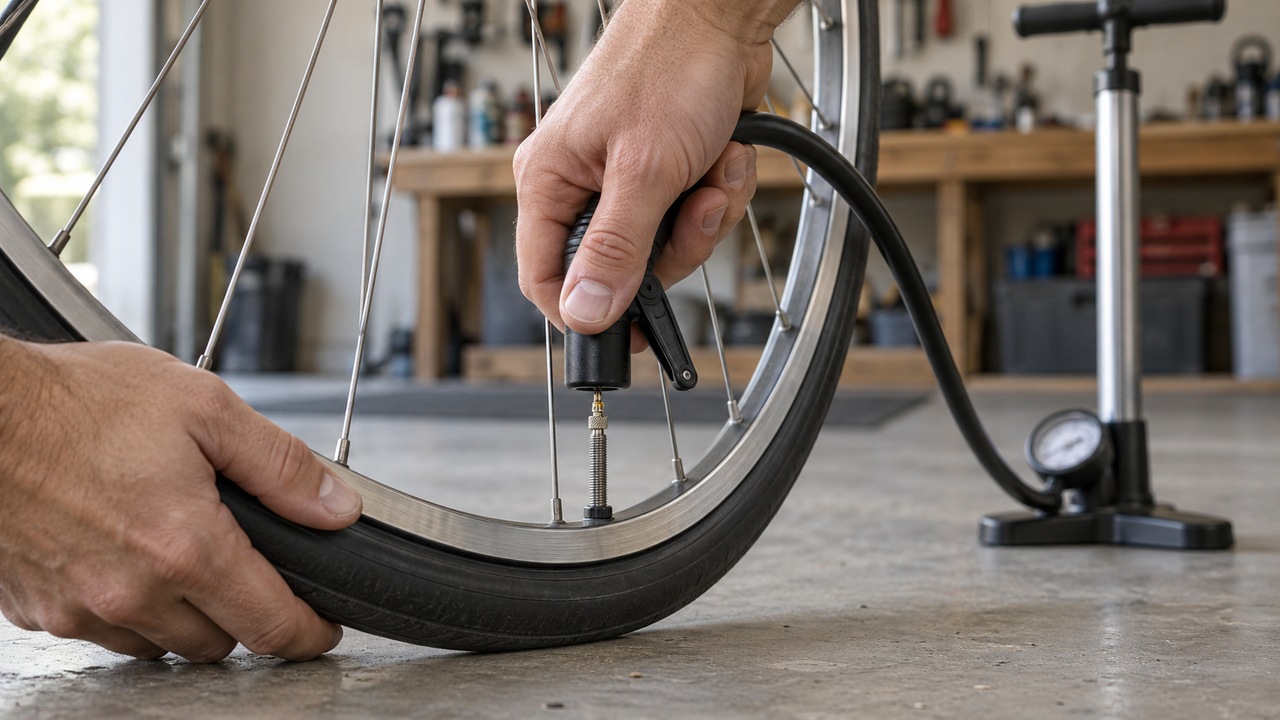
- Take off the cap, unscrew the tip nut until it stops, and press the tip for a second.
- Set the pump to Presta. On a dual head, use the smaller hole. On a single head with a reversible insert, turn the insert to its Presta side.
- Push the head straight onto the stem until the seal grips the threads, then flip the lever to lock it. Hold the tire with your other hand so the stem stays straight.
- Pump with full strokes. Read the gauge between strokes, when the needle settles.
- At your target, flip the lever and pull the head straight off in one motion.
- Tighten the tip nut with your fingers and refit the cap.
Schrader valve
- Take off the cap.
- Use the Schrader side of the head and push it all the way on. The plunger inside the head has to press the valve pin, or no air goes in.
- Lock the lever and pump, reading the gauge between strokes.
- Unlock the lever and pull the head straight off. A brief hiss as the pin closes is normal.
- Refit the cap to keep grit out of the core.
Dunlop (Woods) valve
- Unscrew the small dust cap only. Leave the large knurled ring tight; it holds the core in.
- Use the Presta side of the head, push it on and lock it.
- Pump, remove the head and refit the cap.
Schwalbe notes that you cannot check pressure through a traditional Dunlop valve; its own Dunlop design lets air flow back so a gauge works. On an older Dunlop valve, treat the pump gauge as a rough guide.
Schwalbe Clik Valve
Pull off the dust cap, push the Clik head on until you hear and feel it engage, pump, and pull the head off. There is no nut to open or close. Schwalbe says any hiss as the head comes off is air from the pump hose, not from the tire. To let air out, press the valve with the edge of the dust cap.
Tubeless valves
Pump a Presta-type tubeless valve like any Presta. The differences come at setup: the core comes out to inject sealant and goes back in before riding, and a new tubeless tire may need a fast burst of air to seat the bead. Our guide to inflating tubeless tires covers that first inflation.
Floor pump, mini pump, CO2 or compressor?
Each one fills the same valves. They differ in speed, accuracy and where you can use them.
| Air source | Best for | Gauge | The one rule |
|---|---|---|---|
| Floor (track) pump | Home, every ride | Usually built in | Use it for your regular top-ups; Schwalbe recommends one with a gauge for every active cyclist. |
| Mini pump | Roadside repairs | Often none | Brace the valve and expect many short strokes. Match HP models to road tires and HV models to wide tires. |
| CO2 inflator | Fast roadside fills | None | Fit the head before you release gas, hold it with a glove, and refill with air at home. |
| Electric pump or car compressor | Home and car trips | Digital or built in | Set the target pressure. Presta needs an adapter on a Schrader-only hose. |
| Gas-station air | When nothing else is around | On the machine | Presta adapter, short bursts, then check with your own gauge. |
Floor pump
Stand on the base, keep the hose free of kinks, and push the handle down with straight arms. In short, a piston pushes air from the barrel down the hose and through the valve, and the tire’s own valve stops it coming back between strokes.
How to use a mini pump
- Open the valve if it is Presta.
- Attach the pump. Many mini pumps, Lezyne’s among them, use a short flexible hose that threads onto the valve; screw it on, then connect it to the pump. A push-on head goes straight on, with its insert set to your valve type.
- Brace the head and the tire together in one hand so the strokes do not rock the stem. The Presta pin and stem bend easily.
- Pump with short, full strokes. It takes far more strokes than a floor pump.
- Unscrew or pull off the head and close the valve. If a threaded hose pulls a Presta core loose, tighten the core again; Lezyne builds a core tool into some of its hoses for this.
Lezyne sells mini pumps in two versions: high pressure (HP) for road tires, such as its Pressure Drive rated to 120 psi, and high volume (HV) for gravel and mountain bike tires. Many mini pumps have no gauge, so top up with a floor pump or check with a tire gauge when you get home.
CO2 inflator
- Fit the head first. Thread or press the inflator head onto the opened valve. Lezyne’s Trigger Drive head threads onto both Presta and Schrader valves and uses a trigger valve, so you control the flow and can stop short of full.
- Protect your hand. The cartridge gets cold as the gas comes out. Lezyne fits a neoprene sleeve to insulate your hand; a glove does the same job.
- Check your sealant before using CO2 on a tubeless tire. Schwalbe’s Tech Info says not to use CO2 cartridges with its own sealant, because CO2 harms it. Other sealant makers give their own advice, so check yours.
- Refill with air at home. Icebike’s advice: let the CO2 out and pump the tire up with air, because CO2 escapes through a butyl tube faster than air does.
Electric pumps, car compressors and gas stations
Electric pumps let you set a target and stop there. Lezyne’s E-Drive, for example, goes to 120 psi (8.25 bar) with digital pressure control and fits Presta, Schrader and Clik valves through its hose. Car compressors and gas-station hoses carry Schrader chucks, so a Presta valve needs the adapter steps above. Bike tires hold little air compared with car tires, so add it in short bursts and confirm the reading with your own gauge.
Reading the gauge and choosing your target pressure
Pick the number before you pump. The sidewall gives a minimum and a maximum. If the rim lists a lower maximum, follow the rim. On hookless (TSS) road rims the ISO/ETRTO maximum is 5 bar (72.5 psi), whatever the tire label says (ENVE). Inside those limits, rider weight, tire width and surface decide the best pressure, and wider tires run lower. Our bike tire pressure calculator turns those inputs into a starting number.
- Read the right scale. Most floor-pump gauges show psi and bar. One bar equals 14.5 psi.
- Read between strokes. The needle swings up while you push. Pause and read it once it settles.
- Use the target marker if your gauge has one. Set it before you start, then pump until the needle meets it.
- Trust the gauge over your thumb. Schwalbe says every tire feels equally hard to the thumb from about 2 bar (29 psi) up.
- Check the gauge itself. Icebike’s advice: compare your pump against a separate tire gauge once a season, because pump gauges drift. Our guide to checking bike tire pressure covers gauge types.
How often should you pump your tires?
Check pressure at least once a month. Schwalbe treats a loss of about 1 bar (14.5 psi) a month as normal for a tube, faster at high pressure, and recommends a check before every ride with latex tubes. If you lose air faster than that, read why bike tires lose air. Riding in the cold? Pressure drops as the tire cools, so set it outdoors or use the winter bike tire pressure calculator.
Quick answers
Can you use a Schrader pump on a Presta valve without an adapter?
No. Icebike’s explanation: a Schrader head is sized for an 8 mm stem, so it cannot seal around a 6 mm Presta stem, and air escapes around it. Pushing harder risks the thin Presta pin. Screw a Presta-to-Schrader adapter onto the opened valve, or use a dual-head pump.
Do Presta adapters work with an air compressor or at a gas station?
Yes. Open the Presta tip nut, screw on the adapter and use the compressor or station hose in short bursts. Release the trigger to read the gauge, then confirm the result with your own gauge before you ride.
Why does air hiss when I take the pump off?
A short hiss that stops at once is the air in the pump hose and head. A hiss that keeps going after the head is off means the valve is still open: close a Presta tip nut, or press and release a Schrader pin. If it still leaks, the core is loose or damaged, and our tire won’t inflate guide walks through the core fix.
Do you need to let air out of a Presta valve before pumping?
No. You only press the tip for a second after opening the nut, to free a valve that has stuck shut. The puff of air you lose is tiny.
Sources
- Park Tool. Tire and Tube Removal and Installation. Valve types, Schrader stem of about 8 mm with a plunger-operated pin, core removal, pressure label beside the valve.
- Park Tool. Tire, Wheel and Inner Tube Fit Standards. Presta stems nominally 6 mm with a locknut that must be unthreaded, removable cores with two wrench flats, 60 and 80 mm stems and extenders, Dunlop inflation with a Presta head.
- Park Tool. Tubeless Tire Removal and Installation. Core removal for sealant injection.
- Park Tool. INF-2 Shop Inflator instructions (PDF). Presta and Schrader head; the gauge does not show true tire pressure during inflation.
- Schwalbe. Tech Info (2015 edition, PDF). Valve types, 6 vs 8 mm, weight, Presta pin, Dunlop pressure checks, Regina valve and rim nut (p. 30); valve tear-off and 6.5 vs 8.5 mm holes (p. 31); monthly checks, 1 bar per month, thumb test, gas-station adapter, track pump and wide-tire pressure (p. 36); no CO2 with Schwalbe’s tubeless sealant (p. 40).
- Schwalbe. Clik Valve and FAQ. Conversion kits, pump head adapter, push-on Presta pump compatibility, pull-off cap, hose air on removal.
- Schwalbe. Road Bike Technology. Follow the rim’s maximum pressure when it is lower than the tire’s.
- Lezyne. Product specifications: Trigger Drive CO2 (trigger valve, Presta and Schrader head, insulating sleeve), Pressure Drive (high-pressure hand pump to 120 psi, threaded hose with core tool), Pocket Drive HV (high-volume version), E-Drive (electric pump, 120 psi, preset pressure).
- Michelin. What are the different types of bike tire valves? Rim holes of 6.5 and 8.5 mm, valve hole reducers, Dunlop regions and Presta-head inflation, where Schrader is used.
- ENVE. Hookless Rim Technology 101. ETRTO/ISO maximum of 5 bar (72.5 psi) on hookless rims.