
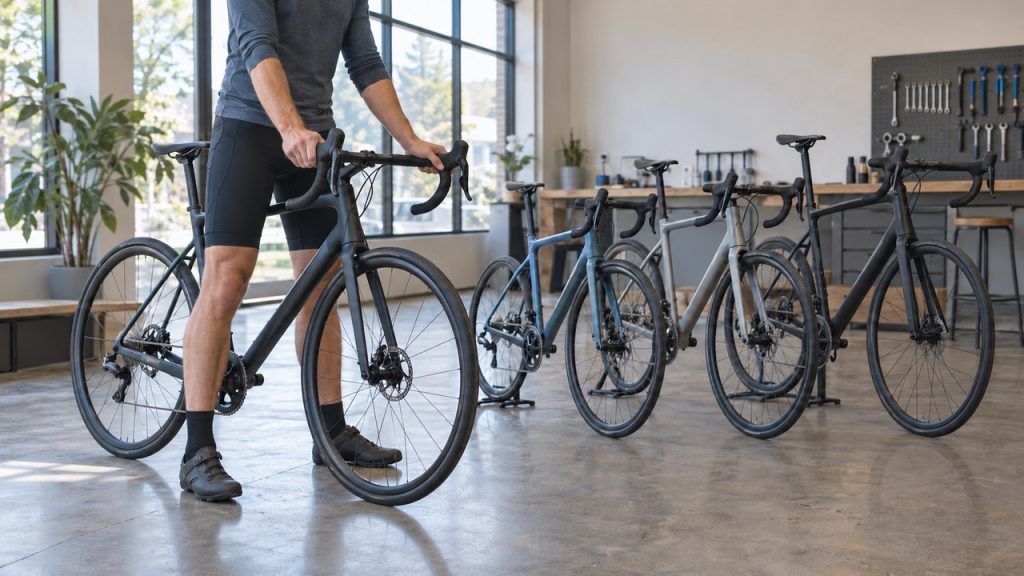
What size bike do I need?
Find your height in the chart below and read across to your bike type for a starting size. Then check your inseam against the bike’s standover height and compare reach before you buy. For a rider 5’8″ to 5’11” (172-180 cm), Giant’s charts point to a Medium road, gravel, mountain or hybrid bike. On a road bike sized in centimeters, that Medium matches a traditional 54-56 cm frame. Kids’ bikes go by wheel size.
Bike size chart by height
Road bikes use centimeters. Gravel, mountain and hybrid bikes use letters (S, M, L) and sometimes inches. Each column uses its own system, so a 54 cm road bike and a 17-inch mountain bike can both fit the same rider.
| Rider height | Typical inseam | Road (cm) | Gravel | Mountain (seat tube) | Hybrid |
|---|---|---|---|---|---|
| 4’11”-5’2″ (150-158 cm) | 68-73 cm (27-28.5 in) | 47-49 (XXS-XS) | XS | XS (13-14 in) | XS |
| 5’2″-5’5″ (158-165 cm) | 72-77 cm (28.5-30.5 in) | 49-51 (XS) | XS-S | S (15 in) | S |
| 5’5″-5’8″ (165-172 cm) | 75-80 cm (29.5-31.5 in) | 51-53 (S) | S | S-M (15-17 in) | S-M |
| 5’8″-5’11” (172-180 cm) | 78-84 cm (30.5-33 in) | 54-56 (M) | M | M (17 in) | M |
| 5’11”-6’1″ (180-186 cm) | 82-86 cm (32.5-34 in) | 56-58 (M/L) | M/L | L (19 in) | L |
| 6’1″-6’4″ (186-193 cm) | 85-90 cm (33.5-35.5 in) | 58-60 (L) | L-XL | L-XL (19-21 in) | L-XL |
| 6’4″-6’7″ (193-200 cm) | 88-93 cm (34.5-36.5 in) | 60-62 (XL) | XL | XL (21 in) | XL |
| 6’7″ and up (200+ cm) | 91+ cm (36+ in) | 62-64 (XXL, few brands) | XL-XXL | XXL (22 in+) | XL-XXL |
The letter columns from about 5’3″ to 6’7″ follow Giant’s published rider-height ranges for four models (listed in Sources). Giant’s mountain and hybrid models start at S and stop at XL, so treat the first and last rows as estimates and confirm them on the brand’s own chart. The inseam column assumes a book-method inseam of about 45.5-46.5% of height, a typical adult proportion; your own measurement beats it. Run any row’s road size back through the 0.67 formula below and you land inside that row’s inseam range. Size ranges overlap: Giant lists its Medium Contend road bike for 171-181 cm and its M/L for 177-187 cm. If your height lands in an overlap, skip to the between-sizes section.

Already know your bike type? The mountain bike size chart, gravel bike size chart and women’s bike size chart go deeper on each one.
Kids bike sizes at a glance
Kids’ bikes go by wheel size, and makers’ charts overlap. Trek, woom and Guardian agree on a 14 in wheel for children about 37-43 in tall (ages 3-5), 16 in at 41-46 in (ages 4-6), 20 in at 45-51 in (ages 5-9), 24 in at 51-55 in (ages 7-12) and 26 in from about 55 in (ages 9-14). Between two sizes, the child’s inseam and the bike’s lowest seat height decide. Our kids bike size chart compares six makers’ charts by age, height and inseam, and our balance bike size chart covers toddlers.
Kids Bike Size Calculator
Estimate a child bike wheel size from height, inseam, age, and confidence level.
How to calculate bike size from your inseam
Height gets you to a row in the chart. Inseam gets you to a size, because two riders at 5’10” can differ by 5 cm or more in leg length.

To measure your inseam:
- Take off your shoes and stand with your back against a wall, feet about 20-25 cm (8-10 in) apart.
- Pull a hardcover book up between your legs, spine up, with the pressure of a saddle.
- Have a helper measure from the floor to the top of the spine. Measure twice and use the average.
Then multiply by the factor for your bike type:
| Bike type | Formula | Example: 81 cm (32 in) inseam |
|---|---|---|
| Road | inseam (cm) x 0.67 = frame size (cm) | 54 cm |
| Gravel | inseam (cm) x 0.66 = frame size (cm) | 53 cm, or M on letter-sized frames |
| Mountain | inseam (cm) x 0.226 = frame size label (inches); the measured seat tube is often shorter | 18.3 in, between M and L |
| Hybrid | Use the height chart | M for most riders 170-180 cm |
These factors are shop conventions and no standards body sets them. Published road factors run from 0.67 to 0.70. At 0.70, an 80 cm inseam comes out at 56 cm, a full size bigger than the 54 cm that 0.67 gives and that Giant’s height ranges support. The mountain bike formula tends to read a size long on modern trail bikes, which pair short seat tubes with long reach. Giant’s Medium Talon has a 16.9 in seat tube, under the 18.3 in the formula suggests for an 81 cm inseam. Treat the result as a pointer to two sizes, then pick between them with the standover and reach checks below.
The calculator uses the road, gravel and mountain factors above, adds its own estimates for hybrid and city bikes, and shifts the result for a relaxed or aggressive riding position. Compare any result with the brand’s size chart:
Bike Size Calculator By Type
Estimate a starting frame size for road, gravel, mountain, hybrid, and city bikes from height, inseam, and riding style.
Why a 54 cm road bike and a 17-inch mountain bike fit the same rider
A reader once asked why a hybrid listed as “16 in” also showed “53-54 cm” when 16 inches is about 41 cm. The two numbers measure different things. Mountain and hybrid sizes in inches are a size label; the measured seat tube is often shorter, so compare reach and standover on the geometry chart. Road sizes in centimeters started as seat tube lengths on level steel frames. Cannondale’s road sizing guide says a “56cm” road bike today “probably doesn’t have any measurement that equals 56cm”; the label tells you which traditional size it matches.
Giant’s Medium frames for a rider around 5’9″ show how far apart the numbers sit:
| Giant Medium frame | Seat tube | Reach | Stack | Standover |
|---|---|---|---|---|
| Contend 3 (road) | 500 mm (19.7 in) | 378 mm | 563 mm | 774 mm |
| Revolt 2 (gravel) | 470 mm (18.5 in) | 387 mm | 586 mm | 752-759 mm |
| Talon 3 (mountain, 2020) | 430 mm (16.9 in) | 419 mm | 605 mm | 749 mm |
| Escape 3 (hybrid) | 485 mm (19.1 in) | 410 mm | 556 mm | 754 mm |
Same rider, seat tubes from 16.9 to 19.7 inches. Reach and standover are the numbers that carry over between bike types. Compare those when you shop across brands, and ignore the size label.
Standover check: 1-2 inches on the road, 2-4 on trails
Stand over the top tube with both feet flat, in the shoes you ride in. You want 2.5-5 cm (1-2 in) between you and the tube on a road, gravel or hybrid bike, the range Cannondale gives in its road sizing guide. On a mountain bike, aim for about 5-10 cm (2-4 in), because you will step off in a hurry on rough ground. Both ranges are shop rules of thumb.

You can run this check from a geometry chart before you see the bike. Subtract the listed standover height from your inseam:
- 81 cm inseam on a Giant Contend M (774 mm standover): 3.6 cm clearance. Inside the target.
- 81 cm inseam on a Giant Talon L (788 mm on the 2020 chart): 2.2 cm. Under the 5 cm trail target, so the Medium at 749 mm (6.1 cm clearance) is the better mountain bike pick.
Skip this check on step-through frames. Use saddle height and reach instead.
Should your feet touch the ground when you sit on the saddle?
Your toes, at most, on an adult bike. With the saddle set for pedaling, you reach the ground with your tiptoes or the ball of one foot, or tip the bike to put a foot down. Both feet flat while seated means the saddle sits too low and your knees bend too far on each stroke. Flat feet belong to the standover check, standing over the top tube. Kids learning to ride are the exception and often start flat-footed.
Reach check: does the cockpit fit?
Reach is the horizontal distance from the bottom bracket to the top of the head tube. It sets how far forward you lean. Too long and your hands, neck and lower back take the load. Too short and your knees come close to the bars when you stand.
Giant’s own charts show road and mountain sizes change in different ways. On the Contend, going from S to M to M/L adds 3-6 mm of reach per size and 14-22 mm of stack (bar height). On the Talon, each size up adds 15-21 mm of reach. A road size change lifts the bars more than it moves them forward. A mountain bike size change stretches you out.
In the shop, sit on the bike with your hands on the hoods or grips. Your elbows should bend a little. If you have to lock your arms to reach the bars, try the smaller size.
Between two sizes? Use this decision table
| Your situation | Pick | Reason |
|---|---|---|
| Long torso or long arms for your height | Larger | The longer top tube keeps you from feeling cramped (Cannondale’s guidance). |
| Short torso or limited flexibility | Smaller | Shorter reach, and you can add stem spacers to raise the bars. |
| New rider, technical trails or ice | Smaller | More standover and a bike that turns and stops on command. |
| Long road rides, stable at speed | Larger, if standover passes | A taller front end and longer wheelbase settle the bike at speed. |
| Child between wheel sizes | The size they control now | A child who can stop and start with ease rides more and learns faster. |
Changing a stem costs far less than replacing a frame. A bike one size small can take a longer stem. You can’t shorten the seat tube on a frame one size too big, so if standover fails, go down a size.
Sizing a bike for winter riding and ice
Winter changes two inputs. Boots with thick soles raise you off the pedals, and on ice you put a foot down more often and with less warning. If a winter commuter or fat bike falls between two sizes, take the smaller one. Do the standover test in your winter boots and riding pants, and aim for at least 2 in (5 cm), the low end of the trail range.
Fat bikes ride on 4-5 inch tires, which lift the whole frame. Two fat bikes with the same seat tube can differ in standover, so read the standover line on the geometry chart. The saddle height calculator linked in the next section has a setting for winter boots on flat pedals.
After you buy: set saddle height first
A correct frame still rides wrong with the saddle in the wrong place. Start with the bike saddle height calculator, then fine-tune on the bike. Ferrer-Roca and colleagues studied trained cyclists and used a knee bend of 30-40 degrees at the bottom of the stroke, measured while pedaling, as the target. They found that the common rule of setting saddle height at 106-109% of inseam does not guarantee that angle, so check your knee on the bike instead of trusting a single number.
Look for the minimum insertion mark on the seatpost. US federal bicycle rules (16 CFR 1512.15) require that mark, and it has to stay inside the frame. If you need to raise the saddle past the line, the frame is too small. Our guide to how to measure a bike frame shows how to check a used bike’s size when the label has worn off.
Sources
- Giant Bicycles. Contend 3 (2025) size chart and geometry. Rider height by size, seat tube, reach, stack and standover.
- Giant Bicycles. Revolt 2 (2026) size chart and geometry.
- Giant Bicycles. Talon 3 (2020) size chart and geometry.
- Giant Bicycles. Escape 3 (2024) size chart and geometry.
- Giant Bicycles. ARX 20 and ARX 24 (2020) rider height ranges.
- Cannondale. What Size Road Bike Do I Need? (January 22, 2024). Standover clearance, nominal frame sizes, torso length.
- Ferrer-Roca V, Roig A, Galilea P, García-López J. Influence of saddle height on lower limb kinematics in well-trained cyclists: static vs. dynamic evaluation in bike fitting. J Strength Cond Res. 2012;26(11):3025-3029.
- US Code of Federal Regulations. 16 CFR 1512.15, Requirements for seat. Seatpost minimum insertion mark.
- Formula conventions: road factor 0.67 as published by Bicycles Quilicot; mountain bike factor 0.226 as published by bike-test.com. Both are rules of thumb, checked here against Giant’s height ranges. The gravel factor 0.66 is Icebike’s own estimate, set between the road factor and the calculator’s hybrid factor (0.64); no published source backs it.

Also, a very important yet overlooked factor when choosing a bike: Do you look and feel cool while riding it?
How could we forget the most important factor 🤙
Based on the chart above, the hybrid size I should get is:
16″ 53-54 cm
I’m confused, 16″ is only ~41 cm. When looking at bike frame sizes, are they measured differently in inches versus centimeters? It does not seem like it is a direct conversion.
“”Let assume your leg inseam is 80cm, then the perfect frame size for your right road bike size is 56 cm. According to the chart above, your perfect bike will be a small-sized road bike.””
Your calculation is right, but your decision is wrong.
Your 56cm-bike will be a ”large”-sized road bike. Right?
Great info, thanks for sharing! While I often see bikes being sold by tire size in many places, both local and online, it’s interesting to learn about the importance of frame size from sources like your site. It would be wonderful to see more alignment between the information provided and market practices. Any ideas on how to bridge this gap?
The chart is helpful for choosing a bike but I’m looking to buy a recumbent exercise bike or some other exercise bike. Any chart for that?
Are you curious what’s the right BMX size for you? Having one that fits perfectly to your height allows you to stay comfortable throughout the ride. Getting the right size for you depends on your reach and height: For people with a height of 110 to 122 cm, the suggested BMX wheel size is 16 inches. Children from seven to 11 years old that are 122 cm to 147 cm in height are good to have a wheel size of 18 inches. While people with a height of 147 cm to 193 cm can have BMX bikes 20 inch.
You can try to take measurements anywhere, but it’s best to have a solid free wall when you’re trying to stay upright. Make sure that the space is spacious when you lean back against it.
going to go with the frame 1″ below the crotch method – it seems the simplest and logical. Will see if it works
Absolutely, finding the right BMX size is crucial for comfort and performance! Based on the guidance, we’ve added a new BMX size chart to our resources. This should help further in ensuring riders find the perfect fit according to their height and age. Happy riding!
Dalton Bourne, while you can take measurements in various locations, it’s ideal to have a clear, solid wall to ensure you remain upright. Ensure there’s ample space around you, especially when leaning back against the wall.
I think this bike size chart is a great resource! It’s always helpful to have a reference when shopping for a bike, and this chart is easy to understand and use.
I’m glad you found it helpful.