
Bike Saddle Height Calculator
Compare the LeMond and Hamley & Thomas starting heights from your cycling inseam.
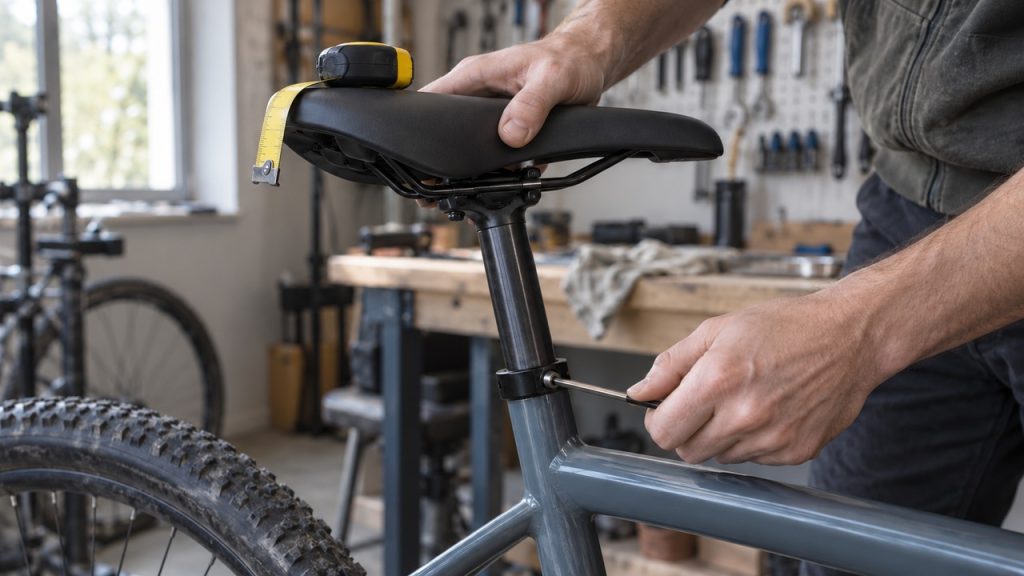
Set your saddle to the calculator’s “Start here” number, measured from the center of the bottom bracket (BB), the axle your cranks turn on, along the seat tube to the top of the saddle. For an 81 cm (31.9 in) inseam on 172.5 mm cranks that is 71.0 cm (28.0 in). Measure the inseam in socks with your back to a wall: pull a hardcover book up firmly between your legs, the way a saddle presses, and measure from the floor to the top edge of the book.
Enter your inseam in centimeters or inches, your crank length (172.5 mm unless you change it) and, if you like, any extra shoe and pedal stack in millimeters. The calculator shows four numbers in cm and inches, to one decimal place. “Start here” is the lower of the two BB figures below it, with one Icebike adjustment: before comparing, it shifts the LeMond figure 1:1 for cranks other than 170 mm, so a 5 mm shorter crank means a 5 mm higher saddle. The others are the LeMond height (0.883 × inseam, BB to saddle top), the Hamley and Thomas height (109% of inseam, pedal axle to saddle top), and that 109% height minus your crank length as an approximate BB figure. Icebike picks the lower figure because both formulas set saddles a touch high on average in testing (details below), and a 25 degree knee bend beat 35 degrees on economy.
Treat “Start here” as your first setting, then check your knee. When Peveler and colleagues tested the 0.883 formula on 19 trained cyclists in 2005, it left 35% of them outside the 25-35 degree knee bend that Holmes and colleagues recommend for preventing overuse injuries. Change the height in small steps until your knee bend falls in that range.
Which saddle height method should you use?
Four methods dominate bike-fit advice, and they measure different things. The test results in the last column come from the same 2005 study of 19 cyclists (14 men, 5 women), which scored each method against the 25-35 degree knee range. Knee angle here means degrees of bend: 0 degrees is a straight leg.
| Method | How it works | Measured from | Source | Peveler et al. 2005 result |
|---|---|---|---|---|
| LeMond, 0.883 | Inseam × 0.883 | Center of the bottom bracket to the top of the saddle | Greg LeMond’s Complete Book of Bicycling (1987) | Mean knee bend 24.3°, range 14-43°, inside 25-35° 65% of the time |
| Hamley and Thomas, 109% | Inseam × 1.09 | Pedal axle, with the pedal at the bottom, to the top of the saddle | Hamley and Thomas, J Physiol 1967 | Mean knee bend 24.2°, inside 25-35° 55% of the time |
| Heel method | Sit on the saddle, heel on the pedal at the bottom of the stroke, leg locked straight | Your own bike, shoes and cranks | Common coaching practice | Mean knee bend 30.3°, range 21-40°, inside 25-35° 70% of the time |
| Knee angle (Holmes) | 25-35° of knee bend with the pedal at 6 o’clock, measured with a goniometer | Your leg on your bike | Holmes, Pruitt and Whalen, Clin Sports Med 1994 | The reference range the other three were scored against |
The 0.883 and 109% methods produced almost the same saddles in that study (24.3 vs 24.2 degrees), because 109% is the same idea measured from the pedal instead of the crank axle. On average both gave just under 25 degrees of bend, which puts the saddle a touch above the range. The heel method set saddles lower, with a 30.3 degree average inside it. No method fit every rider: the 0.883 formula gave one cyclist 14 degrees and another 43.
Peveler’s later studies point the same way. With 27 participants in 2007, 18 of them non-cyclists, the 109% method fell outside 25-35 degrees 63% of the time; with 11 well-trained men in 2011, 73% of the time. In the 2008 study (15 participants, 10 of them non-cyclists) and the 2011 study, subjects used less oxygen at a steady effort with the saddle set to a 25 degree knee bend than at 35 degrees or at 109%. A 2011 review by Bini and colleagues suggests 25-30 degrees to reduce knee injury risk and oxygen cost.
Use a formula to get close, then set the final height by knee angle. Skip the formulas if you already ride pain-free at a height you like: measure that height and copy it to your next bike or saddle.
How to measure your inseam for saddle height
Cycling inseam runs from the floor to your sit bones, which is higher than the inseam on a pair of trousers. The Peveler studies measured it from the floor to the ischium, the bone you sit on.
- Take off your shoes. Wear thin socks or cycling shorts.
- Stand with your back and heels against a wall, feet under your hips.
- Hold a hardcover book between your legs with its spine up, and pull it up until you feel the pressure of a saddle on your sit bones.
- Keep the book level and pressed against the wall. Have a helper mark the wall at the top edge of the book.
- Measure from the floor to the mark in centimeters.
- Repeat twice. Icebike’s rule: if the three readings spread by more than 1 cm, the book was not level or not pulled up the same way. Measure again.

Saddle height chart by inseam
Each column matches one calculator output for 172.5 mm cranks and no extra stack. “Start here” is the lower of the 109% BB figure and the LeMond figure after Icebike’s crank shift (2.5 mm lower for 172.5 mm cranks), so it can sit below both of the columns to its right. The 0.883 column starts at the BB. The 109% column starts at the pedal axle. The last column turns the 109% result into an approximate BB number by subtracting the crank, which is exact only with the crank in line with the seat tube. With other cranks, use the calculator.
| Inseam | Start here (bottom bracket to saddle top) | 0.883 × inseam (bottom bracket to saddle top) | 109% × inseam (pedal axle to saddle top) | 109% minus 172.5 mm crank (approx. bottom bracket) |
|---|---|---|---|---|
| 66 cm (26.0 in) | 54.7 cm (21.5 in) | 58.3 cm (22.9 in) | 71.9 cm (28.3 in) | 54.7 cm (21.5 in) |
| 68 cm (26.8 in) | 56.9 cm (22.4 in) | 60.0 cm (23.6 in) | 74.1 cm (29.2 in) | 56.9 cm (22.4 in) |
| 70 cm (27.6 in) | 59.1 cm (23.3 in) | 61.8 cm (24.3 in) | 76.3 cm (30.0 in) | 59.1 cm (23.2 in) |
| 72 cm (28.3 in) | 61.2 cm (24.1 in) | 63.6 cm (25.0 in) | 78.5 cm (30.9 in) | 61.2 cm (24.1 in) |
| 74 cm (29.1 in) | 63.4 cm (25.0 in) | 65.3 cm (25.7 in) | 80.7 cm (31.8 in) | 63.4 cm (25.0 in) |
| 76 cm (29.9 in) | 65.6 cm (25.8 in) | 67.1 cm (26.4 in) | 82.8 cm (32.6 in) | 65.6 cm (25.8 in) |
| 78 cm (30.7 in) | 67.8 cm (26.7 in) | 68.9 cm (27.1 in) | 85.0 cm (33.5 in) | 67.8 cm (26.7 in) |
| 80 cm (31.5 in) | 70.0 cm (27.6 in) | 70.6 cm (27.8 in) | 87.2 cm (34.3 in) | 70.0 cm (27.5 in) |
| 82 cm (32.3 in) | 72.1 cm (28.4 in) | 72.4 cm (28.5 in) | 89.4 cm (35.2 in) | 72.1 cm (28.4 in) |
| 84 cm (33.1 in) | 73.9 cm (29.1 in) | 74.2 cm (29.2 in) | 91.6 cm (36.0 in) | 74.3 cm (29.3 in) |
| 86 cm (33.9 in) | 75.7 cm (29.8 in) | 75.9 cm (29.9 in) | 93.7 cm (36.9 in) | 76.5 cm (30.1 in) |
| 88 cm (34.6 in) | 77.5 cm (30.5 in) | 77.7 cm (30.6 in) | 95.9 cm (37.8 in) | 78.7 cm (31.0 in) |
| 90 cm (35.4 in) | 79.2 cm (31.2 in) | 79.5 cm (31.3 in) | 98.1 cm (38.6 in) | 80.9 cm (31.8 in) |
| 92 cm (36.2 in) | 81.0 cm (31.9 in) | 81.2 cm (32.0 in) | 100.3 cm (39.5 in) | 83.0 cm (32.7 in) |
| 94 cm (37.0 in) | 82.8 cm (32.6 in) | 83.0 cm (32.7 in) | 102.5 cm (40.3 in) | 85.2 cm (33.5 in) |
| 96 cm (37.8 in) | 84.5 cm (33.3 in) | 84.8 cm (33.4 in) | 104.6 cm (41.2 in) | 87.4 cm (34.4 in) |
Do not set a 109% number from the bottom bracket. That mix-up puts the saddle about one crank length, roughly 17 cm, too high. An earlier version of this page made the same mistake: its “road” setting showed 87.2 cm for an 80 cm inseam without saying the number started at the pedal axle.
How to set and check saddle height on the bike
- Measure the current height. Run a tape from the center of the crank axle, along the line of the seat tube, to the top of the saddle. Write it down before you change anything. This bottom-bracket-to-saddle-top number is what a seatpost height calculator means by seat height; the length of post showing above the frame is a different number.
- Set the “Start here” height. Loosen the seatpost clamp, move the post, and line the saddle nose up with the top tube again. Keep the seatpost’s minimum-insertion mark hidden inside the frame. Tighten the clamp to the torque printed on it or in the frame manual.
- Take a side photo. Sit on the bike on a trainer, or lean against a wall, in the shoes you ride in. Put the pedal at 6 o’clock with your foot in its normal pedaling position. Photograph from the side at knee height.
- Read the knee angle. Draw a line from the bony point on the outside of your hip to the outside of your knee joint, and a second line from the knee to the outside ankle bone. These are the landmarks Peveler’s 2012 study used for its goniometer. Knee bend is 180 minus the angle between the lines. The safe range is 25-35 degrees of bend (145-155 degrees between the lines). Aim for the 25-30 degree end unless it feels uncomfortable: Bini’s 2011 review suggests 25-30 degrees, and the Peveler economy studies favored 25.
- Adjust and ride. More bend than 35 degrees: raise the saddle. Less than 25: lower it. Icebike’s rule is to move 3-5 mm at a time and ride twice before you judge, because the first ride on a new height feels strange.
A photo of a still rider reads lower than a video of the same rider pedaling. In Peveler’s 2012 study of 34 cyclists, average knee bend was 28.2 degrees in the still position and 35.4 degrees during easy pedaling, falling to about 33 degrees at hard efforts. If you film yourself riding instead of taking a still photo, use the 30-40 degree target that Ferrer-Roca and colleagues used for pedaling video in 2012. A 2022 systematic review by Bini and Priego-Quesada found strong evidence for setting saddle height from knee angle measured while pedaling.
Your body gives warning signs too. Icebike’s checks: hips rocking on the saddle, or toes pointing down hard to reach the bottom of the stroke, suggest the saddle is high. A cramped feeling at the top of the stroke suggests it is low. Use these as a second check on the knee angle.
If the saddle keeps slipping down or tipping back after you tighten it, fix the clamp first: see why a bike seat keeps tilting and how to fix it by clamp type.
Cranks, shoes and winter boots change the number
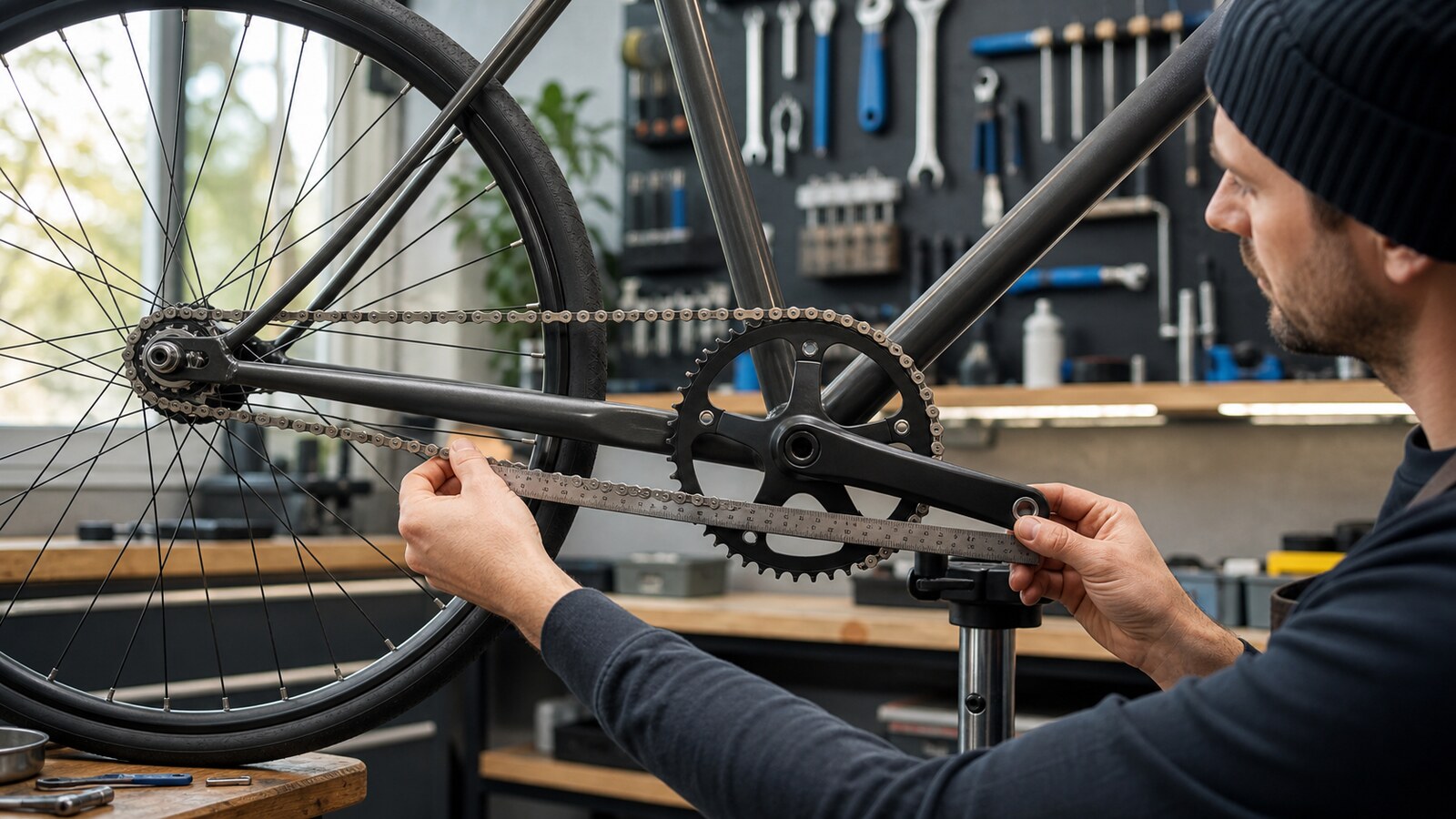
Crank length. A longer crank drops the pedal lower at the bottom of the stroke by the full difference. Moving from 172.5 mm to 175 mm cranks means lowering the saddle 2.5 mm to keep the same leg extension. Enter your crank length in the calculator and its approximate 109% bottom-bracket figure moves by that amount. The 0.883 formula ignores crank length, a gap Peveler’s 2005 paper points out; the 109% method includes it. For the “Start here” number, Icebike shifts the LeMond figure 1:1 from a 170 mm reference crank. The 170 mm reference and the shift are Icebike’s rule, not part of LeMond’s formula, and the LeMond output itself stays unshifted. Check what suits your legs with the crank length calculator.
Shoes and pedals. Anything that lifts your foot farther above the pedal axle, such as a thicker sole, an insole or a taller pedal body, calls for the same extra height at the saddle. Measure the difference between your usual setup and the new one, and enter it in the calculator’s stack field: it adds that many millimeters to every result. The field takes only positive numbers, so if the new setup is thinner, subtract the difference from the result yourself. Hamley and Thomas published in 1967, before clipless pedals existed, a limit Peveler’s 2005 paper notes. Neither formula knows your shoe and pedal stack.
Winter boots. Insulated boots add sole and liner thickness. The fitter behind UK studio Bike Dynamics estimates that his own winter boots add about 3 mm over his summer shoes, and he raises his saddle to match on longer rides. Chunky snow boots on flat pedals can add more, so measure them. On ice, some riders lower the saddle a little so a foot reaches the ground sooner. The 2022 review by Bini and Priego-Quesada found moderate evidence that saddle height changes under 4% of leg length have no effect on oxygen uptake and only trivial to small effects on leg loads, so a 1 cm drop for winter control costs you little.
Road, gravel, mountain bike and commuting
None of the formulas has a separate version for each type of bike, and the studies above tested riders on road bikes and ergometers. Icebike does not apply a riding-style multiplier for that reason. The earlier calculator on this page used factors from 1.00 for recreational riding to 1.11 for triathlon; no study we could find supports them.
- Road and gravel: use the inseam formula, then the knee angle check.
- Mountain bike with a dropper post: set the fully extended dropper to your pedaling height using the same method. The dropper takes care of descents, so you do not need to compromise. Check that the post’s extended height still leaves the minimum-insertion mark inside the frame.
- Mountain bike without a dropper: keep pedaling height for climbs and long rides. Dropping the post for technical descents is a tradeoff you make per trail.
- Commuting and city bikes: pedaling height works here too. To stop, slide forward off the saddle and put a foot down instead of lowering the saddle until your feet touch while seated.
- Time trial and triathlon: the rotated-forward position changes hip and knee angles, so check knee bend in the aero position on your own bike.
Saddle height mistakes to avoid
- Using your trouser inseam. Tailors measure to the crotch seam, not to the sit bones, so the number comes out short and the saddle ends up low.
- Setting the saddle so your feet reach the ground while seated. On most road, gravel and hybrid frames, a correct pedaling height means you tip the bike or stand over the top tube when you stop.
- Locking the knee straight while pedaling. The heel method locks the knee with the heel on the pedal. When you then pedal on the ball of your foot, the knee should bend.
- Straightening the leg to less than 25 degrees of bend for power. In Peveler and Green’s 2011 study of 11 well-trained men, a 25 degree knee bend gave better economy than both 35 degrees and the 109% formula. On power it won only part of the time: higher peak power than 109%, and higher mean power than 35 degrees. Nothing in these studies supports a straighter leg than 25 degrees.
When to see a bike fitter
Book a professional fit if knee pain continues after you have set a 25-35 degree knee angle, if one leg is longer than the other, if you get numbness or pain on one side only, or if you are new to cycling. Peveler’s 2012 study found more variation in pedaling angles among novice riders than experienced ones, which makes a static formula less reliable for them. Bini’s 2011 review reports that overuse knee pain affects about half of cyclists. Our cycling knee pain guide covers the fit checks and warning signs to raise with a fitter.
Saddle height cannot fix a frame that is the wrong size. If the seatpost needs to sit past its insertion limit, or the saddle sits so low that the knee bend stays above 35 degrees, check your size with the bike frame size calculator and the bike size chart.
Saddle height FAQ
What is the 109% saddle height method?
Hamley and Thomas set saddle height at 109% of inseam, measured from the pedal axle (pedal at the bottom of the stroke) to the top of the saddle. For an 80 cm inseam that is 87.2 cm from the pedal axle, or about 70.0 cm from the BB with 172.5 mm cranks. The calculator’s “Start here” for that rider is also 70.0 cm (27.6 in).
Is the LeMond 0.883 formula accurate?
It gets most riders close. In Peveler’s 2005 test it put 65% of 19 cyclists inside the 25-35 degree knee range, and the rest anywhere from 14 to 43 degrees. It also ignores crank length. Use the calculator’s “Start here” number as a first setting and confirm with knee angle.
How high should my bike seat be when I stand next to the bike?
No study we found has tested a standing or hip-height rule. Inseam formulas and knee angle have been tested, so measure your inseam, use the calculator and check your knee bend.
Should a mountain bike saddle be lower than a road bike saddle?
Not for pedaling. Set the same knee angle on both. A dropper post gives you a low saddle for descents without changing your pedaling height.
Can the wrong saddle height cause knee pain?
It can. Bini’s 2011 review reports that compressive force behind the kneecap seems to rise as the saddle goes lower, though the evidence on injury risk is limited. Set the knee angle first, then see a fitter if the pain stays.
Sources
- Peveler W, Bishop P, Smith J, Richardson M, Whitehorn E. Comparing methods for setting saddle height in trained cyclists. JEPonline. 2005;8(1):51-55. LeMond, 109% and heel methods scored against a 25-35° knee angle in 19 cyclists; inseam measured floor to ischium.
- Peveler WW, Pounders JD, Bishop PA. Effects of saddle height on anaerobic power production in cycling. J Strength Cond Res. 2007;21(4):1023-1027.
- Peveler WW. Effects of saddle height on economy in cycling. J Strength Cond Res. 2008;22(4):1355-1359.
- Peveler WW, Green JM. Effects of saddle height on economy and anaerobic power in well-trained cyclists. J Strength Cond Res. 2011;25(3):629-633.
- Peveler WW, Shew B, Johnson S, Palmer TG. A kinematic comparison of alterations to knee and ankle angles from resting measures to active pedaling during a graded exercise protocol. J Strength Cond Res. 2012;26(11):3004-3009.
- Ferrer-Roca V, Roig A, Galilea P, García-López J. Influence of saddle height on lower limb kinematics in well-trained cyclists: static vs. dynamic evaluation in bike fitting. J Strength Cond Res. 2012;26(11):3025-3029.
- Bini R, Hume PA, Croft JL. Effects of bicycle saddle height on knee injury risk and cycling performance. Sports Med. 2011;41(6):463-476.
- Bini R, Priego-Quesada J. Methods to determine saddle height in cycling and implications of changes in saddle height in performance and injury risk: a systematic review. J Sports Sci. 2022;40(4):386-400.
- Holmes JC, Pruitt AL, Whalen NJ. Lower extremity overuse in bicycling. Clin Sports Med. 1994;13(1):187-205.
- Hamley EJ, Thomas V. Physiological and postural factors in the calibration of the bicycle ergometer. J Physiol. 1967;191(2):55P-56P.
- LeMond G, Gordis K. Greg LeMond’s Complete Book of Bicycling. 1987.

Very nice article. I APRECIATE so much this table showing the formulas for every single case: Roadie, MTB, Tourism. And a calculator included!! and indeep details. Thank you so much, warm regards from Mexico.