
To size a new chain on most derailleur bikes, wrap it around the largest chainring and the largest rear cog without threading it through the rear derailleur, pull it snug, find the nearest rivet where the ends could join, then add two rivets (one inch) and cut there. That is Park Tool’s method for cassettes whose largest cog has 36 teeth or fewer. A 1x drivetrain with a 42-tooth or bigger cog gets four rivets (two inches) instead, and a full-suspension bike gets measured with the suspension set where your derailleur’s maker says.
Shimano and SRAM publish their own numbers, and some differ from Park’s by an inch or more. Find your drivetrain in the table, cut by that rule, then run the two-gear check.
Links, rivets and inches: how each maker counts
Mixing up these units is the easiest way to cut a chain wrong. Bicycle chains use a 1/2 in pitch (KMC lists its chain sizes as 1/2 in by an inner width), so:
- One rivet, or one single link, adds 1/2 in. Park counts rivets. Shimano’s manuals count single links and give pairs of numbers such as “4 or 5” because the two chain ends can meet two ways.
- One inner link plus one outer link adds 1 in. SRAM counts this way.
- A chain only joins inner end to outer end. A master link (Shimano QUICK-LINK, SRAM PowerLock, KMC MissingLink) takes the place of an outer link. Park says it adds half an inch, the same as one link.
So Shimano’s “add 2 links” is one inch, while SRAM’s “two inner links and two outer links” is two. The inch conversions on this page are ours.
Chain length rules by drivetrain
Each row is the maker’s own rule, with the length it adds in inches. “Big-big” means the largest chainring plus the largest rear cog, with the chain bypassing the rear derailleur.
| Your drivetrain | Where to measure | Add (maker’s words) | In inches | Source |
|---|---|---|---|---|
| Most 2x and 3x bikes, largest cog 36T or smaller | Big-big, from the nearest joinable rivet | 2 rivets | 1 in | Park Tool |
| 1x with a largest cog of 42T or more | Chainring and largest cog, from the shortest joinable length | 4 rivets | 2 in | Park Tool |
| SRAM Eagle AXS, hardtail | Chainring and largest cog, where the chain starts to overlap | 2 inner + 2 outer links | 2 in | SRAM |
| SRAM Eagle AXS, full suspension | Same, with the shock compressed to where the rear axle is farthest from the bottom bracket | 1 inner + 1 outer link | 1 in | SRAM |
| SRAM Eagle Transmission (T-Type, full-mount derailleur) | No wrap method: look up your frame | Length from SRAM’s Full Mount Chain Length Guide (AXS app or AXS Web) | Varies by frame | SRAM |
| SRAM road 1x (eTap AXS 1x, Force AXS 1x, Apex 1x) | Chainring and largest cog | 2 inner + 2 outer links | 2 in | SRAM |
| SRAM road 2x (eTap AXS 2x, Force AXS 2x) | Big-big | 1 inner + 1 outer link | 1 in | SRAM |
| SRAM RED AXS | Big-big | “one inner and one outer link and the Powerlock” | SRAM gives no inch figure | SRAM |
| Shimano MTB derailleurs in manual DM-MARD001 (XTR M9100, DEORE XT M8100/M8130, SLX M7100, DEORE M6100/M5100), hardtail | Big-big, with the zero point at the back of the largest sprocket | 4 or 5 links + QUICK-LINK; 5 or 6 links with a connecting pin | 1/2 in per link | Shimano DM-MARD001-06 |
| Same Shimano MTB derailleurs, full suspension | Same, with the suspension fully extended | 5 or 6 links + QUICK-LINK; 6 or 7 links with a connecting pin | 1/2 in per link | Shimano DM-MARD001-06 |
| Older Shimano MTB and trekking derailleurs in manual DM-MBRD001 (SLX M7000, DEORE M6000, M5120) | Big-big, at the point in the travel where the chainstay is longest | 2 links (inner meets outer) or 1 or 3 links (inner meets inner); if the chain wanders after +1, add 2 more | 1 in (or 1/2 or 1 1/2 in) | Shimano DM-MBRD001-07 |
| Shimano 12-speed Di2 road (DURA-ACE R9250, ULTEGRA R8150, 105 R7150) | Big-big | Conventional hanger: 2 or 3 links + QUICK-LINK. UDH: 1 or 2 links + QUICK-LINK | 1/2 in per link | Shimano DM-RARD010-08 |
| Shimano GRX RX810, RX812, RX400 | Big-big | 4 or 6 links (inner meets outer) or 5 links (inner meets inner) | 2 to 3 in | Shimano DM-GARD001-02 |
| Shimano 11-speed road, non-SHADOW derailleur, double crank, largest cog 27T or smaller | Largest chainring and smallest cog, threaded through the derailleur | Length where the line through both pulleys stands at 90° or more to the ground | Set by eye | Shimano DM-RD0003-09 |
| Single speed, fixed gear, hub gear | Wheel all the way forward in the dropouts, chain pulled tight | 2 rivets, then set 1/2 in of slack | 1 in | Park Tool |
Where your derailleur’s manual and Park’s general method disagree, follow the manual. Shimano’s chain manual says the same about its own general rule. Campagnolo uses a different method: Park’s Campagnolo article sizes the chain through the derailleur in the smallest chainring and smallest cog, lengthening it until the gap between the lower run and the chain at the guide pulley is 8 to 15 mm, because Campagnolo wants the longest chain the bike can use.
SRAM: wrap the chainring and largest cog, bypassing the rear derailleur, and add links “where the chain starts to overlap”. Eagle Transmission (T-Type) skips the wrap: SRAM’s Full Mount Chain Length Guide in the AXS app or on AXS Web gives the length for your frame, and you look it up again after a chainring or chainstay change. For mechanical Eagle, SRAM points to the rear derailleur’s user manual.
The big-big method, step by step
Use this when you have no correct old chain to copy. These are Park Tool’s steps for a largest cog of 36 teeth or fewer.
- Shift the front derailleur to the largest chainring and the rear derailleur to the smallest cog. The rear shift parks the derailleur out of the way while you measure.
- Wrap the chain around the largest rear cog. If one end of a new chain has an outer plate, point it toward the chainring.
- Pass it through the front derailleur cage onto the largest chainring and hold it there at about five o’clock.
- Fit half of the master link if your chain uses one. Park says this accounts for the half inch the master link adds.
- Pull the lower run snug and engage it on the chainring. Leave the rear derailleur out of the loop and check that the chain sits fully on the largest cog.
- Find the reference rivet: the closest rivet where an inner end could join an outer end. If two outer plates meet, add one rivet and use that as the reference.
- Count two more rivets (one inch) from the reference rivet and cut there. Then thread the chain through both derailleurs and join it.
Don’t cut at the reference rivet. That leaves the chain an inch short, and Shimano warns that a short chain can damage the rear derailleur.
1x drivetrains with a 42-tooth or bigger cog
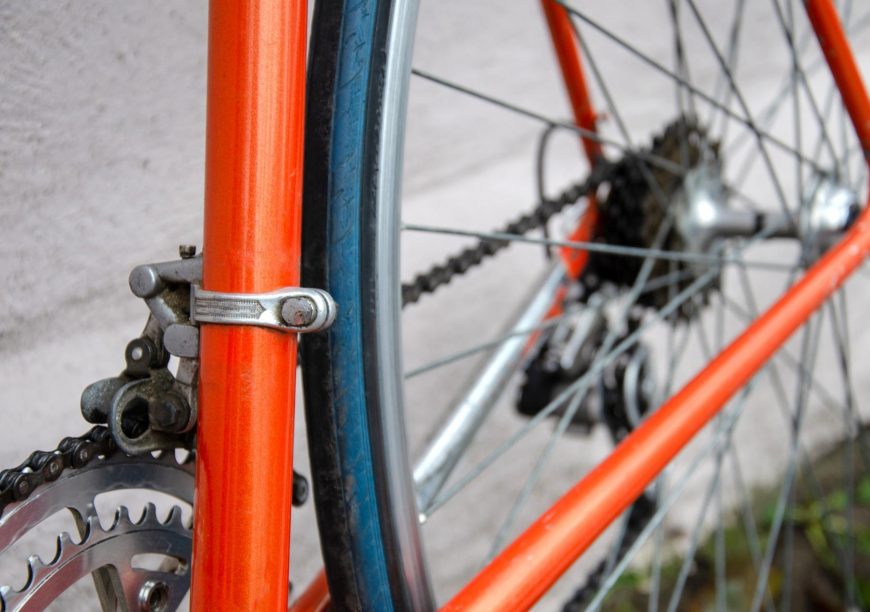
Add two inches, not one. Park Tool says dedicated 1x systems with rear cogs of 42 teeth and larger need a longer chain: route it over the chainring and the largest cog, bypassing the rear derailleur, find the shortest length where inner and outer plates connect, and count four more rivets.
Skip the 1x rule if your 1x cassette tops out at 36T or smaller. Use the derailleur maker’s rule, or Park’s big-big method if it gives none.
Shimano’s method, by derailleur family
Shimano prints chain length in each rear derailleur’s dealer’s manual. Two details the table can’t hold:
- Di2 road on a UDH (DM-RARD010). Check for slack in every gear and remove it with the B-screw.
- 11-speed road (DM-CN0001 and DM-RD0003). A non-SHADOW derailleur on a double crank with a largest cog of 27T or less skips the big-big wrap: thread the chain through the derailleur on the largest chainring and smallest cog, and size it so the line through the guide and tension pulleys stands at 90° or more to the ground. With 28T or more, add 2 links to big-big. Triple cranks use 30T and 32T thresholds. A SHADOW derailleur adds 1 to 3 links to big-big.
For a derailleur not listed here, search its model number at si.shimano.com and read the “Checking the chain length” page.
Full-suspension bikes: where to measure
Size the chain where the chainstay is longest, or the chain can come up short as the suspension moves. Shimano’s manuals warn that a short chain puts excessive load on the drivetrain. They describe it differently:
- Park Tool: disconnect the shock and compress the linkage until it bottoms out.
- SRAM (Eagle AXS): compress the shock to the point in the travel where the rear axle is farthest from the bottom bracket.
- Shimano DM-MBRD001 (older MTB): set the length “at the point in the suspension travel where dimension [X] is the greatest”, X being the bottom bracket to rear axle distance. Shimano DM-MARD001 (current MTB): check with the suspension fully extended and add one more link than on a hardtail, then confirm the chain isn’t too short in big-big where the rear axle sits farthest from the bottom bracket (p. 15).
On some frames the axle moves farthest from the cranks partway through the travel. SRAM and the older Shimano manual both describe a point in the travel rather than an end position. SRAM says to deflate or remove the shock to reach it.
Shimano adds a notice: on a bike with a lot of chainstay growth, a chain sized this way can hang slack in the smallest chainring and smallest cog with no rider on the bike. Size it at the longest point anyway.
Matching the old chain
Copying the old chain works only if it had the right length. Test it on the bike first (Park Tool):
- In big-big, the chain makes the shift with two slight bends, one at each derailleur pulley.
- In the smallest chainring and smallest cog, the chain has no slack, and the derailleur doesn’t pull so far back that the chain touches itself.
If it passes, lay both chains side by side with inner plates matched to inner plates (or outer to outer), fit the master link if there is one, and match them rivet by rivet. Don’t line up the far ends: a worn chain is longer. At 0.75% wear, a 55 in (110-link) chain has grown about 0.4 in (our math), close to a whole rivet. Shimano suggests counting the old chain’s links and cutting the new one to the same count. Check how worn yours is with the chain wear replacement estimator.
Skip this method if you changed the cassette, chainrings or derailleur, or if the old chain failed either test. SRAM says a larger cassette will likely need a longer chain, and that a chainring change can need one too.
Chain length formula and calculator
Park Tool’s older chain-sizing article (archived 2016 version; the current page drops it) gives an equation for derailleur bikes:
L = 2C + F/4 + R/4 + 1
- L: chain length in inches
- C: chainstay length in inches, bottom bracket center to rear axle center, to the nearest 1/8 in
- F: teeth on the largest chainring
- R: teeth on the largest rear cog
Round to the nearest whole inch, rounding 0.5 up, and double it for the link count. Park’s own example: 42T ring, 32T cog, 16 3/8 in chainstay gives 32.75 + 10.5 + 8 + 1 = 52.25 in, which rounds to 52 in (104 links). The “+ 1” is the derailleur inch. Park says it is for derailleur bikes only.
Park says its methods all tend to give an adequate length. Use the equation to check a cut or to order the right chain length, and cut by the wrap method on the bike.
How many links does a bike chain need?
No single number fits every bike: it depends on the chainstay and the biggest ring and cog. Park notes that replacement chains usually come longer than you need, so expect to cut some off. These examples run Park’s equation on typical setups, with the chainstay rounded to the nearest 1/8 in first (our math; the 1x rows swap Park’s one-inch allowance for its two-inch 1x rule):
| Example bike | Chainstay | Largest ring x largest cog | Sum (in) | Rounded | Links |
|---|---|---|---|---|---|
| Road 2x | 405 mm (16 in) | 52 x 30 | 32 + 13 + 7.5 + 1 = 53.5 | 54 in | 108 |
| Road 2x | 410 mm (16 1/8 in) | 50 x 32 | 32.25 + 12.5 + 8 + 1 = 53.75 | 54 in | 108 |
| Gravel 2x | 425 mm (16 3/4 in) | 48 x 36 | 33.5 + 12 + 9 + 1 = 55.5 | 56 in | 112 |
| Hybrid 3x | 450 mm (17 3/4 in) | 48 x 34 | 35.5 + 12 + 8.5 + 1 = 57 | 57 in | 114 |
| Gravel 1x | 425 mm (16 3/4 in) | 40 x 44 | 33.5 + 10 + 11 + 2 = 56.5 | 57 in | 114 |
| MTB 1x hardtail | 435 mm (17 1/8 in) | 32 x 51 | 34.25 + 8 + 12.75 + 2 = 57 | 57 in | 114 |
These examples land between 108 and 114 links. Use your own numbers, and treat the result as a check on the wrap method.
The calculator runs the same equation from a chainstay in millimeters. Pick “Derailleur” or “1x with a 42T or larger cog” and it rounds the chainstay to 1/8 in and the length to the nearest inch, as Park does; Park’s 16 3/8 in example gives 104 links. It also sits on its own page as the bike chain length calculator.
Bike Chain Length Calculator
Estimate chain length for single-speed or derailleur bikes from chainstay length and tooth counts.
Single-speed, fixed-gear and hub-gear bikes
With no derailleur, the axle position sets the tension. Park Tool’s method for BMX, fixed-gear and internally geared bikes:
- Loosen the axle nuts and move the wheel all the way forward in the dropouts. On forward-facing dropouts, snug the nuts with the wheel fully forward.
- Wrap the chain around both sprockets with the end on the chainring at about two or three o’clock. Engage the master link if you use one.
- Pull the lower run as tight as you can and find the reference rivet, where an inner end meets an outer end. If two outer plates meet, add one rivet.
- Add two more rivets (one inch) and cut. Park adds the inch so you can lift the chain off to remove the wheel, and for room to fit a larger tire.
- Join the chain, pull the wheel back, center it, and set the tension: about 1/2 in of up-and-down movement midway between the sprockets. If the sprockets are out of round, set 1/4 in at the tightest spot.
Match the chain width to the sprockets first. KMC lists single-speed and hub-gear chains in 1/8 in and 3/32 in inner widths. Our guide to tightening a bike chain covers the tension step.
Vertical dropouts can’t move the axle, so the chain length has to land on the sprocket combination. A rear chain tensioner, an eccentric bottom bracket or a half-link chain (KMC sells a Half Link series, including a BMX chain) gives you the adjustment you’re missing.
For a number before you cut, choose “Single speed or fixed gear” in the calculator above and measure the chainstay with the axle all the way forward. That mode adds the same one inch as step 4 and rounds up so the chain fits; Park notes the simple equation can run an inch short on a very short chainstay with a big ring-to-cog gap, such as 58 x 11.
Check the length before you ride
Lift the rear wheel, turn the cranks by hand and run both checks before you put weight on the pedals:
- Big-big: shift to the largest chainring and the second-largest cog, then ease into the largest cog. The chain should make it with a slight bend at each pulley. If it jams, or shifts with no bend at the pulleys, the chain is too short (Park Tool, 2016 article). Add length before you ride.
- Small-small: in the smallest chainring and smallest cog, the chain shouldn’t sag or rub against itself at the upper pulley. Sag or rub means too long.
Shimano lists what a wrong length does. Too short: the rear derailleur can be damaged, you can’t reach every gear, and the big gears get hard to pedal and noisy. Too long: shifting loses accuracy and the chain bashes from side to side. If a correctly cut chain still drops or skips, see our bike chain slipping guide.

When no length passes both checks
If the chain fails big-big at one length and small-small at the next, the gearing exceeds the derailleur’s capacity, the slack its cage can take up (Park Tool). The derailleur capacity calculator adds the chainring difference to the cog difference and compares the total with the derailleur’s rating: a 50/34 crank with an 11-34 cassette needs 16 + 23 = 39 teeth (our math). Park’s advice: size it long rather than short and avoid small-small.
Tools you need
- A chain tool. Break the chain a couple of links away from any connecting pin already in it (Park Tool).
- Master link pliers, plus a new master link or connecting pin for your chain’s speed count (see how to fix a bike chain).
- A tape measure for the equation.

Questions riders ask
Is it better to have a chain too long or too short?
Too long is the safer error. A short chain can jam in big-big and damage the derailleur; a long one shifts poorly and slaps. Park advises erring long when the gearing exceeds the derailleur’s capacity.
Sources
- Park Tool. Chain Length Sizing (August 25, 2015; accessed October 15, 2026). Old-chain checks, replacement chains usually longer than needed, big-big with 2 rivets for cogs up to 36T, 4 rivets for 1x with 42T and larger, half master link, outer-meets-outer rule, rear suspension bottomed out.
- Park Tool. Chain Length Sizing, archived December 31, 2016 (accessed October 15, 2026). Equation L = 2C + F/4 + R/4 + 1, rounding, derailleur inch only for derailleur bikes, too-short and too-long checks, derailleur capacity advice.
- Park Tool. Chain Length Sizing: Campagnolo (accessed October 15, 2026). Longest usable chain, 8 to 15 mm gap at the guide pulley in small-small.
- Park Tool. Chain Replacement: Derailleur Bikes (accessed October 15, 2026). Sizing to the original chain.
- Park Tool. Chain Replacement: Single Speed Bikes (accessed October 15, 2026). Wheel-forward sizing, 1 in added, 1/2 in tension, 1/4 in at the tightest spot.
- Shimano. DM-MARD001-06 Dealer’s Manual, Rear Derailleur (XTR M9100, DEORE XT M8100, SLX M7100, DEORE M6100/M5100; accessed October 15, 2026), pp. 13-15. Zero point, hardtail and full-suspension link counts, maximum-extension check.
- Shimano. DM-MBRD001-07 Dealer’s Manual, Rear Derailleur (SLX M7000, DEORE M6000; accessed October 15, 2026), p. 14. Longest-chainstay rule, 1 to 3 links, slack notice.
- Shimano. DM-RARD010-08 Dealer’s Manual, Rear Derailleur (Di2) (R9250, R8150, R7150; accessed October 15, 2026), pp. 27-28. Conventional hanger and UDH link counts, B-screw slack check.
- Shimano. DM-CN0001-07 Dealer’s Manual, Chain (11-speed) (accessed October 15, 2026), pp. 9-11. Road SHADOW and non-SHADOW methods, MTB rule, derailleur manual takes priority.
- Shimano. DM-RD0003-09 Dealer’s Manual, ROAD Rear Derailleur (RD-9000, 6800, 5800, 4700; accessed October 15, 2026), pp. 8-10. 90° pulley line for 27T and smaller, 2 links for 28T and larger.
- Shimano. DM-GARD001-02 Dealer’s Manual, Rear Derailleur (GRX RX810, RX812, RX400; accessed October 15, 2026), pp. 11-12. 4 to 6 links.
- Shimano. How to Check Your Chain Length (undated; accessed October 15, 2026). Count old-chain links, effects of a chain too short or too long.
- SRAM. How do I size a chain for a SRAM Eagle AXS drivetrain? (edited March 5, 2025; accessed October 15, 2026).
- SRAM. eTap AXS 1x, eTap AXS 2x, Force AXS 1x, Force AXS 2x, Apex 1x and RED AXS chain sizing articles (accessed October 15, 2026).
- SRAM. Eagle Transmission: chainring or chainstay changes, Setup Key position, larger cassette, longer chain and Eagle chain length (accessed October 15, 2026).
- KMC. FAQ: How to choose speed chain? (accessed October 15, 2026). 1/2 in pitch sizes, 1/8 in and 3/32 in single-speed widths.
- KMC. Half Link Series (accessed October 15, 2026). Half-link chains, including the HL1B BMX chain.