
How do you measure a bike frame?
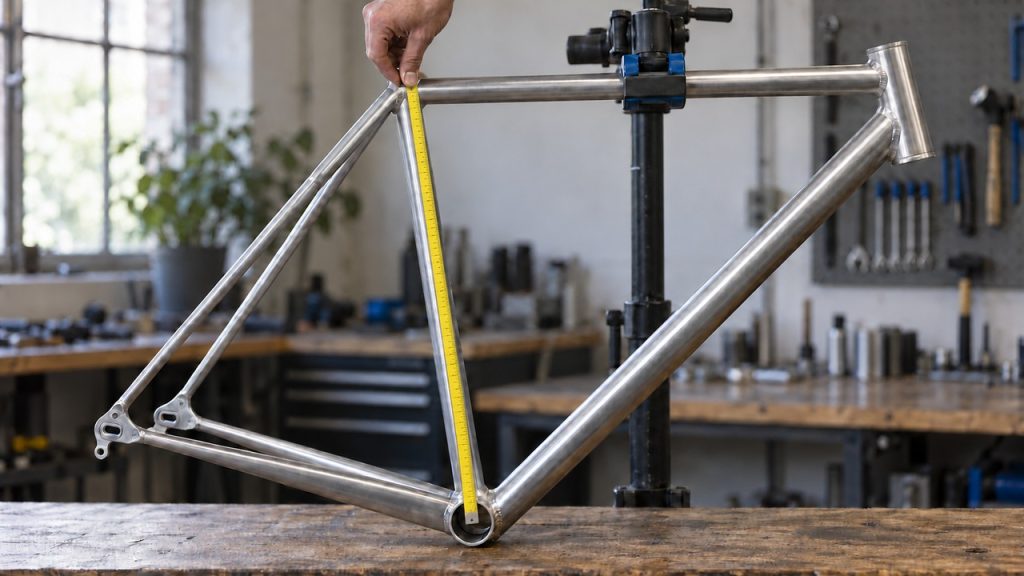
Run a tape measure from the center of the crank axle up along the seat tube to the top of the tube, where the seatpost goes in. That number is the seat tube length, and on an older steel road bike with a level top tube it was the frame size. On most bikes sold today, the size printed on the frame does not match that measurement: a Trek Domane sold as a 56 has a 52.5 cm seat tube, and a Trek Marlin sold as a 17.5 in measures 42 cm (16.5 in). Measure the seat tube, then look the bike up on the maker’s geometry chart, or compare stack and reach.
A common shortcut says the seat tube gives the size in centimeters for road bikes and inches for mountain bikes. Cannondale’s own road sizing guide disagrees: on a modern sloping frame, a “56cm” bike “probably doesn’t have any measurement that equals 56cm”. The tables below show how far apart the label and the tape get on four brands.
This page covers measuring the bike. To pick a size from your height and inseam, use our bike size chart.
Step by step: measure your bike frame at home
You need a tape measure (metric is easier), a spirit level or a long straightedge with a bubble, a piece of string with a small weight tied on as a plumb line, masking tape, and a level floor. Stand the bike upright with both tires pumped up. A helper or a wall to lean the bike against makes the stack and reach steps easier.
- Seat tube, center to top (c-t). Put the end of the tape on the center of the crank bolt or bottom bracket axle. Run it along the seat tube to the top edge of the frame where the seatpost enters, not the top of the seatpost clamp. Write it down in cm. Divide by 2.54 for inches. If the seat tube bends, as on many mountain bikes, or runs behind the bottom bracket instead of into it, hold a straightedge from the crank center to the top of the seat tube and measure along the straightedge.
- Seat tube, center to center (c-c). Same start point, but stop at the center of the top tube where it joins the seat tube. On a frame with a sloping top tube this number is a lot shorter than c-t.
- Effective top tube. Hold the level against the top center of the head tube so it points back toward the seatpost, horizontal. Mark the point where it meets the centerline of the seatpost with masking tape, and measure from the head tube center to that mark. Geometry charts call this effective, virtual or horizontal top tube. Your number matches the chart when the seatpost runs in a straight line from the bottom bracket. Full-suspension bikes and frames with a bent or offset seat tube don’t: Trek, for one, measures to an effective seat tube line drawn from the bottom bracket center to the top of the saddle at a set saddle height for each size. On those bikes your top tube number will differ from the chart, so compare reach instead.
- Stack. Measure the height of the bottom bracket center from the floor. Measure the height of the top center of the head tube from the floor, to the frame itself and not the top of the headset spacers. Subtract the first from the second.
- Reach. Hang the plumb line from the top center of the head tube and mark the floor where the weight points. Mark the floor directly below the bottom bracket center the same way. The horizontal distance between the two marks is reach.
- Standover. Measure from the floor to the top of the top tube a few centimeters ahead of the bottom bracket. Brands differ on the exact spot: Trek’s Fuel EX chart measures 100 mm forward of the bottom bracket, and Cannondale’s Synapse diagram marks 75 mm forward.
Steps 4 and 5 are Icebike’s home method, not a factory procedure. Tape, string and a sloping floor each add error, so treat your stack and reach as checks within several millimeters of the published figure. If your numbers land close to one size on the maker’s chart, you have found your size.
Center to center vs center to top: which one is the frame size?
Center to top (c-t) runs from the bottom bracket center to the top of the seat tube. Center to center (c-c) stops at the top tube’s centerline. On a level-top-tube road frame the two differ by about half the top tube’s diameter, plus any seat tube that extends above the top tube. On a compact or mountain frame they can differ by many centimeters, which is why a used-bike ad that says “52 cm” can mean two different bikes.
Trek’s Fuel EX geometry chart defines seat tube as “center of the bottom bracket to the top of seat tube”, which is c-t. If a chart doesn’t say, compare your c-t number to its seat tube row first, then check stack and reach to confirm.
Why the size on the frame doesn’t match your tape measure
Below are four road bikes in sizes aimed at riders around 5’9″-5’11”. Trek lists its Domane 56 for 174-180 cm, and Cannondale lists its 56 for 5’9″-6’1″. Giant labels the Contend in letters, so we picked the ML, the size closest to the others on reach. We pulled each chart on October 15, 2026. None of the four has a 56 cm seat tube.
| Brand and bike | Size on the bike | Seat tube | How the brand defines seat tube | Top tube | Stack | Reach |
|---|---|---|---|---|---|---|
| Trek Domane SL 5 Gen 4 | 56 cm | 525 mm | Center of bottom bracket to top of seat tube (c-t), per Trek’s chart definitions on the Fuel EX page | 554 mm effective | 591 mm | 377 mm |
| Specialized Allez Sport | 56 | 530 mm | Not stated on the chart | 556 mm horizontal | 590 mm | 378 mm |
| Cannondale Synapse (alloy) | 56 | 520 mm | Not stated in words; the chart’s diagram draws it to the top of the tube | 567 mm horizontal | 590 mm | 387 mm |
| Giant Contend 3 | ML | 535 mm | Not stated on the chart | 560 mm | 577 mm | 384 mm |
The three bikes labeled 56 have seat tubes from 520 to 530 mm, and Giant’s chart has no centimeter label at all. Stack sits within 14 mm across all four bikes, so a rider who fits one could start a test ride on any of them.
Skip this table if you ride a vintage steel road bike with a level top tube. On those frames the label was the seat tube length, measured c-t or c-c depending on the builder.
Stack and reach: why modern sizing uses them
Stack is the vertical distance from the bottom bracket center to the top center of the head tube. Reach is the horizontal distance between the same two points. Neither one depends on how long the seat tube is or how far the top tube slopes, so they compare frames across brands and bike types. Trek’s mountain bike sizing guide says reach “tends to be the most helpful metric when comparing bike sizes from different brands”, and tells riders to look at reach and effective top tube over standover or seat tube length.
A longer reach stretches you out. A taller stack puts the bars higher. Enter your current bike and the one you’re considering below. The tool calls the fit “noticeably different” past 20 mm of stack or 15 mm of reach, Icebike’s own cutoffs.
Stack and Reach Comparison Tool
Compare two bikes by stack, reach, and effective cockpit difference.
Example: the Trek Domane 56 (591 mm stack, 377 mm reach) against the Cannondale Synapse 56 (590 mm, 387 mm). The Synapse puts the bars 10 mm farther away at the same height, which the tool reads as similar.
Mountain and hybrid bikes: what S, M and L mean in numbers
Mountain bikes and most hybrids use letter sizes. Some brands print an inch number next to the letter, and that number is a label too. Trek’s Marlin 5 Gen 3 hardtail shows both:
| Trek size label | Wheel | Measured seat tube | Reach | Stack |
|---|---|---|---|---|
| 14.5 in / XS | 27.5 in | 34.0 cm (13.4 in) | 390 mm | 563 mm |
| 15.5 in / S | 27.5 in | 37.0 cm (14.6 in) | 415 mm | 572 mm |
| 17.5 in / M | 29 in | 42.0 cm (16.5 in) | 440 mm | 609 mm |
| 18.5 in / ML | 29 in | 43.5 cm (17.1 in) | 455 mm | 614 mm |
| 19.5 in / L | 29 in | 45.0 cm (17.7 in) | 470 mm | 618 mm |
| 21.5 in / XL | 29 in | 50.0 cm (19.7 in) | 495 mm | 637 mm |
A medium Marlin measures 16.5 in on the tape, not 17.5. Trek’s Fuel EX C Gen 6 trail bike in medium has a shorter 410 mm seat tube but a longer 450 mm reach, so two Trek mediums differ by 10 mm of reach. If you’re replacing a mountain bike, write down your old bike’s reach and shop by that. Our mountain bike size chart maps letter sizes to rider height.
Hybrids follow the same letter system, and the same advice applies: the letter tells you the range, and reach plus standover tell you the fit.
How can I tell what size my bike is?
Try these in order.
- Look for a size decal. Check the seat tube, the top tube and the underside of the frame for a number (52, 54, 56) or a letter (S, M, L). Some frames have none.
- Find the model and year, then read the maker’s chart. The serial number sticker usually sits on the underside of the frame near the bottom bracket on Trek and modern Cannondale bikes. Giant lists the seat tube, the underside of the top tube, the bottom bracket shell and the left rear dropout as possible spots. Cannondale says its serial is 2 letters plus 5 numbers on a barcode sticker, and that QR codes or other numbers on the down tube are something else. Trek’s online registration page has a Find bike field that takes the serial number.
- Measure the seat tube c-t and match it to the chart. Find the seat tube row on the model’s geometry chart and read up to the size label above your number. A 42 cm seat tube on a Marlin Gen 3 is a medium, even though it reads 16.5 in.
- Still stuck? Measure stack and reach with the steps above. Those two numbers describe the fit better than any label.
Selling a used bike? List the brand, model, year, size label and your c-t seat tube measurement, so a buyer can check it against the maker’s chart.
Kids’ bikes: what “16 inch” and “20 inch” mean
A kids’ bike labeled 16 in or 20 in takes its size from the wheel, not the frame. The inch number is the tire’s approximate outside diameter. Schwalbe, the tire maker, calls inch sizes “not precise” and points to the ETRTO number on the sidewall instead. In a marking such as 47-406, the 47 is the tire width in mm and 406 is the rim diameter the tire fits. One inch size can cover several rim diameters:
| Labeled wheel size | ETRTO rim diameters Schwalbe lists under that size |
|---|---|
| 12 in | 203 mm |
| 14 in | 254, 279, 288 and 298 mm |
| 16 in | 305, 330, 340 and 349 mm |
| 20 in | 400, 406, 428, 432, 438, 440 and 451 mm |
| 24 in | 507, 520, 531, 534, 540 and 541 mm |
| 26 in | 559 mm (mountain bikes), 571, 590 and 597 mm |
| 28 in, 29 in and 700c | 622 mm; some 28 in tires use 635 or 642 mm |
A tire fits only the rim diameter printed on its sidewall. A 20 x 1.75 tire marked 47-406 won’t go on a 451 mm rim, so read the ETRTO number off the old tire before you buy a tube or tire. How to read rim and tire markings is covered in our guide to measuring bike wheel size.
On a kids’ bike, 16 in is the wheel. On an adult mountain bike, an inch label refers to the frame: Trek’s Marlin labels put 15.5 in at S and 17.5 in at M. Check the wheel first: if it’s 26 in or 29 in, the 16 refers to the frame. For which wheel size suits a child’s height, see the kids bike size chart.
What is a bike frame? Parts of a bike frame
The frame is the bike’s body: the welded or bonded set of tubes that every other part bolts to. It has a front triangle (top tube, down tube, seat tube, with the head tube at the front) and a rear triangle (chainstays and seat stays, sharing the seat tube). The fork is a separate part. A frame sold with its matching fork is called a frameset.
| Frame part | Where it is | What it does | Where it shows up in sizing |
|---|---|---|---|
| Top tube | Top of the front triangle, head tube back to seat tube | Joins the front of the bike to the seat tube | Effective top tube and standover |
| Down tube | Head tube down to the bottom bracket | Links the steering end of the bike to the bottom bracket; often holds bottle mounts and cable routing | Not measured for size |
| Seat tube | Bottom bracket up to the seatpost clamp | Holds the seatpost; some carry a front derailleur mount | Seat tube length, c-t or c-c |
| Head tube | Front of the frame | Holds the headset bearings the fork turns in | Head tube length; its top center is the end point for stack and reach |
| Bottom bracket shell | Where the seat tube, down tube and chainstays meet | Holds the bearings the crank axle spins in | Start point for seat tube, stack and reach |
| Chainstays | Bottom bracket back to the rear wheel | Connect the bottom bracket to the rear axle; the chain runs beside the right one | Chainstay length (handling, not size) |
| Seat stays | Top of the seat tube back to the rear wheel | Close the rear triangle; many carry rear brake or rack mounts | Not measured for size |
| Dropouts | Where the stays meet at the rear axle | Hold the rear axle (quick-release or thru-axle) | Not measured for size |
| Fork (separate part) | In front of the head tube | Holds the front wheel and steers | A longer or shorter replacement fork changes the frame’s real stack and reach |
For the parts that bolt onto the frame, from cranks to brakes, see our bike anatomy guide.
Sources
Geometry figures were taken from each maker’s US product page on October 15, 2026. Charts change between model years.
- Cannondale. What size road bike do I need? On sloping frames and centimeter labels.
- Cannondale. Synapse 2, geometry chart for the Synapse alloy frame.
- Cannondale Support. Where do I find my bike’s serial number?
- Trek. Domane SL 5 Gen 4, Marlin 5 Gen 3 and Fuel EX C Gen 6 frameset geometry charts, including Trek’s definitions of seat tube, reach, stack and standover.
- Trek. What size mountain bike do I need? On reach and effective top tube.
- Trek. Bike registration, serial number location.
- Specialized. Allez Sport, Shimano Tiagra, geometry chart.
- Giant Bicycles. Contend 3 (2025), geometry chart, and warranty information on frame number locations.
- Schwalbe Tires North America. Tire sizes, ETRTO markings and the full inch-to-ETRTO size table.

this is what i needed. i have a full suspension 21 inch mountain bike but ive been thinking of getting a cruiser/comfort bike but i cant find a 21in frame. now i know it doesnt matter get the biggerst they have at a cheap price and ride it..
One site says I need a frame at 22.5″ yours says 25″ frame…if you look on ebay a 25″ is a kid’s bike…I’m 6’7″ 38″inseam
If I’m 5’3 what has to be the size of my bike?
A diagram that shows the parts of the frame to measure to arrive at a frame size would be really helpful. Still in the dark!!
This is a great post! I have been measuring my bikes for years and this is the best guide I have found.
This is a great post! I have been measuring my bikes for years and this is the best guide I have found.