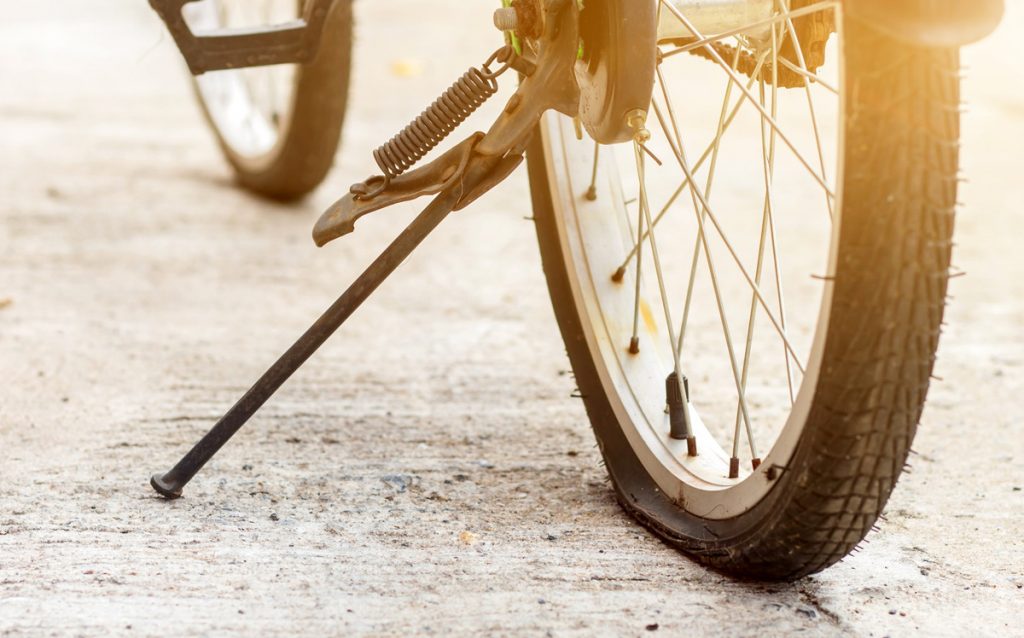
You can ride a bike on a flat tire, but you will pay for it in parts. Icebike’s rule of thumb (ours, not a manufacturer’s): ride at walking pace (about 3 mph, 5 km/h) and only as far as the nearest safe place to stop, usually a few hundred feet. Then get off and walk. With the air gone, the rim takes every bump, the tire can roll off the rim, and a ruined tube can turn into a ruined tire or wheel.
Two cases mean you stop as soon as it is safe and then walk: a flat front tire, and any carbon rim. The table below covers the rest. Already rode a few miles on it? Jump to the damage check.
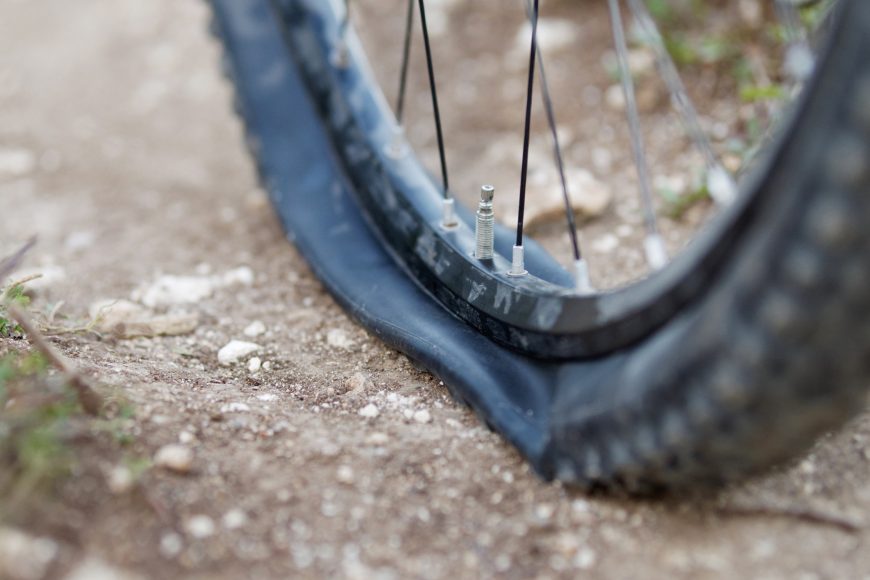
Ride or walk? Decide by tire, rim and wheel
No tire or rim maker we could find publishes a safe distance for riding a plain tube or tubeless tire flat. Insert makers do publish run-flat figures for their own products: Vittoria says its Air-Liner Road insert lets you ride up to 30 miles (50 km), or up to an hour, after a puncture. The rows below are Icebike’s rules, based on what each part does once the air is gone, and each row names the part that fails first.
| Your situation | Ride or walk? | How far, how fast | What breaks first |
|---|---|---|---|
| Slow leak, tire still holds some air | Ride | Normal pace. Pump it up and stop again when it goes soft. | Nothing yet. Fix it at home before the next ride. |
| Rear tire fully flat, tube, aluminum rim, smooth pavement | Ride only to safety | Walking pace, a few hundred feet, seated, around every bump | The tube shreds or tears at the valve. Then the rim dents on the first pothole or curb edge. |
| Rear flat, tube, aluminum rim, smooth road, miles from help and no way to fix it | Walk if you can. Ride only as a last resort. | Slow, seated, weight forward, around every crack and pothole | Expect to throw away the tube and possibly the tire. The rim may survive at low speed on smooth pavement, but one pothole can dent it. Run the damage check before the next ride. |
| Front tire flat, any setup | Walk | Only far enough to get off the road | Steering and braking. A tire that rolls off the rim can jam the wheel and pitch you over the bars. |
| Carbon rim, front or rear | Walk | Zero. Coast to a stop and get off. | The rim. ENVE reports that most of the carbon rims it sees broken were damaged between the flat and the stop. |
| Tubeless, tire still partly inflated | Ride after a quick stop | Spin the wheel to let sealant reach the hole, add air, then ride on | Nothing, if the sealant holds. Stan’s rates its standard sealant to holes up to 6.5 mm; other sealants differ. Bigger holes need a plug. |
| Tubeless, fully flat with the bead off the rim | Walk | Only to a spot where you can fix it | The tire rolls off the rim and the rim edge meets the ground. |
| Rim brakes, tire loose or bulging | Walk | Only to the roadside | The flopping tire can catch in the brake and lock the wheel. |
| Mountain or fat bike on rocks or roots | Walk | Push it out to the trailhead or a flat spot | Rocks hit the rim through the empty tire. Wide tires pad the rim a little, too little to ride on. |
| E-bike, front or rear | Walk with the motor off | Only to the roadside | The extra weight lands on the rim, and pedal assist adds speed you do not want. |
Skip the table if the tire still feels firm under your thumb and only lost a little air. A slow leak is a pump-and-ride problem, and our guide to fixing a bike tire that won’t inflate covers finding it at home.
How long can you ride a bike with a flat tire?
On a fully flat tire, ride a few hundred feet at walking pace, no more. That gets you off a busy road, across an intersection, or to a shoulder where you can work. The farther you go, the more bumps the rim has to take with nothing in between. On a tire that is going soft but still holds air, you can ride as long as you stop to pump it up each time it softens.
Speed matters more than distance. At walking pace you can steer around cracks and ease the wheel over bumps. At 15 mph a pothole drives the rim straight into the road with nothing to cushion it. Sheldon Brown notes that the impact behind a pinch flat can also put a dent, or “blip,” in the rim. That happens on a soft tire. Our reasoning: a fully flat tire leaves the rim even less protected.
Past a few hundred feet, walk, or fix it where you are with the checklist further down.
What if you are miles from home with no tools?
Walking is still the safe call. If you cannot walk it out, ride the rear flat slowly on the smoothest surface you can find, stay seated with your weight forward, and ease over every crack. Riders on forums report covering several miles this way with the rim intact, but those are reports, not tests, and one pothole changes the result. Plan on replacing the tube and probably the tire. Do not ride a flat front tire or a carbon rim this way. Once home, run every step of the damage check below.
Is it bad to ride a bike with a flat tire?
Yes. Riding on a flat almost always ruins the tube, and the farther and faster you ride, the more you put the tire and rim at risk. The parts fail in order of price:
- Tube. The rim pinches it against the ground and cuts two slits, the “snakebite” Sheldon Brown describes. A tube that has been ridden flat for a while often ends up with holes too long to patch. Schwalbe adds that a tire running at low pressure slips on the rim, drags the tube around, and can tear the valve off at its base. You cannot patch a torn valve.
- Tire. Schwalbe explains that low pressure forces the sidewalls to flex more than they were built for, until they crack and tear. A flat tire is the extreme version of that, and the rim edge can also cut the casing from inside.
- Rim. Aluminum rims dent and get flat spots. Carbon rims crack and chip. ENVE says most carbon rims it sees cracked, chipped or dented were damaged in the moments between the flat and the stop, when only the tire stood between the rim and the ground.
- You. Sheldon Brown warns that a flat tire may come off the rim and cause a crash.
A tube costs little. A rim or a complete wheel costs many times more, and a dented rim is hard to fix. Park Tool’s Calvin Jones writes that re-bending a damaged rim “is difficult, takes experience, and has a limited ability to really fix the wheel.”
Is a flat front tire more dangerous than a flat rear?
Yes. Schwalbe points out that the rear wheel transmits the driving force, and the front wheel transmits the braking and steering forces. A flat front tire squirms under every steering input and gives you less grip when you brake.
The bigger risk is the tire coming off. Sheldon Brown writes that a loose tire can flop around, make the bike impossible to balance, and catch on a rim brake, locking the wheel: “If it is the front wheel, this can result in a very sudden and serious crash.” A rear tire that locks makes the bike skid. A front tire that locks can throw you over the bars.
If the front goes flat on a descent or in traffic, brake mostly with the rear, steer gently, and stop as soon as it is safe. Then walk.
Tubeless, tubed and carbon wheels behave differently
Inner tubes give you the least time. The tube takes the damage first, and riding on finishes it off. Plan on replacing it.
Tubeless tires often seal themselves. Stan’s says its standard sealant seals punctures up to 6.5 mm (1/4 in), and the wheel has to rotate to carry sealant to the hole. If yours hisses and sprays, stop, turn the hole to the bottom, spin the wheel, and add air. If the tire goes fully flat, the bead can drop off the rim seat and the tire can roll off, so walk.
Tire inserts (foam rings inside a tubeless tire) exist to prevent pinch flats and protect rims, as ENVE describes them. If you run one, check the insert maker’s guidance on rolling out on a flat. Without one, treat a flat tubeless tire like any other flat.
Carbon rims fail without warning and cost the most. ENVE’s care guide says to inspect the wheel after any hard hit and not to ride it if you find cracks, chips or fibers peeling. Walk a flat carbon wheel every time.
Get-home checklist
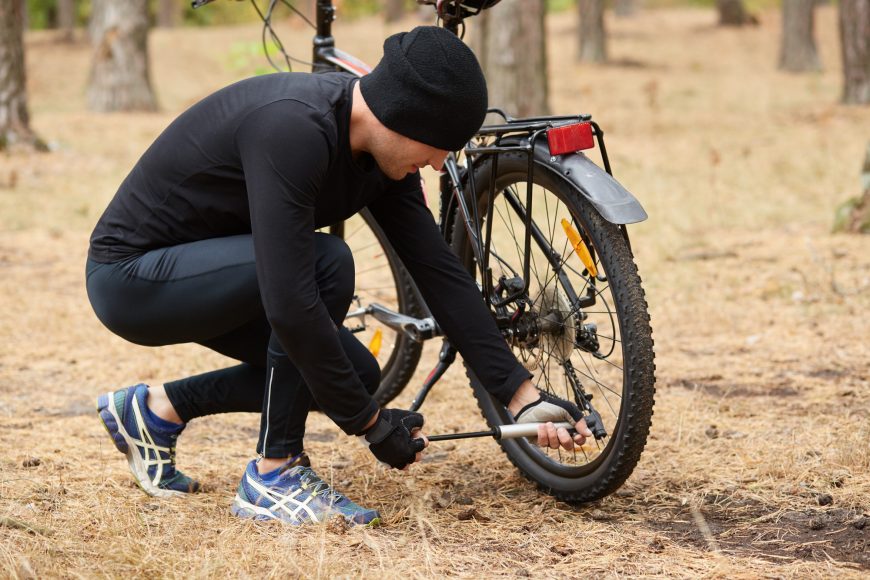
Work down this list until one step gets you rolling.
- Stop and get off the road. Do it as soon as you feel the tire squirm or hear the rim tap. Walking the bike puts almost none of your weight on the rim.
- Find the cause before you add air. Park Tool’s Calvin Jones says to check the inside of the tire as well as the outside for the object that caused the flat. A thorn or glass shard left in the tread can puncture your new tube as soon as you ride on it. Two parallel slits in the tube mean a pinch flat, from low pressure or a hard hit. If the tire will not pump up at all, he notes, the hole is big.
- Swap in a spare tube. It is faster and more reliable than patching at the roadside. Patch the old tube at home.
- Patch it if you have no spare. Park Tool calls a pre-glued patch “a temporary trailside fix for emergency situations.” It gets you home. A vulcanizing patch, applied with glue, bonds to the tube and lasts.
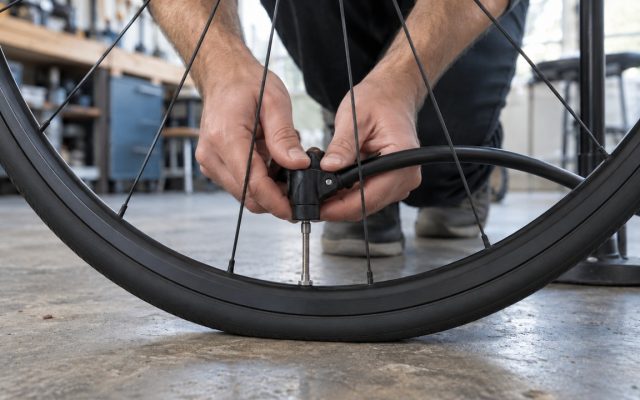
- Inflate with a pump or CO2. Add a little air first and check that no tube shows between the tire bead and the rim. Calvin Jones warns that CO2 cartridges “can be fast, sometimes too fast,” so fill in short bursts. A hand pump is slower, but it lets you check the tube as you go. Our guide on how to pump a bike tire covers Presta and Schrader heads.
- Tubeless: spin, then plug. Rotate the hole to the bottom so sealant pools on it, spin the wheel and add air. If the hole is too big to seal, push in a tubeless plug. Park Tool recommends a plug tool, since stick-on patches cannot repair a tubeless tire body.
- Tubeless that will not seal: fit a tube. Schwalbe’s advice: remove the tubeless valve, wipe the sealant out of the tire, and install a spare tube.
- Boot a cut in the tire. A cut in the casing lets the new tube bulge out and burst. Put a boot inside the tire under the cut. Park Tool says the boot “must completely overlap the rip” to work. Without a proper boot, Sheldon Brown notes that mountain bikers use a folded dollar bill or a Mylar food wrapper, such as an empty gel packet. Calvin Jones calls paper money “simply paper,” so ride a bill boot gently at lower pressure, and replace the tire as soon as you get home. Boots need a tube pressing on them, so they do not work on tubeless tires alone.
- Nothing works: walk or call a ride. A bike shop, a bus with a bike rack, or a friend with a car beats riding a mile on the rim.
Carry these five things and you can handle most flats: a spare tube, a pre-glued patch kit, two tire levers, a mini pump or CO2 inflator, and a tire boot. Add a plug kit if you ride tubeless.
I rode miles on a flat. Is my rim ruined?
Not always. A rim can come through a slow ride on smooth pavement with only scuffs, and a single hard hit can dent it. Check it before your next ride, even if the bike felt fine on the way back. A scuffed rim edge is cosmetic; a dent, a wobble or a crack is not.
- Tube: Inflate it and listen. Two slits side by side mean a pinch flat. A tear where the valve meets the tube means you replace the tube, since you cannot patch the valve base.
- Tire casing: Run your fingers around the inside of the tire to find cuts and anything still stuck in the tread. Look along both sidewalls for cracks, frayed threads or a bulge. Park Tool notes that a ripped casing “may not hold an inner tube.” Replace a tire with a sidewall cut or a booted cut.
- Rim: Spin the wheel in the frame and watch the gap between the rim and a brake pad or the frame. A dip or wobble at one spot points to a dent or a bent rim. Run a thumb along both rim edges where the tire bead sits, feeling for dents and flat spots. On rim brakes, a dent in the braking surface shows up as a pulse in the lever.
- Carbon rim: Check every rim surface for cracks, chips and fibers lifting, as ENVE’s care guide describes. If you find any of them, do not ride the wheel, and contact the maker.
- Spokes and rim tape: ENVE suggests having your wheels checked for trueness and spoke tension when you change tires. On a tubed wheel, make sure the rim tape still covers every spoke hole. On a tubeless wheel, look for cuts in the tape.
If the same wheel keeps going flat after a repair, our guide to why a bike tire keeps popping walks through rim tape, tire cuts and pressure causes.
Avoid the next flat: start with pressure
Sheldon Brown traces pinch flats to “insufficient tire pressure” most of the time, and Schwalbe says the risk of punctures is “substantially higher” at low pressure. Schwalbe tells riders to check pressure with a gauge at least once a month, and treats a loss of about 1 bar (14.5 psi) a month as normal for a tube with no hole in it.
Set your pressure from the tire width, your weight and the surface, not from the maximum printed on the sidewall. The bike tire pressure calculator gives you a starting pressure from those three inputs. If you run tubeless, top up sealant before it dries out. The tubeless sealant calculator tells you how much your tire size needs, and our guide to inflating tubeless tires covers seating a bead after a trailside repair.
Sources
- Park Tool. How to Patch a Tire and Tube. Pre-glued patches as temporary trailside fixes, vulcanizing patches, tire boots that overlap the rip, damaged casings, plug tools for tubeless tires.
- Park Tool, Calvin Jones. Repairing On-The-Ride (May 30, 2012). Checking the tire inside and out, CO2 speed, paper-money boots, re-bending damaged rims.
- Park Tool. Tire and Tube Removal and Installation. Checking that the tube is not caught under the bead before full inflation.
- Schwalbe. Tech Info (2015 edition, PDF). Front wheel carries braking and steering forces (p. 19), low pressure and puncture risk (p. 23), sidewall tears from low pressure (p. 26), monthly pressure checks and normal 1 bar a month loss (p. 36), valve tear-off from tire slip (p. 31), fitting a tube after a tubeless puncture (p. 43).
- Sheldon Brown. Flat Tires. Riding on a flat, tire coming off the rim, front-wheel lockup, pinch flats and rim dents, improvised boots.
- ENVE. Pinch Flats, The Ultimate Buzzkill (May 20, 2019). Most damaged carbon rims broken between the flat and the stop; tire inserts.
- ENVE. Carbon Fiber Cycling Wheel Care (May 2015). Inspecting rims after impacts; do not ride a cracked or chipped rim.
- Stan’s. Tubeless Guide. Sealant seals punctures up to 6.5 mm and needs wheel rotation.