
Crank Length Calculator
Compare an inseam-based range with common stock crank lengths.
Lennard Zinn, a frame builder who makes custom cranks, recommends a crank length of 20.5% to 21.6% of your cycling inseam for road riding and 20% to 21% for mountain bikes and cyclocross. An 81 cm (32 in) inseam works out to 166-175 mm on the road and 162-170 mm off-road. In the best-known lab test, peak power changed by less than 4% across cranks from 120 to 220 mm, so when two sizes fit you, take the shorter one.
Enter your inseam in cm or inches and pick how you ride. The calculator applies Zinn’s road range to road riding and his 20-21% range to everything else: MTB, gravel, cyclocross, track and time trial or triathlon. It shows the computed range, every common stock length inside it, and the shortest of those as its recommended stock crank. For an 81 cm inseam it shows 166.1-175.0 mm and recommends 167.5 mm on the road, and 162.0-170.1 mm and 165 mm on a mountain bike.
Add your current crank length and the calculator shows what a switch would change: the difference in millimeters, how far to move your saddle (one for one, up when the crank gets shorter) and how much harder or easier every gear will feel. Going from 175 to 167.5 mm means raising your saddle about 7.5 mm, and every gear feels about 4.5% harder.
Crank length chart by inseam
Icebike computed this chart with the calculator’s own rules: Zinn’s percentages give the range, and the pick is the shortest stock length inside it. Picks use Shimano and SRAM road lengths (160 to 177.5 mm) for road, gravel, cyclocross, track and TT, and mountain lengths (155 to 180 mm) for MTB. “Range below stock” or “range above stock” means no common size falls inside your range, so the calculator shows the closest one. Measure your inseam barefoot: press a book or carpenter square up firmly at your crotch and measure from the floor to its top edge. Zinn does the same with a level broomstick.
| Inseam | Road range (20.5-21.6%) | MTB, gravel, CX, track and TT range (20-21%) | Calculator pick: road | Calculator pick: gravel, CX, track, TT | Calculator pick: MTB |
|---|---|---|---|---|---|
| 70 cm (27.6 in) | 143.5-151.2 mm | 140.0-147.0 mm | 160 (range below stock) | 160 (range below stock) | 155 (range below stock) |
| 72 cm (28.3 in) | 147.6-155.5 mm | 144.0-151.2 mm | 160 (range below stock) | 160 (range below stock) | 155 (range below stock) |
| 74 cm (29.1 in) | 151.7-159.8 mm | 148.0-155.4 mm | 160 (range below stock) | 160 (range below stock) | 155 |
| 76 cm (29.9 in) | 155.8-164.2 mm | 152.0-159.6 mm | 160 | 160 (range below stock) | 155 |
| 78 cm (30.7 in) | 159.9-168.5 mm | 156.0-163.8 mm | 160 | 160 | 160 |
| 80 cm (31.5 in) | 164.0-172.8 mm | 160.0-168.0 mm | 165 | 160 | 160 |
| 82 cm (32.3 in) | 168.1-177.1 mm | 164.0-172.2 mm | 170 | 165 | 165 |
| 84 cm (33.1 in) | 172.2-181.4 mm | 168.0-176.4 mm | 172.5 | 170 | 170 |
| 86 cm (33.9 in) | 176.3-185.8 mm | 172.0-180.6 mm | 177.5 | 172.5 | 175 |
| 88 cm (34.6 in) | 180.4-190.1 mm | 176.0-184.8 mm | 177.5 (range above stock) | 177.5 | 180 |
| 90 cm (35.4 in) | 184.5-194.4 mm | 180.0-189.0 mm | 177.5 (range above stock) | 177.5 (range above stock) | 180 |
| 92 cm (36.2 in) | 188.6-198.7 mm | 184.0-193.2 mm | 177.5 (range above stock) | 177.5 (range above stock) | 180 (range above stock) |
| 94 cm (37.0 in) | 192.7-203.0 mm | 188.0-197.4 mm | 177.5 (range above stock) | 177.5 (range above stock) | 180 (range above stock) |
Stock road cranks fit Zinn’s road range only for inseams between about 74 and 86.5 cm (29 to 34 in). Below that, Shimano and SRAM road cranksets stop at 160 mm, though SRAM’s Eagle 90 and 70 mountain cranks go down to 155 mm. Above it, most groupsets stop at 175 mm, Dura-Ace at 177.5 mm and Shimano XT at 180 mm. Only top-tier cranks come in 167.5 mm (Dura-Ace and SRAM Red) or 177.5 mm (Dura-Ace), so check the groupset table below. If your crankset skips the recommended length, take the next stock size inside your range, or the closest one if none is left. Past those limits you need a specialist crank.
Zinn’s range rests on years of selling custom cranks, not on a controlled study. His FAQ notes that most tall riders on time trial bikes choose less than the 21.6% figure. The calculator recommends the shortest stock size in range because the studies below found that a shorter crank costs little or no power.
Do shorter cranks cost power?
Rarely. In Martin and Spirduso’s 2001 study, 16 trained cyclists sprinted on cranks of 120, 145, 170, 195 and 220 mm. Peak power ran from 1,149 W on the 220 mm cranks to 1,194 W on the 145 mm cranks, a spread under 4%. The 145 and 170 mm cranks both beat the 120 and 220 mm extremes, and the authors concluded that a standard 170 mm crank should not substantially compromise maximum power in most adults.
That study also reported an optimum of 20% of leg length, or 41% of tibia length. Their 20% uses the authors’ own leg-length measure, so it does not transfer directly to a cycling inseam. Later studies of everyday crank sizes found the same small effects:
| Study | Riders | Cranks tested | What changed |
|---|---|---|---|
| Martin and Spirduso, 2001 | 16 trained cyclists | 120 to 220 mm | Peak power within 4%; 145 and 170 mm beat 120 and 220 mm |
| Barratt et al., 2011 | 15 trained cyclists | 150 to 190 mm | Hip, knee and ankle kept the same share of power once pedaling rate was optimized |
| Ferrer-Roca et al., 2017 | 12 amateur road cyclists | Preferred (172.5-175 mm), 5 mm longer, 5 mm shorter | No change in gross efficiency (20.4%, 20.1%, 20.3%); the longer crank added hip and knee flexion |
| Li et al., 2025 | 28 trained male road cyclists | 165, 170, 175 mm | No difference in economy or 6-second sprint power; riders rated steady riding on 165 and 170 mm cranks easier than on 175 mm |
| Reynolds et al., 2026 | 14 amateur cyclists | Preferred (165-172.5 mm), plus and minus 5 and 10 mm | No change in power; shorter cranks reduced hip and knee flexion |
Ferrer-Roca’s group suggested that when you are in doubt between two lengths, the shorter one is the safer pick. The evidence for any rule is thin, though. A 2024 systematic review by Husband and colleagues found no clear recommendation for crank length, and it rated none of the 47 bike-position studies it analyzed as “good” quality. Most of these trials used small groups of trained men over short sessions, so they say little about what a different crank does over a full season.
What crank length changes: hips, knees, ground clearance and gearing
Hip and knee angle at the top of the stroke
Barratt and colleagues had 15 trained cyclists ride at 90 rpm and 240 W on cranks from 150 to 190 mm. Longer cranks increased how far the hip and knee bend and straighten on each stroke, while ankle motion changed little. The authors suggest shorter cranks for riders who want a flatter, more aero torso without the thigh hitting the torso, and for riders with hip impingement or knee osteoarthritis who want to limit deep flexion.
The geometry is easy to check. Drop from 175 to 165 mm and raise your saddle 10 mm to keep the same leg extension at the bottom. At the top of the stroke your pedal now sits 20 mm farther from your hip: 10 mm because the pedal circle is smaller and 10 mm because the saddle moved up. Reset your saddle with the bike saddle height calculator after any crank swap.
Mountain bikes, gravel and cyclocross
Zinn’s reason for a shorter crank off-road is cadence. Technical trails make you slow down and accelerate again and again, and spinning the cranks back up to speed is easier on a shorter crank. Ground clearance is a separate gain: each millimeter you take off the crank lifts the pedal one millimeter at the bottom of the stroke, so a 165 mm crank clears roots and rocks by 10 mm more than a 175 mm crank on the same frame. SRAM’s XX DH Transmission downhill crank comes only in 150 to 165 mm. In a lab study of seven female cross-country racers, Macdermid and Edwards found the riders reached peak power faster on 170 mm cranks than on 175 mm (2.57 vs 3.29 seconds), with no loss in endurance measures. Check frame fit with the mountain bike size chart before you blame the cranks.
Gravel is a judgment call. Zinn says his road length works well for dirt roads and relatively smooth trails, so a gravel rider who stays on smooth roads can use the road column. The calculator puts gravel on the 20-21% range because many gravel rides include rougher, stop-and-go terrain; that choice is Icebike’s, not Zinn’s.
Gearing
Shorter cranks give you less leverage, so every gear feels a little harder. Sheldon Brown’s gain ratio puts numbers on it: a switch from 175 to 165 mm raises every gear by about 6% (175 ÷ 165 = 1.06). On a geared bike you shift one cog easier now and then. On a single speed, rework the ratio with the fixed gear calculator, and see how cadence turns into speed with the bicycle gear speed calculator.
Time trial, triathlon and track
Zinn calls for a shorter crank on time trial and triathlon bikes because your knee rises less and you can drop your torso lower, and he tells TT riders to pick closer to the lower end of the recommended range. Barratt’s group suggests the same for riders chasing a flatter torso. Zinn also says a shorter crank suits most track events. He gives no separate percentage for either, so the calculator’s use of the 20-21% range for TT, triathlon and track is Icebike’s choice.
Should you change your cranks?
A new crankset costs real money, so change length only when you have a reason. These are Icebike’s starting points, built on the studies above:
| Your situation | What to try |
|---|---|
| Hip pinch or knee pain at the top of the stroke, with saddle height and cleats already checked | 5-10 mm shorter, saddle raised by the same amount |
| Your thighs hit your torso in the drops or on aero bars | 5 mm shorter, or the short end of your road range |
| Frequent pedal strikes on technical trails | A size inside the 20-21% off-road range |
| Two stock sizes both fall in your range | The shorter one |
| No pain, no pedal strikes, stock crank inside your range | Keep what you have |
Skip this if your bike fits and you ride pain-free: a 2.5 or 5 mm change will not make you faster. If you are choosing a whole new bike, start with frame size in the bike size chart.
Crank lengths you can buy, by groupset
Icebike checked these on each maker’s product page on October 14, 2026. Icebike found no crank length calculator or inseam chart on Shimano’s site, so pair the chart above with the Shimano sizes below.
| Crankset | Lengths offered (mm) |
|---|---|
| Shimano Dura-Ace FC-R9200 | 160, 165, 167.5, 170, 172.5, 175, 177.5 |
| Shimano Ultegra FC-R8100, 105 FC-R7100 | 160, 165, 170, 172.5, 175 |
| Shimano Tiagra FC-4700 | 165, 170, 172.5, 175 |
| Shimano GRX FC-RX820 | 160, 165, 170, 172.5, 175 |
| SRAM Red E1 | 160, 165, 167.5, 170, 172.5, 175 |
| SRAM Force E1, Rival E1, Apex 1 Wide | 160, 165, 170, 172.5, 175 |
| Campagnolo Super Record 13, Chorus 12, Ekar | 165, 170, 172.5, 175 |
| Shimano XTR FC-M9100, SLX FC-M7100, Deore FC-M6100 | 165, 170, 175 |
| Shimano XT FC-M8100 | 165, 170, 175, 180 |
| SRAM Eagle Transmission XX, X0, GX (T-Type) | 165, 170, 175 |
| SRAM Eagle 90 and 70 Transmission | 155, 160, 165, 170, 175 |
| SRAM XX DH Transmission | 150, 155, 160, 165 |
| Shimano e-bike FC-EM600 | 160, 165, 170, 175 |
Road riders have the widest choice between 160 and 175 mm. Mountain bike cranks mostly come in 5 mm steps, so a rider whose off-road range lands on 167.5 mm has to choose 165 or 170.
How to measure the crank length you have
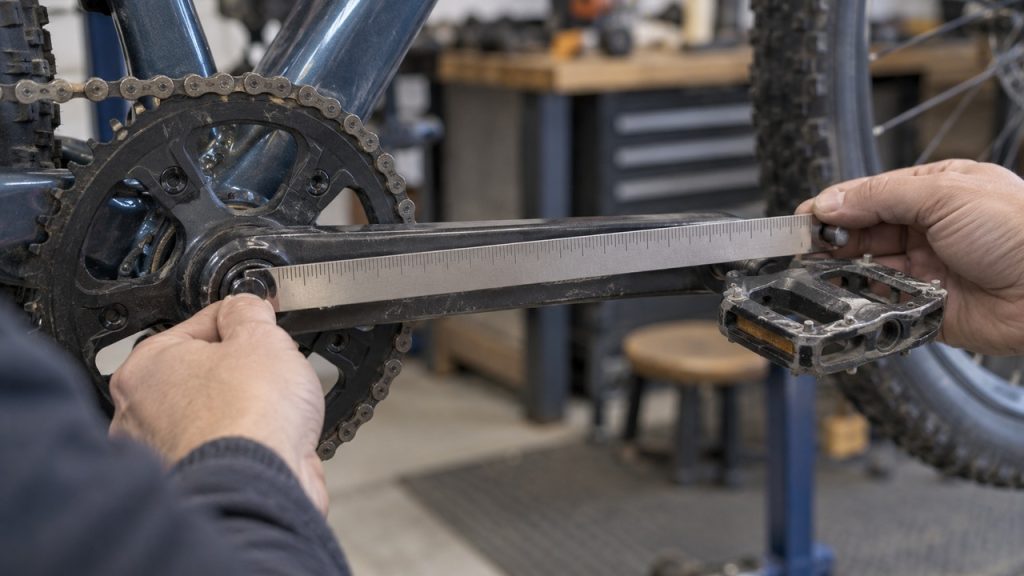
Check the inside face of the crank arm near the pedal thread, where many makers stamp or print the length as “170” or “172.5”. If you can’t find a marking, measure from the center of the pedal hole to the center of the bottom bracket spindle, in line with the arm. Sheldon Brown defines crank length this way. A tape measure tells 165 from 175, but not 170 from 172.5, so trust the stamp when it exists.
Quick answers
Is 170 or 172.5 mm better?
Ferrer-Roca’s group found no efficiency change from a 5 mm step in either direction, so a 2.5 mm gap matters less than fit. Pick the size inside your range from the chart; if both fit, take 170.
Should I size cranks by height?
Use inseam. Riders of the same height can have different inseams, and the calculator and chart work from inseam.
Does crank length change saddle height?
Yes, one for one. Shorten your cranks 5 mm and raise your saddle 5 mm to keep the same leg extension at the bottom of the stroke. Enter your current crank length in the calculator to get the figure for your switch.
What crank length for a mountain bike?
Use 20-21% of your inseam: 162.0-170.1 mm for an 81 cm (32 in) inseam, which makes 165 mm the calculator’s pick. Most trail cranks come in 165, 170 and 175 mm, and SRAM’s Eagle 90 and 70 go down to 155 mm.
Sources
- Zinn Cycles, Customer Support and FAQ (crank length percentages, inseam method, time trial and off-road guidance): https://www.zinn.bike/service
- Martin JC, Spirduso WW. Determinants of maximal cycling power: crank length, pedaling rate and pedal speed. European Journal of Applied Physiology, 2001;84(5):413-418. https://pubmed.ncbi.nlm.nih.gov/11417428/
- Barratt PR, Korff T, Elmer SJ, Martin JC. Effect of crank length on joint-specific power during maximal cycling. Medicine and Science in Sports and Exercise, 2011;43(9):1689-1697. https://pubmed.ncbi.nlm.nih.gov/21311357/
- Barratt PR, Martin JC, Elmer SJ, Korff T. Effects of pedal speed and crank length on pedaling mechanics during submaximal cycling. Medicine and Science in Sports and Exercise, 2016;48(4):705-713. https://pmc.ncbi.nlm.nih.gov/articles/PMC5638423/
- Ferrer-Roca V, Rivero-Palomo V, Ogueta-Alday A, Rodríguez-Marroyo JA, García-López J. Acute effects of small changes in crank length on gross efficiency and pedalling technique during submaximal cycling. Journal of Sports Sciences, 2017;35(14):1328-1335. https://pubmed.ncbi.nlm.nih.gov/27484153/
- Li J, et al. Effects of crank length on cycling efficiency, sprint performance, and perceived fatigue in high-level amateur road cyclists. Journal of Exercise Science and Fitness, 2025;23(3):175-180. https://pubmed.ncbi.nlm.nih.gov/40342376/
- Reynolds S, Chidley J, Briley S, Outram T. The impact of minor crank length adjustments on lower body cycling kinematics. Sports Biomechanics, 2026;25(3):454-467. https://pubmed.ncbi.nlm.nih.gov/40464620/
- Macdermid PW, Edwards AM. Influence of crank length on cycle ergometry performance of well-trained female cross-country mountain bike athletes. European Journal of Applied Physiology, 2010;108(1):177-182. https://pubmed.ncbi.nlm.nih.gov/19771448/
- Husband SP, et al. Cycling position optimisation: a systematic review of the impact of positional changes on biomechanical and physiological factors in cycling. Journal of Sports Sciences, 2024;42(15):1477-1490. https://pubmed.ncbi.nlm.nih.gov/39285616/
- Sheldon Brown, Cranks (crank length definition and markings): https://www.sheldonbrown.com/cranks.html
- Sheldon Brown, Gain Ratios: https://www.sheldonbrown.com/gain.html
- Shimano crankset specifications: https://bike.shimano.com/products/components/pdp.P-FC-R9200.html, pdp.P-FC-R8100.html, pdp.P-FC-R7100.html, pdp.P-FC-4700.html, pdp.P-FC-RX820-1.html, pdp.P-FC-M9100-1.html, pdp.P-FC-M8100-1.html, pdp.P-FC-M7100-1.html, pdp.P-FC-M6100-1.html, pdp.P-FC-EM600.html
- SRAM crankset specifications: https://www.sram.com/en/sram/models/fc-red-e1, fc-frc-e1, fc-riv-e1, fc-apx-1w-d1, fc-xx-d1, fc-x0-d1, fc-gx-d1, fc-90-a1, fc-70-a1, fc-xx-dh-a1
- Campagnolo crankset specifications: https://www.campagnolo.com/us-en/super-record-13-crankset/CFCSUPERRECORD13.html, chorus-crankset-12×2-speed/CFCCHORUS12S.html, ekar-crankset-1×13-speed/CFCEKAR1X13S.html



What about shoe size and foot position? My friend and I have relatively the same inseam (him 33, me 34) but he wars a size 9 1/2 shoe and I wear a size 14. Shouldn’t that matter? Not to mention how you pedal, cleats on the balls of your feet and flats more to the middle. Am I wrong thinking this way?