
Gear Inches Calculator
Compare the gears on your chainrings and cassette, with development and speed at your cadence.
Gear inches = (chainring teeth ÷ cog teeth) × wheel diameter in inches. A 50-tooth chainring driving a 17-tooth cog on a 700×28 road wheel (26.69 in) gives 50 ÷ 17 × 26.69 = 78.51 gear inches. The number matches the drive wheel size of a high-wheel bicycle that would cover the same ground per pedal turn, so a lower number means an easier gear and a higher number means more distance for each stroke.
To use the calculator, pick a drivetrain preset or type your own chainrings (up to 3) and cassette cogs (up to 13) as comma lists, such as 50,34 and 11,12,13,14,15,17,19,21,24,27,30,34. Choose your wheel and tire, or pick Custom and enter the outside diameter in millimeters, then set your cadence and speed units (mph or km/h). The grid updates as you type. Each row is a cog and each column a chainring, the same layout as the charts below. Every cell shows gear inches, development in meters per crank turn and speed at your cadence. Above the grid you get your lowest and highest gear, the range, and on 2x and 3x setups the number of combinations that overlap another chainring. Darker grey cells mark taller gears.
How the calculator measures wheel diameter
The calculator takes the rim’s ISO bead seat diameter, adds twice the tire width, and divides by 25.4 to get inches. Sheldon Brown’s ISO cross-reference lists 622 mm for 700C and 29-inch wheels, 584 mm for 650B and 27.5-inch, and 559 mm for 26-inch mountain bike wheels. Read the ISO pair on your sidewall (for example 28-622) and you have both numbers. For a size without a preset, add twice the tire width to the bead seat diameter and enter the total under Custom. The bike tire size chart decodes the older labels.
A “700c” wheel is not one size. A 700×25 wheel works out to 26.5 inches, 700×28 to 26.7 inches, 700×35 to 27.2 inches and a 29 x 2.4 mountain bike wheel to 29.3 inches. A 650b x 47 gravel wheel measures 678 mm, the same as 700×28. Swapping 25 mm tires for 45 mm tires on the same rims raises every gear by 6%.
On narrow road tires the formula lands close to real rollout. Sheldon Brown’s cyclecomputer table lists 2,136 mm of rollout for a 700×28 tire, a 680 mm diameter; the formula gives 678 mm, 0.3% lower. Wide tires drift the other way: his table gives 2,070 mm for a 26 x 2.125 (ISO 54-559), a 659 mm diameter, while the formula gives 667 mm, 1.2% high. For an exact figure, roll your loaded bike one full wheel turn, measure the distance, divide by π and enter the result under Custom.
Gear inch charts for four common drivetrains
These charts match the calculator’s output for each preset. Tooth counts come from the Shimano and SRAM spec pages listed under Sources. Development is the distance in meters the bike travels per crank turn.
Road 2x: 50/34 chainrings, 11-34 cassette, 700×28 tires
Shimano 105 crankset (FC-R7100, 50-34T) with the 105 12-speed 11-34 cassette (CS-R7101-12). Calculator: preset “Shimano 105 11-34 12s (50/34)”, wheel 700×28 (678 mm, 26.69 in).
| Cog | 50T gear inches | 50T development | 34T gear inches | 34T development |
|---|---|---|---|---|
| 11 | 121.33 | 9.68 m | 82.51 | 6.58 m |
| 12 | 111.22 | 8.87 m | 75.63 | 6.03 m |
| 13 | 102.67 | 8.19 m | 69.81 | 5.57 m |
| 14 | 95.33 | 7.61 m | 64.83 | 5.17 m |
| 15 | 88.98 | 7.10 m | 60.50 | 4.83 m |
| 17 | 78.51 | 6.26 m | 53.39 | 4.26 m |
| 19 | 70.24 | 5.61 m | 47.77 | 3.81 m |
| 21 | 63.55 | 5.07 m | 43.22 | 3.45 m |
| 24 | 55.61 | 4.44 m | 37.81 | 3.02 m |
| 27 | 49.43 | 3.94 m | 33.61 | 2.68 m |
| 30 | 44.49 | 3.55 m | 30.25 | 2.41 m |
| 34 | 39.25 | 3.13 m | 26.69 | 2.13 m |
Gravel 1x: 40T chainring, 10-44 cassette, 650b x 47 tires
SRAM XPLR XG-1251 cassette (10, 11, 13, 15, 17, 19, 21, 24, 28, 32, 38, 44). Calculator: preset “SRAM 10-44 12s (40)”, wheel 650b x 47 (678 mm, 26.69 in).
| Cog | Gear inches | Development |
|---|---|---|
| 10 | 106.77 | 8.52 m |
| 11 | 97.07 | 7.75 m |
| 13 | 82.13 | 6.55 m |
| 15 | 71.18 | 5.68 m |
| 17 | 62.81 | 5.01 m |
| 19 | 56.20 | 4.48 m |
| 21 | 50.84 | 4.06 m |
| 24 | 44.49 | 3.55 m |
| 28 | 38.13 | 3.04 m |
| 32 | 33.37 | 2.66 m |
| 38 | 28.10 | 2.24 m |
| 44 | 24.27 | 1.94 m |
Trekking 3x: 48/36/26 chainrings, 11-36 cassette, 700×35 tires
Shimano Deore trekking crankset (FC-T6010, 48-36-26T) with a Shimano 10-speed 11-36 cassette (CS-HG50-10). Calculator: preset “3x 48/36/26 + 11-36”, wheel 700×35 (692 mm, 27.24 in).
| Cog | 48T gear inches | 48T development | 36T gear inches | 36T development | 26T gear inches | 26T development |
|---|---|---|---|---|---|---|
| 11 | 118.88 | 9.49 m | 89.16 | 7.11 m | 64.40 | 5.14 m |
| 13 | 100.59 | 8.03 m | 75.45 | 6.02 m | 54.49 | 4.35 m |
| 15 | 87.18 | 6.96 m | 65.39 | 5.22 m | 47.22 | 3.77 m |
| 17 | 76.92 | 6.14 m | 57.69 | 4.60 m | 41.67 | 3.32 m |
| 19 | 68.83 | 5.49 m | 51.62 | 4.12 m | 37.28 | 2.97 m |
| 21 | 62.27 | 4.97 m | 46.70 | 3.73 m | 33.73 | 2.69 m |
| 24 | 54.49 | 4.35 m | 40.87 | 3.26 m | 29.51 | 2.36 m |
| 28 | 46.70 | 3.73 m | 35.03 | 2.80 m | 25.30 | 2.02 m |
| 32 | 40.87 | 3.26 m | 30.65 | 2.45 m | 22.14 | 1.77 m |
| 36 | 36.33 | 2.90 m | 27.24 | 2.17 m | 19.68 | 1.57 m |
Mountain bike 1x: 32T chainring, 10-51 cassette, 29 x 2.4 tires
Shimano Deore 12-speed cassette (CS-M6100-12, 10-12-14-16-18-21-24-28-33-39-45-51T). Calculator: preset “MTB 10-51 12s (32)”, wheel 29 x 2.4 (744 mm, 29.29 in).
| Cog | Gear inches | Development |
|---|---|---|
| 10 | 93.73 | 7.48 m |
| 12 | 78.11 | 6.23 m |
| 14 | 66.95 | 5.34 m |
| 16 | 58.58 | 4.67 m |
| 18 | 52.07 | 4.16 m |
| 21 | 44.63 | 3.56 m |
| 24 | 39.06 | 3.12 m |
| 28 | 33.48 | 2.67 m |
| 33 | 28.40 | 2.27 m |
| 39 | 24.03 | 1.92 m |
| 45 | 20.83 | 1.66 m |
| 51 | 18.38 | 1.47 m |
Gear range and overlap: 1x, 2x and 3x compared
Range is the highest gear divided by the lowest. Overlap counts the combinations whose gear also falls inside another chainring’s span, the same figure the calculator reports. Speeds assume 70 rpm in the lowest gear and 90 rpm in the highest.
| Drivetrain | Lowest | Highest | Range | Overlapping combinations | Lowest gear at 70 rpm | Highest gear at 90 rpm |
|---|---|---|---|---|---|---|
| Road 2x 50/34, 11-34, 700×28 | 26.69 in | 121.33 in | 454.5% | 15 of 24 | 8.9 km/h (5.6 mph) | 52.3 km/h (32.5 mph) |
| Gravel 1x 40, 10-44, 650b x 47 | 24.27 in | 106.77 in | 440.0% | None (one chainring) | 8.1 km/h (5.1 mph) | 46.0 km/h (28.6 mph) |
| Trekking 3x 48/36/26, 11-36, 700×35 | 19.68 in | 118.88 in | 604.2% | 25 of 30 | 6.6 km/h (4.1 mph) | 51.2 km/h (31.8 mph) |
| MTB 1x 32, 10-51, 29 x 2.4 | 18.38 in | 93.73 in | 510.0% | None (one chainring) | 6.2 km/h (3.8 mph) | 40.4 km/h (25.1 mph) |
On a 1x drivetrain, the range equals the cassette’s: 44 ÷ 10 = 440%, the figure SRAM quotes for the XG-1251. You pay for that in bigger steps. The gravel cassette jumps 18% from the 11 to the 13 and 19% from the 32 to the 38, while the road cassette moves 7-9% per shift between its five smallest cogs.
Doubles and triples buy range with overlap. On the road bike, the 50 ring covers 39.25-121.33 inches and the 34 ring covers 26.69-82.51, so 15 of the 24 combinations sit inside the other ring’s span. The triple’s 48, 36 and 26 rings cover 36.33-118.88, 27.24-89.16 and 19.68-64.40, which puts 25 of its 30 combinations in overlap. Sheldon Brown saw no harm in duplicates: one gear of a duplicate pair usually runs the chain at an extreme angle, and you should use the other one. He also recommends close steps in the high range, where you spend most of your time, and wider steps for climbing gears. Our guide to shifting bike gears covers which combinations to avoid.
What gear inch numbers mean for climbing and cruising
Sheldon Brown put the lowest gear on most mountain bikes at about 22-26 inches and the highest gear on road racing bikes at about 108-110 inches. Today’s wide-range cassettes go further: the 50×11 on the road bike above reaches 121.33 inches, and the Deore mountain bike drops to 18.38.
The bands below are Icebike guidance built from the speed each gear gives at a steady 90 rpm. Treat them as starting points. The fixed gear bands match the ones in our fixed gear calculator.
| Gear inches | Speed at 90 rpm | Typical use (Icebike guidance) |
|---|---|---|
| Under 20 | Under 5.4 mph (8.6 km/h) | Loaded touring, bikepacking and steep mountain bike climbs |
| 20-30 | 5.4-8.0 mph (8.6-12.9 km/h) | Lowest climbing gear for hilly road, gravel and commuting |
| 30-60 | 8.0-16.1 mph (12.9-25.9 km/h) | Steady climbs, headwinds, snow and starts with a load |
| 60-75 | 16.1-20.1 mph (25.9-32.3 km/h) | Single-speed and fixed gear city riding: 60-68 hilly, 65-75 flat |
| 75-95 | 20.1-25.4 mph (32.3-40.9 km/h) | Cruising on flat roads, fixed gear on open roads at 75-85 |
| 95 and up | 25.4 mph (40.9 km/h) and faster | Fast group riding, sprints and descents |
How low a gear do you need for climbing?
Work backward from the slowest speed you hold on your steepest climb. At 70 rpm, the gear you need equals that speed in mph × 4.8. Crawling up at 5 mph (8.0 km/h) calls for 24 gear inches; at 4 mph (6.4 km/h), 19 inches; at 3 mph (4.8 km/h), 14 inches. Plan on the slower end of that range if you climb with touring or bikepacking luggage. Skip this if your lowest gear already lets you climb seated without your cadence dropping under 60.
Same gear, different wheels: why wheel size matters
Gear inches exist to compare bikes with different wheels. The table runs one ratio, 48×16 (3.00), across eight wheel and tire sizes.
| Wheel and tire | Diameter | 48×16 gear inches | Speed at 90 rpm |
|---|---|---|---|
| 16 x 1-3/8, Brompton (ISO 35-349) | 419 mm | 49.49 | 21.3 km/h (13.3 mph) |
| 20 x 1.75 (BMX) | 495 mm | 58.45 | 25.2 km/h (15.7 mph) |
| 26 x 2.1 | 666 mm | 78.62 | 33.9 km/h (21.1 mph) |
| 700×25 | 672 mm | 79.37 | 34.2 km/h (21.3 mph) |
| 650b x 47 | 678 mm | 80.08 | 34.5 km/h (21.4 mph) |
| 700×35 | 692 mm | 81.73 | 35.2 km/h (21.9 mph) |
| 27 x 1-1/4 | 694 mm | 81.97 | 35.3 km/h (21.9 mph) |
| 29 x 2.4 | 744 mm | 87.87 | 37.9 km/h (23.5 mph) |
The Brompton runs a gear 44% lower than the 29er with the same chainring and cog. Fat bikes push the other way. The formula puts a 26 x 4.8 tire at about 803 mm, but fat casings run shorter than they are wide, so the real diameter is smaller; measure your rollout and enter it under Custom. Either way, the same drivetrain gives taller gears on fat tires. Snow calls for lower gears, so when you fit studded or fat tires for winter, check your lowest gear here before the first snowfall.
Gear inches, gear ratio, development and gain ratio
Sheldon Brown called gear inches the simplest system in common use. The other systems answer different questions.
| System | Formula | 50×17 on 700×28 | Use it to |
|---|---|---|---|
| Gear ratio | chainring ÷ cog | 2.94 | Compare parts on the same bike and wheel |
| Gear inches | ratio × wheel diameter (in) | 78.51 in | Compare bikes with different wheels and tires |
| Development | ratio × wheel circumference (m) | 6.26 m | The metric version of the same comparison |
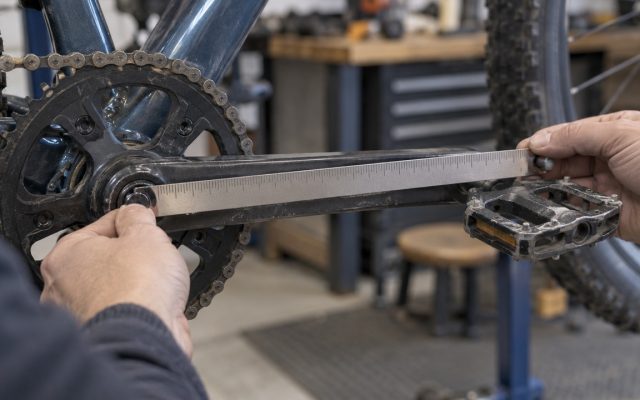
| Gain ratio | (wheel radius ÷ crank length) × ratio | 5.78 with 172.5 mm cranks | Include crank length, as Sheldon Brown proposed |
The bicycle gear meters calculator builds a grid in meters of development. For ratios alone, use the bike gear ratio calculator. To turn a single gear into speeds across a range of cadences, use the bicycle gear speed calculator. Riders building a single-speed or fixie can get gear inches, speed and skid patches in one result from the fixed gear calculator.
Sources
- Sheldon Brown, Gain Ratios, https://www.sheldonbrown.com/gain.html (gear inch definition and history; gain ratio method; mountain bike low 22-26 in, road racing high 108-110 in)
- Sheldon Brown, Glossary G, https://www.sheldonbrown.com/gloss_g.html (gear inch, gain ratio and development definitions)
- Sheldon Brown, Gear Theory for Bicyclists, https://www.sheldonbrown.com/gear-theory.html (duplicate gears and chain angle; close steps on top, wide at the bottom)
- Sheldon Brown, Tire Sizing Systems, https://www.sheldonbrown.com/tire-sizing.html (ISO bead seat diameters: 622, 584, 559, 630, 406, 349 mm)
- Sheldon Brown, Cyclecomputer Calibration, https://www.sheldonbrown.com/cyclecomputer-calibration.html (700×28 rollout 2,136 mm; 26 x 2.125 rollout 2,070 mm)
- Shimano, 105 crankset FC-R7100 spec (50-34T) and 105 cassette CS-R7101-12 spec (11-12-13-14-15-17-19-21-24-27-30-34T), https://bike.shimano.com/products/components/pdp.P-FC-R7100.html and https://bike.shimano.com/products/components/pdp.P-CS-R7101-12.html
- Shimano, Deore trekking crankset FC-T6010 spec (48-36-26T) and cassette CS-HG50-10 spec (11-13-15-17-19-21-24-28-32-36T), https://bike.shimano.com/products/components/pdp.P-FC-T6010.html and https://bike.shimano.com/products/components/pdp.P-CS-HG50-10.html
- Shimano, Deore cassette CS-M6100-12 spec (10-12-14-16-18-21-24-28-33-39-45-51T), https://bike.shimano.com/products/components/pdp.P-CS-M6100-12.html
- SRAM, XPLR XG-1251 cassette spec (10, 11, 13, 15, 17, 19, 21, 24, 28, 32, 38, 44; 440% range), https://www.sram.com/en/sram/models/cs-xg-1251-d1