Fixed Gear Calculator
Compare gearing, speed, and skid patches for your chainring, cog, and wheel size.
Enter your chainring and cog, pick your wheel and tire, and the results update as you type: gear inches, skid patches for one foot and for either foot, speed at your cadence, gear ratio, development and, with your crank length, Sheldon Brown’s gain ratio. Choose how you ride and the calculator suggests gears in that range. The defaults, 48×17 on a 700×25 tire at 90 rpm, give 74.7 gear inches, 17 skid patches, 20.0 mph (32.2 km/h) and a 2.82 ratio.
Fixed gear ratio chart: gear inches, speed and skid patches
Icebike computed every row with the calculator’s own method: a 700×25 tire with a 672 mm outside diameter (622 mm bead seat plus twice the 25 mm width), 90 rpm, and 1 mile = 1.609344 km. The columns follow the calculator’s order, and the rows run from easiest to hardest across 27 common combinations. On 700×23 tires, take off 0.6%; on 700×28, add 0.9%; on 700×32, add 2.1%; on 700×35, add 3%. Or pick your tire in the calculator.
| Chainring x cog | Gear inches | Skid patches (one foot / either foot) | Speed at 90 rpm | Ratio | Development |
|---|---|---|---|---|---|
| 44×19 | 61.3 | 19 / 19 | 16.4 mph / 26.4 km/h | 2.32 | 4.89 m |
| 42×18 | 61.7 | 3 / 6 | 16.5 mph / 26.6 km/h | 2.33 | 4.93 m |
| 44×18 | 64.7 | 9 / 9 | 17.3 mph / 27.9 km/h | 2.44 | 5.16 m |
| 42×17 | 65.4 | 17 / 17 | 17.5 mph / 28.2 km/h | 2.47 | 5.22 m |
| 46×18 | 67.6 | 9 / 18 | 18.1 mph / 29.1 km/h | 2.56 | 5.40 m |
| 44×17 | 68.5 | 17 / 17 | 18.3 mph / 29.5 km/h | 2.59 | 5.46 m |
| 42×16 | 69.4 | 8 / 16 | 18.6 mph / 29.9 km/h | 2.63 | 5.54 m |
| 48×18 | 70.6 | 3 / 3 | 18.9 mph / 30.4 km/h | 2.67 | 5.63 m |
| 46×17 | 71.6 | 17 / 17 | 19.2 mph / 30.8 km/h | 2.71 | 5.71 m |
| 49×18 | 72.0 | 18 / 36 | 19.3 mph / 31.0 km/h | 2.72 | 5.75 m |
| 44×16 | 72.8 | 4 / 8 | 19.5 mph / 31.4 km/h | 2.75 | 5.81 m |
| 47×17 | 73.1 | 17 / 34 | 19.6 mph / 31.5 km/h | 2.76 | 5.84 m |
| 50×18 | 73.5 | 9 / 18 | 19.7 mph / 31.7 km/h | 2.78 | 5.86 m |
| 48×17 | 74.7 | 17 / 17 | 20.0 mph / 32.2 km/h | 2.82 | 5.96 m |
| 46×16 | 76.1 | 8 / 16 | 20.4 mph / 32.8 km/h | 2.88 | 6.07 m |
| 49×17 | 76.3 | 17 / 34 | 20.4 mph / 32.9 km/h | 2.88 | 6.09 m |
| 47×16 | 77.7 | 16 / 32 | 20.8 mph / 33.5 km/h | 2.94 | 6.20 m |
| 50×17 | 77.8 | 17 / 17 | 20.8 mph / 33.5 km/h | 2.94 | 6.21 m |
| 48×16 | 79.4 | 1 / 2 | 21.3 mph / 34.2 km/h | 3.00 | 6.33 m |
| 52×17 | 80.9 | 17 / 17 | 21.7 mph / 34.9 km/h | 3.06 | 6.46 m |
| 49×16 | 81.0 | 16 / 32 | 21.7 mph / 34.9 km/h | 3.06 | 6.47 m |
| 50×16 | 82.7 | 8 / 16 | 22.1 mph / 35.6 km/h | 3.13 | 6.60 m |
| 48×15 | 84.7 | 5 / 5 | 22.7 mph / 36.5 km/h | 3.20 | 6.76 m |
| 52×16 | 86.0 | 4 / 8 | 23.0 mph / 37.1 km/h | 3.25 | 6.86 m |
| 49×15 | 86.4 | 15 / 30 | 23.1 mph / 37.2 km/h | 3.27 | 6.90 m |
| 50×15 | 88.2 | 3 / 3 | 23.6 mph / 38.0 km/h | 3.33 | 7.04 m |
| 49×14 | 92.6 | 2 / 4 | 24.8 mph / 39.9 km/h | 3.50 | 7.39 m |
Two combinations with the same ratio can wear your tire in different ways. A 48×16 and a 51×17 both give 79.4 gear inches, and both put every one-footed skid on a single spot of the tire. A 47×16 sits 2% lower at 77.7 gear inches and spreads skids over 16 spots, or 32 if you skid with either foot forward.
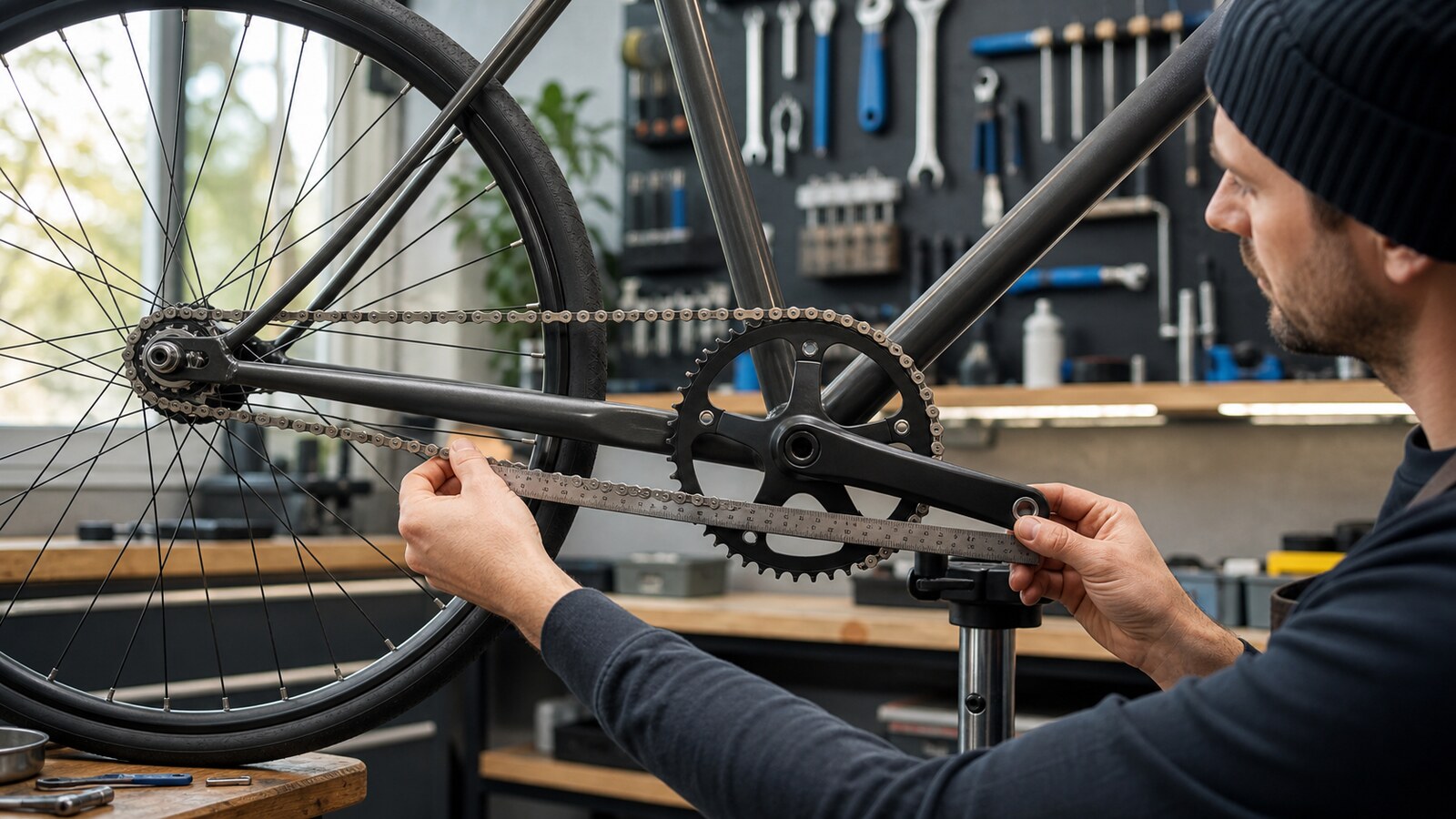
The 672 mm diameter is an estimate. Sheldon Brown’s calibration page describes the same bead-seat-plus-twice-the-width method, and his table of measured circumferences lists 2,105 mm for a 700×25, which works out to a 670 mm diameter, 0.3% smaller. Casings and inflation vary, so treat the last decimal as approximate. For an exact number, roll your bike one wheel turn along the floor, measure the distance in millimeters, divide by pi, and enter the result as a custom diameter.
Which fixed gear ratio should you ride?
Ride the highest gear that still gets you up the steepest hill on your usual route. Sheldon Brown gave that rule on his fixed gear page: the higher the gear, the more fun the ride, provided it stays low enough to climb your steepest hill. He rode 42/15 on New England’s small rolling hills and flipped his wheel to 42/14 when he visited Illinois. He quoted those as 75.6 and 81.0 gear inches on a nominal 27-inch wheel; on a 700×25 tire they come to 74.1 and 79.4.
The four bands below are Icebike guidance, and the calculator’s riding selector uses the same ranges. No standards body sets them. Use them to pick a first cog, then adjust after a week of riding.
| Where you ride | Gear inches | Example combos (700×25) | Speed at 90 rpm |
|---|---|---|---|
| Flat city | 65-75 | 44×17, 46×17, 47×17, 48×17 | 18.3-20.0 mph (29.5-32.2 km/h) |
| Hilly city | 60-68 | 44×19, 44×18, 42×17, 46×18 | 16.4-18.1 mph (26.4-29.1 km/h) |
| Open flat roads | 75-85 | 49×17, 47×16, 52×17, 50×16 | 20.4-22.1 mph (32.9-35.6 km/h) |
| Track and velodrome | 85-95 | 52×16, 49×15, 50×15, 49×14 | 23.0-24.8 mph (37.1-39.9 km/h) |
Sheldon Brown wrote that flatland riders tend to prefer a substantially higher gear and time trialists higher still. He called Beryl Burton probably the greatest time-trialist in history and recalled that she ran 52/14 or 52/13, which comes to 98 and 106 gear inches on a 700×25 tire.
Gear inches or gain ratio?
Gear inches ignore crank length. Sheldon Brown’s gain ratio adds it: wheel radius divided by crank length, times the gear ratio. It tells you how far the bike travels for each unit of distance your foot moves around the pedal circle. A 48×17 on 700×25 gives 5.58 with 170 mm cranks; Sheldon’s own 42/15 with 165 mm cranks gave 5.77 on his figures. Use gain ratio when you compare bikes with different crank lengths, such as one with 165 mm cranks and one with 175 mm cranks. Skip it if you keep the same cranks.
Check the top end before you buy a cog
A fixed gear cannot coast. On a descent your legs turn at whatever cadence the wheel demands. Set the cadence to 120 in the calculator: a 48×17 on 700×25 reaches 26.7 mph (42.9 km/h) there. If your descents carry you faster than the speed at your highest comfortable cadence, you need a hand brake to hold the bike back, a higher gear, or both.
Sheldon Brown makes a related point about brakes. A low gear lets your legs push back against the pedals with more force for the same effort. In his words, “The lower your gear, the lower your maximum speed will be.” The higher your gear, the more you want a real brake on the bike.
Fine-tune with the cog, then the chainring
One tooth on a 17 cog changes your gear by about 6%: going from 48×17 to 48×18 drops you from 74.7 to 70.6 gear inches, or about 1.1 mph at 90 rpm. One tooth on a 48 chainring changes it by about 2%. Change the cog for a gear you will feel and the chainring for small corrections. A larger cog or chainring takes up chain slack, so check that the rear axle still sits inside the track ends before you ride. The bike chain length guide covers when to add or remove a link.
Skid patches: pick a combo that spreads tire wear
A skid patch is the spot on your rear tire that touches the road when you lock the pedals and skid with your favorite foot forward. Reduce the ratio to lowest terms. The bottom number is your skid patch count. If you skid with either foot forward and the top number is odd, the count doubles. That is Sheldon Brown’s method, and the calculator uses it for both skid patch results.
- 48×17 reduces to 48/17: 17 patches with either foot, because 48 is even.
- 47×17 reduces to 47/17: 17 patches, or 34 if you skid with either foot.
- 44×16 reduces to 11/4: 4 patches, or 8 with either foot.
- 48×16 reduces to 3/1: one patch, or 2 with either foot.
Icebike’s rule of thumb: avoid any combination that gives fewer than 8 patches if you skid to stop. The calculator above and our skid patch calculator both warn below that point. In the chart that rules out 42×18, 48×18, 48×16, 48×15, 50×15 and 49×14 for everyone, plus 44×16 and 52×16 if you skid with one foot. Track riders do not skid to stop, so 52×16, 50×15 and 49×14 stay fine on a velodrome. A 17-tooth cog gives 17 patches with every chainring from 42 to 52 except 51, because 17 is a prime number and only 51 divides by it.
A common tip tells ambidextrous skidders to pair an even chainring with an odd cog. Doubling needs an odd top number after you reduce the ratio, so choose an odd chainring instead. A 48×17 stays at 17 patches when you switch feet; a 47×17 doubles to 34.
Skip this section if you ride a freewheel single speed or stop with hand brakes alone. Skid patches only matter when you lock the rear wheel on purpose. The skid patch calculator runs the same skid math for a single combination.
Single speed gear ratios: what changes with a freewheel
The ratio, gear inch and speed math stays the same on a single speed. Two things change. You can coast, so the descent check above no longer limits your gear: pick it for your steepest climb and your cruising speed. And you can ignore skid patches. The calculator’s presets include 27 x 1-1/4 for old ten-speed conversions, 650c, 650b x 47, 26 x 2.1, 24 x 1.75 and 20 x 1.75, so they cover most single speed road, gravel, mountain and BMX bikes. To see speed across a range of cadences, try the bicycle gear speed calculator; to compare gears across wheel sizes, use the bicycle gear inches calculator. Our fixie bike guides cover frames, conversions and parts.
Fixed gear in snow and ice
Sheldon Brown considered a fixed gear well suited to rain and icy roads, because the pedals give you a direct feel for how much traction the rear tire has. He also noted that racers who train on a fixed gear in winter tend to run a considerably lower gear to work on their spin.
Watch the tire change. A wider winter tire raises your gear without you touching the drivetrain. A 700×35 tire measures 692 mm across (622 + 2 x 35) against 672 mm for a 700×25, so a 48×17 climbs from 74.7 to 76.9 gear inches. Sheldon Brown gives no number for “considerably lower”. Icebike’s starting point for snow is two cog teeth bigger than your summer cog: a 48×19 on the 700×35 tire comes to 68.8 gear inches and 18.4 mph (29.7 km/h) at 90 rpm, 8% below the summer 48×17 on 700×25 and 19 skid patches. One extra tooth is not enough here, because the wider tire cancels about half of it. The studded tire selector helps you choose a tire for ice, packed snow or mixed roads.
Sources
- Sheldon Brown. Fixed Gear Bicycles for the Road. Skid patch method and examples, gear choice (42/15 and 42/14), lower gears for winter training, brakes and gear height, traction feel on slippery roads.
- Sheldon Brown. Gain Ratios: A New Way to Designate Bicycle Gears. Definitions of gear inches, development and gain ratio; 42/15 gain ratio of 5.77 with 165 mm cranks is from his fixed gear page.
- Sheldon Brown. Cyclecomputer calibration table. Tire diameter from bead seat diameter plus twice the tire width; measured circumference of 2,105 mm for a 700×25.
- NIST. Guide to the SI, Appendix B.8: Factors for Units Listed Alphabetically. 1 mile = 1.609344 km exactly.