Why won’t my bike tire inflate?
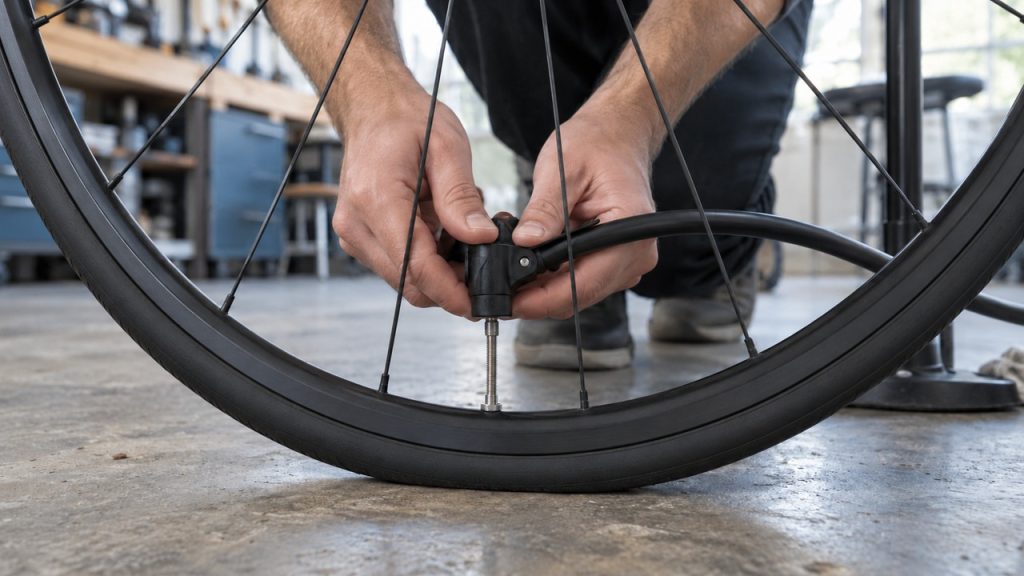
If no air goes in at all, start at the valve and the pump head, not inside the tire. On a Presta valve, unscrew the small knurled nut at the tip and tap it once to free the valve. Then push the pump head on straight, using the Presta side, and lock the lever. If the tire takes air but goes soft again, you have a leak in the tube, rim strip or tubeless bead.
The pump tells you which problem you have. Watch the gauge and feel the handle on the first three strokes, then find the match below.
Find the cause from what the pump does
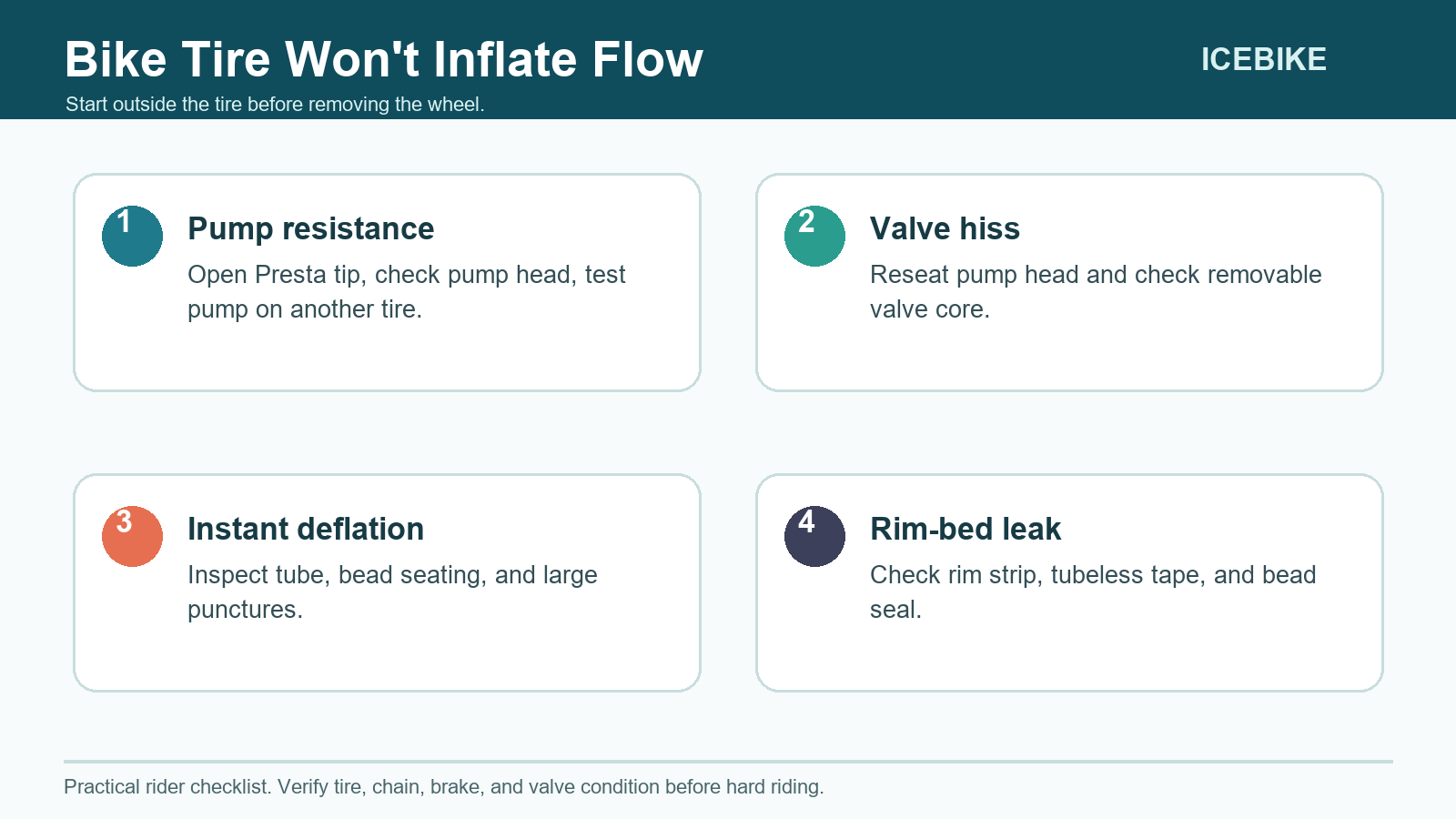
| What you see | Most likely cause | Quick check | Fix |
|---|---|---|---|
| Handle goes hard after 1-3 strokes and the gauge jumps high, but the tire stays soft | Valve still closed: Presta tip nut tightened down, core stuck, or sealant plug | Unthread the Presta tip nut and press it. If the tire still holds some air and nothing hisses, the valve is stuck shut. | Open and tap the tip. Clear or replace the core (Presta section below). |
| Air hisses out at the pump head | Wrong head side, head not pushed on far enough, worn seal, or bent stem | Swap to the other side of a dual head, or flip a reversible insert | Push the head on straight, lock the lever, replace the head seal if it is cracked |
| Hiss from the very tip of a Presta valve, even with the pump off | Valve core unscrewed itself, often when you pulled the pump head off | Look for two small wrench flats on the tip. Those mean a removable core. | Tighten the core with a valve core tool or a small adjustable wrench |
| Valve disappears into the rim when you push the pump on | Rim nut missing, or pressure too low to hold the valve up | Push the tire from the opposite side to bring the valve out | Fit the rim nut finger tight, and brace the valve with your fingers behind the pump head |
| Tire takes air, then goes flat in seconds or minutes | Torn tube, valve torn off at its base, or a big puncture | Pump in 20 psi, then listen and feel around the tire and valve base | Patch or replace the tube, and find the cause first (tube section below) |
| Tubeless tire hisses at the rim and never firms up | Bead not seated, dry tape, or a leaking valve base | Soapy water on the bead and valve. Bubbles show the leak. | Seat the bead with soapy water and a fast burst of air (tubeless section below) |
| Pump will not build pressure on any bike | The pump: cracked head, failed seal, split hose | Try the pump on a second bike, or a second pump on this bike | Repair the pump or replace it |
Skip ahead if you already know your valve is open and the pump works on other bikes. Then the cause is inside the tire, and the tube and tubeless sections cover it.
Presta valve won’t inflate: five checks in order
Presta (Sclaverand or French) valves are the thin 6 mm valves on most road, gravel and many mountain bikes. Schwalbe notes that first-time users struggle with them and that the thin top pin bends when you push a pump head on or pull it off. Work through these in order.
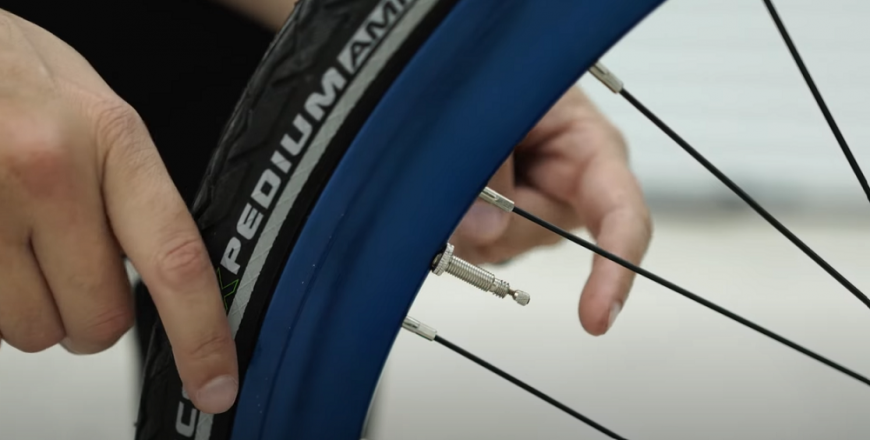
- Open the tip. Unscrew the knurled nut at the top until it stops; it stays on the pin. Park Tool says to unthread the locknut and tap the valve so it is not stuck. If the tire holds some air, a short hiss when you press the tip shows the valve opens.
- Use the Presta side of the pump and push it on far enough. A Schrader head on a Presta valve does nothing. On a dual head, the Presta hole is the smaller one. Push the head down until the seal grips the threaded stem, lock the lever, and hold the stem behind the head so it does not bend. With only a Schrader pump or a gas-station air line, screw a Presta valve adapter onto the opened tip.
- Tighten a loose core. Many Presta valves have a removable core. Park Tool says to look for two wrench flats at the end of the valve, and lists a leaky core as a cause of flats on Schrader and some Presta valves. If air hisses from the threads at the tip, tighten the core with a valve core tool. A pump head that grips hard can unscrew the core as you pull it off.
- Clear a stuck or gummed core. Tubeless sealant dries inside the core and blocks the airflow. Remove the core, clear the stem with a spoke or a small hex key, and fit a new core. Keep two spare cores in your saddle bag.
- Check for a bent pin. A bent tip pin can stop the valve opening or closing. You can bend it back once with your fingers. If it is bent again or snaps, replace the core, or the tube if the core is not removable.
Still not sure which valve you have? Our guide to bike tire valve types compares Presta, Schrader and Dunlop with photos and pump fit.
Schrader valve won’t take air
Schrader valves are the 8 mm car-style valves on most kids’, hybrid and older mountain bikes. The pump head has to press the spring-loaded pin in the center, so a head pushed on crooked or halfway leaks around the outside. Push it all the way on and lock it. Then press the pin with a hex key. If the tire holds some air and nothing hisses, dirt or sealant has jammed the core. Unscrew it with a valve core tool and fit a new one. Car-parts stores sell Schrader cores that fit bike valves.
Tire won’t pump up? Check the pump before you pull the tire off
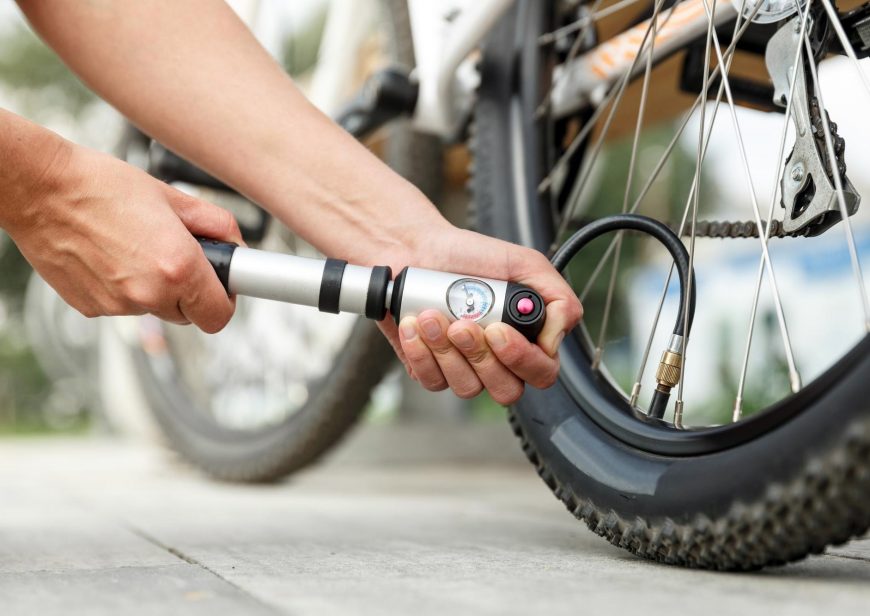
Try the pump on another bike. If it fails there too, look at these four parts:
- Head insert: Older single-hole heads switch between Presta and Schrader by flipping or swapping a rubber insert inside. If someone flipped it for a different valve, it will not seal on yours.
- Head seal: A cracked or flattened rubber seal hisses on every stroke. Pump makers sell replacement seal kits.
- Hose: Flex the hose while pumping and listen for a leak at either end.
- Gauge: Pump gauges drift with age. Check yours against a separate tire gauge once a season.
Mini pumps move little air per stroke, and the last 20 psi on a road tire gets hard to push. If the tire firms up and then stalls on a mini pump, finish it with a floor pump before you look for a fault.
The tire takes air but goes flat again
Air that goes in and leaks out means a hole. Pump to about 20 psi and listen. If you hear nothing, take the tube out, inflate it until it holds its shape, and dunk it in water or pass it near your lips to find the leak.
- Tear at the valve base: Schwalbe traces most valve tear-offs to the tire slipping on the rim at low pressure, which drags the tube and shears the valve. Schwalbe names a second frequent cause: a Presta tube in a rim hole drilled for Schrader (8.5 mm), where the hole edge cuts the stem. Use a valve-hole adapter or a Schrader tube there. You cannot patch a torn valve base; replace the tube.
- Tube pinched under the bead: Park Tool’s method: inflate to low pressure and check both sides for any tube showing between bead and rim before going to full pressure.
- Crooked valve: Line the valve up so it points straight at the hub. Park Tool notes a crooked valve can lead to a flat later.
- Rim strip: Park Tool says the strip should sit centered over the nipple holes and cover the bottom of the rim. A strip that has slid sideways leaves a spoke-hole edge against the tube.
If the same tube keeps failing in the same spot, our guide to why a bike tire keeps popping walks through rim tape, tire cuts and pressure causes. For a tire that goes soft over days instead of minutes, start with why bike tires lose air. Schwalbe treats a loss of about 1 bar (14.5 psi) a month as normal for a tube, more at high pressure.
Tubeless tire won’t inflate or seat
A tubeless tire holds no pressure until both beads lock against the rim. If air hisses out around the rim as fast as you pump it in, the bead has not sealed, and a floor pump may not move air fast enough to close the gap.
- Center both beads. Schwalbe says both beads must sit either side of the valve. Push each bead into the rim’s center channel all the way around to give the tire slack.
- Wet the bead. Soapy water on both beads lets them slide up onto the bead seat. Park Tool recommends it for tight beads.
- Remove the valve core. Schwalbe suggests pulling the core on the first inflation to increase airflow. Put the core back once the beads pop into place.
- Use a burst of air. For stubborn tires Schwalbe says to use a compressor instead of a track pump. A charger pump (a floor pump with a pressure tank) works at home, and a CO2 cartridge on the trail.
- Find the slow leak. If the tire seats and then drops, Schwalbe starts at the valve: tighten the valve nut, clean and deburr where the valve meets the rim, or replace the valve. Soapy water on the bead and valve shows bubbles at the leak.
Seat the beads at a pressure the rim allows. On hookless road rims the ETRTO and ISO limit is 5 bar (72.5 psi), as ENVE explains for 28 mm tires, even if the tire label says more. Our guide to inflating tubeless tires covers sealant and first-ride checks.
Why tires won’t pump up in cold weather
Cold weather adds three problems. First, air pressure falls with temperature. A tire set in a warm hallway reads lower outside, and the drop hits low-pressure fat bike tires hardest. These figures come from the ideal gas law, which uses absolute pressure and temperature, for a tire set at 68°F (20°C):
| Set indoors at 68°F | Outside at 14°F (-10°C) | Outside at -4°F (-20°C) |
|---|---|---|
| 80 psi (road) | 70.3 psi (-12%) | 67.1 psi (-16%) |
| 40 psi (gravel, hybrid) | 34.4 psi (-14%) | 32.5 psi (-19%) |
| 25 psi (mountain) | 20.9 psi (-16%) | 19.6 psi (-22%) |
| 8 psi (fat bike) | 5.7 psi (-29%) | 4.9 psi (-39%) |
| 5 psi (fat bike, soft snow) | 3.0 psi (-40%) | 2.3 psi (-54%) |
A fat tire you set to 5 psi indoors sits well under the 5 psi (0.4 bar) minimum Schwalbe prints for its 4.8 in Jumbo Jim once you ride at -4°F. Set winter pressure outside once the bike has cooled to air temperature, or add the difference from the table before you leave. The winter bike tire pressure calculator gives a starting point for snow, ice and studded tires.
Second, rubber stiffens. Pump-head seals and valve O-rings harden and stop sealing, so a pump that works in the garage hisses on the trail. Carry it inside your jacket. Third, water and sealant freeze. Slush in a valve can freeze the core shut, and sealant thickens as it cools. Warm the valve in your hand or bring the wheel inside, and check the freeze rating on your sealant bottle.
A CO2 cartridge frosts over as the gas expands, so hold it with a glove. CO2 also seeps out of butyl tubes faster than air; swap it for pump air when you get home.
How much pressure should the tire hold?
Read the range printed on the tire sidewall, and the rim’s maximum if it lists one. Schwalbe says to follow the rim’s limit when it is lower than the tire’s. Treat the figures below as limits and published starting points.
| Tire (size) | Published range | Note |
|---|---|---|
| Schwalbe Pro One TLE road, 25 mm | 4.8-7.0 bar (70-102 psi) | Schwalbe’s chart for riders 55-85 kg on a 19 mm inner rim. Above 72.5 psi, hooked rims only. |
| Schwalbe Pro One TLE road, 28 mm | 4.0-6.0 bar (58-87 psi) | Same chart. Wider tires need less pressure. |
| Schwalbe Pro One TLE road, 30 mm | 3.6-5.0 bar (52-73 psi) | Same chart |
| Road tire on a hookless (TSS) rim | Max 5 bar (72.5 psi) | ETRTO/ISO limit, as ENVE cites it for 28 mm tires |
| Schwalbe G-One Allround gravel, 40 mm | Max 4.5 bar (65 psi) | Maximum only listed |
| Schwalbe Motion Big Apple city/hybrid, 50 mm | 2.2-4.5 bar (32-65 psi) | Sidewall range |
| Schwalbe Nobby Nic MTB, 29 x 2.40 in | Max 3.5 bar (50 psi) | Maximum only listed |
| Schwalbe Jumbo Jim fat bike, 26 x 4.80 in | 0.4-2.0 bar (5-30 psi) | Snow riding uses the low end |
Use a gauge, not your thumb. Schwalbe points out that every tire feels the same to the thumb from about 2 bar (29 psi) up. For a starting pressure based on your weight, tire width and surface, use the calculator:
Bike Tire Pressure Calculator
Estimate starting tire pressure for road, gravel, mountain, fat, and winter bikes.
Tools that fix most no-air problems
- Floor pump with a gauge and a dual head: moves air fast and shows real pressure.
- Valve core tool: tightens loose cores and pulls clogged ones.
- Two spare Presta cores: cheaper than a tube when the core is the fault.
- Presta-to-Schrader adapter: for gas-station air or a Schrader-only pump.
- Patch kit and a spare tube: for the tire that takes air and goes flat.
Topeak JoeBlow Sport III Floor Pump
Floor pump with a 3 in gauge, rated to 160 psi. Its TwinHead fits Presta, Schrader and Dunlop valves without swapping parts, which removes the wrong-head-side problem.
Park Tool VC-1 Valve Core Tool
Removes and installs Presta and Schrader valve cores, plus Presta valve extenders with 5 mm flats. Use it to tighten a hissing core or pull one clogged with sealant.
Sources
- Park Tool. Tire and Tube Removal and Installation. Presta locknut, tapping the valve, leaky valve cores, valve alignment, bead inspection at low pressure, rim strip position.
- Park Tool. Tubeless Tire Removal and Installation. Soapy water on tight beads, core removal for sealant.
- Park Tool. Tire, Wheel and Inner Tube Fit Standards. Removable Presta cores have two wrench flats; Presta stems are about 6 mm.
- Schwalbe. Tech Info (2015 edition, PDF). Valve types and Presta nut (p. 30), valve tear-off and rim hole sizes (p. 31), pressure checks, 1 bar per month loss and the thumb test (p. 36), tubeless tires that will not inflate (p. 41).
- Schwalbe. Road Bike Technology. Pro One TLE pressure chart by rider weight; follow the rim’s maximum pressure.
- Schwalbe product pages: G-One Allround 40-622, Motion Big Apple 50-622, Nobby Nic 62-622, Jumbo Jim 120-559. Published pressure ranges.
- ENVE. Hookless Rim Technology 101 (April 4, 2024). ETRTO/ISO maximum of 5 bar (72.5 psi) for a 28 mm tire on a hookless rim.
- NASA Glenn Research Center. Equation of State. Ideal gas law with absolute temperature, used for the cold-weather table.